Another home made lowering device

Hello Up, Are you aware of the restoration of the famous old sailing vessel "Tally Ho" taking place in Port Townsend?
 
Thanks for your post Phil. Some of your points have crossed my mind concerning what bad things might happen between when the wood breaks free and when the rope begins to catch it. I’ve seen some videos of lowering devices anchored at the base do some wild gymnastics during this time period as well. I’ll do some more research on other methods before I add more gadgets to the lowering device that should work better right side up. What method do you think would work best for lowering from aloft?

The picture on the spar is of about a 150 lb piece I snap cut, so I was able to hang my saw before I broke it off when I had the rigging line in one hand. It took some line on impact, but the bark friction stopped it quicker than intended. The rope passing over the sharpish edge of the barrel was just done to seize it for the picture, and I intend to weld a washer on there and round the edges. What looks like a spliced eye is a running bowline.

My statement about solo rigging a tree might seem overly ambitious for someone with my level of experience, but I’m not in a hurry.

Thanks again for the feedback and constructive criticism.

I don’t recommend learning self rigging with homemade tools that were intended for a different application.
Reading this and looking at the photos, my first question is why rig at all. Looks like small logs could just be dropped. Could even firewood the tree down.

For the half hitch issue, you can use a marl instead, or just hitch higher. Slippery trees you can make a couple of saw curfs to make a groove for the rope.

Bark rub on this porty in this application will just be a thing. Wrong tool for the job.

A couple of opposing strategic stubs where you can take wraps with a belly of slack can dampen the shock load and make lowing somewhat hands free. BUT this comes with a lot of experience and practice.

Find a in person mentor to help, maybe even hire someone that you can watch or talk you through the process.
 
i look at the suggested screw links as dual leg support architecture.
>>favour screw closed and back off 1/4 turn for anti-jam at smallest loss.
vs.
single leg of support of hook
.
Carabineer as well 'moused' hook, against carabinier pulling open mostly(and rope keeper)
>>NOT a secondary leg of support by ANY means.


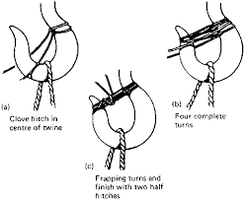
hook-mousing.pngNote how lace tighter and frapping shears across the rigidity to sweat/swig tighter to be even more immediately rigid against first prying open. The tighter the original work gives more rigid/ less rubbery output response to lever of sweat/swig.
.
So in single leg support of hook/carabinier favour load to the solid leg side even if mousing gives a 'seam' side ; even in carabinier.
 
Last edited:
The tree I’m in is a dying doug fir in the woods on my property that I had previously reduced to a habitat spar. There is nothing to damage nearby, which is why I felt comfortable trying a strange method of rigging there.

I think my previous posts may have made it sound like I was going to run out and rig whole trees using what I had in hand. I want to learn the skills to do this, and if it takes years, and other methods, that’s ok.

A friend and I lowered some trunk pieces the other day the conventional way with the porty and everything went great.

Any suggestions on classes or other resources of information on climbing or tree cutting in the PNW? I’m trying to not be such a loner weirdo.

Thanks
 
Any suggestions on classes or other resources of information on climbing or tree cutting in the PNW? I’m trying to not be such a loner weirdo.

Thanks
My first suggestion would be to read “The Tree Climber’s Companion” and “Groundie”, both by Jeff Jepson. If you’ve read them, read them again, and follow what they say very carefully.

I’m sure there are some classes in your area too, but start with those two books. I think one could successfully work a whole career just out of what information is in those two books.
 
The tree I’m in is a dying doug fir in the woods on my property that I had previously reduced to a habitat spar. There is nothing to damage nearby, which is why I felt comfortable trying a strange method of rigging there.

I think my previous posts may have made it sound like I was going to run out and rig whole trees using what I had in hand. I want to learn the skills to do this, and if it takes years, and other methods, that’s ok.

A friend and I lowered some trunk pieces the other day the conventional way with the porty and everything went great.

Any suggestions on classes or other resources of information on climbing or tree cutting in the PNW? I’m trying to not be such a loner weirdo.

Thanks
Could get involved with the pnw isa chapter, we offer LOTS of recorded classes. Also Wesspur hosts classes from time to time.
 
Yep, wonderful series and so much to watch and learn from. I'd sure love to see someone make an updated version with modern tools.

At the end of the day though, the best way to learn is with a crew that knows what they are doing, but I realize that isn't always an option.

(also, I'll second Dans suggestion/pointing out of the vertical speed line technique, and using quick links. something I do myself)


New threads New posts

Kask Stihl NORTHEASTERN Arborists Wesspur TreeStuff.com Teufelberger Westminster X-Rigging Teufelberger
Back
Top Bottom