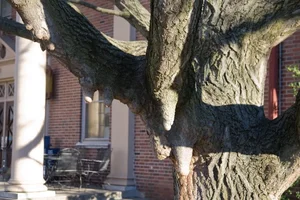
Ancient redwood tissue & antique glass a Liquid ??

mdvaden

Participating member
Just began a new blog this week on Wordpress for overflow tree and redwood stuff. Tonight's new post was:

Is Ancient Redwood Tissue and Antique Glass Technically a Liquid?

Ever seen the parts along redwood trunks that sort of drape? Not neccesarily burls. And have you ever seen antique glass that is thicker at the bottom?

Anyhow, it was a fun one to write, because our son and several friends had window cleaning businesses, and they mentioned some thing about the properties of glass that I was reading about tonight to see whats what.
 
Re: Ancient redwood tissue & antique glass a Liqui

I dont know it I would say it is liquid, I have seen it in old and big trees. I think it is more a result of compression. That is just my uneducated opinion.
 
Re: Ancient redwood tissue & antique glass a Liqui

[ QUOTE ]
I dont know it I would say it is liquid, I have seen it in old and big trees. I think it is more a result of compression. That is just my uneducated opinion.

[/ QUOTE ]

You are right. It a play with words, stemming from the window glass theory.

With all the stained glass in Europe, I'd imagine that half the Brits probably know the scoop about whether stained glass is a liquid or not.
 
Re: Ancient redwood tissue & antique glass a Liqui

Technically, glass is an amorphous solid. I doubt there is much chance that wood is also an amorphous solid. It would be neat to see ancient forest of melted looking trees though. Dali would have loved it.
 
Re: Ancient redwood tissue & antique glass a Liqui

Banjo nailed it. I learned that back in 9th grade physical science. Old glass behaves unlike a solid or liquid. Wax is the best thing to compare it to
 
Re: antique glass a Liqui

A researcher measured the thickness of window panes in European cathedrals with an ultrasonic thickness meter. He found that the panes were thicker at the bottoms and concluded that the glass flowed over the centuries. This theory has been debunked. The glassmaking process at the time could not produce uniform thickness panes. The workmen installed them with the heaavy edge down.
 
[ QUOTE ]
I have seen this on Ginkgo. It is referred to as "Chi Chi"
Here is a link with a little more info.
http://www.springerlink.com/content/dm5722j15465n106/

[/ QUOTE ]

On that page you linked to, there is a .pdf file link tucked away in the corner that has the photos and the rest of the article:

****************
Ginko chi-chi .pdf file

****************

cool.gif
 

New threads New posts

Back
Top Bottom