Anchoring/Bracing young trees

NickfromWI

Participating member
Location
Los Angeles, CA
What guidelines can a person use to determine if a bracing system supporting (?) a young tree is no longer necessary?

What are the drawbacks of leaving a new tree tied down for too long?

love
nick
 
Nick, I rarely will brace a newly planted tree, only if absolutly needed. If it is needed, Ive always understood one year two at the most. Ideally, the tree should grow roots within the first year and be able to support itself without guying. If guyed for to long the tree may not develop the roots or windthrow? needed to stand on its own.
When i do guy young trees I use cheap thin poly rope, this way if I am not ever on the property again or the homeowner neglets to remove it ,UV degredation will eventually breakdown the rope thus giving the tree owner a visual signal that it is time to take it off
 
Many landscape projects are spec'ed with a specific type of guying system for all installed trees. These are the same projects where you see old, disconnected guys hanging from girdled trees 5 years later. Guys should be used if you are planting a tree with a marginal root system and it needs extra support for a few months. Guys should be removed within 6 months, a year tops. If the tree cannot stand on it's own after a year, it should be yanked and replaced anyway.
 
</font><blockquote><font class="small">In reply to:</font><hr />
When i do guy young trees I use cheap thin poly rope, this way if I am not ever on the property again or the homeowner neglets to remove it ,UV degredation will eventually breakdown the rope

[/ QUOTE ]

WOW!!! A perfect use for crappy rope! Nice!

Good tip.

If you grab the trunk of say an 8' tall tree and give it a vigorous shake, and it seems super sturdy, is that enough to say it no longer needs the rope? I've done this to a hundred trees and a few of them I swear I could've pulled right out!


Another thing I'm wondering...I've read a lot that anchoring can inhibit the trees ability to develop a adequate root system that will support the tree in the long run.

So what I'm wondering...If I encounter a tree that may have had the same bracing on for a few years, is it good to just take it off? There is a chance that the tree has come to rely on the rope that's holding it up. If I tell someone, "Hey, this needs to come off," then proceed to remove it, it may fail in the next good wind. Then it would look as if I was wrong!

So would it be better to put a new, but less tensioned brace? Part of me says just take it off, then if the tree fails, it was probably doomed anyway.

I will confess. I often use my knife to remove braces on trees in mall parking lots.

love
nick
 
The reason braces never get removed from those mall parking lot trees is because no one is paid to remove them. But the lawn guys will be grateful that someone else was smart enough to remove an obstacle out of their way, and no one else will ever notice. Only tree guys notice things like old guy wires on trees.

Yes, yes, yes. If a customer has a tree with 3 year old guy wires, then remove them! If the tree falls over, it had way more problems than inadequate guying.
 
Nick , we plant anywhere from 150 to 250 trees a year. We use a heavy green tree tape and put two post in north and south and then strap the trees in opposite directions to the posts.The posts and ties will stay on for one year. Give or take.

Keeping guy wires , straping, hose, whatever else you see out there, on for to long, is like putting a cast on your leg for a year. Leg becomes week, prohibits growth and then Rehabilitation must occur.

Determining factore for us is when we rock the tree back and forth. If the rootball is still wabeling around we leave the stakes. Some times we remove one so the tree will gain more movement.If a after a couple years it's still wobbley, we more then likely yank it.

I know that seems a little long for some people, but we have large variations of soil in our town . Ranging from loam to hard pan and depending on the area may depend on how long we leave the stakes.

Also , the way the hole and rootball was preped is everything and at least three years of summer watering . MOre and more we are planting potted trees , which I cant stand.They have many probs. over bare root which I prefer.

Rocky is right in most cases. If the tree is still rolling around in the ground after a year, something is wrong with the tree or it was preped improperly.But, there are those cituations after a year or six months, providing you did everything right and the tree was healthy, you may have to give it the benifit of the doubt . It just might be slow to react and will eventually catch up.

Greg

 
Nick, no longer than a year will we keep the braces on.
Feel/shake the tree to see if it has rooted.
The trees we get are often pretty large and have rediculously
small root balls. They always need bracing.
One pole in the ground looks cheap and is not very effective. It should be placed in the direction from where the wind often origins.
Two poles are good for smaller and medium sized trees.
Here are some pictures from our airport project
last autumn. We planted 120 linden, birches, prunus and malus and used three poles for each tree.

Here is a row of Betula Pendula 'Dalecarlica'
 
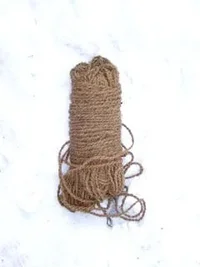
Here is the material we use for tying them up.
It is some kind of natural fiber, about 10mm (3/8")
in diameter. It looks a bit more natural than plastic
and works really well.
These bundles are really weird organised.
 

Attachments

  • 8583-material.webp
    8583-material.webp
    6.6 KB · Views: 61
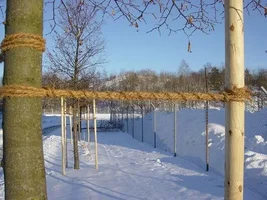
Here is a closeup of a bracing. The way it is tied it
is a bit self-adjusting.
These trees were monsters, over 30cm (12") in circumference! Tilia Cordata 'Erecta'.
The tough poles are made of spruce.
 

Attachments

  • 8584-close up.webp
    8584-close up.webp
    47.3 KB · Views: 66
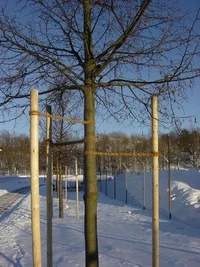
And a picture of the finished product...almost, the poles
are a bit too long, haven't been cut-off yet.
 

Attachments

  • 8585-finished.webp
    8585-finished.webp
    61.3 KB · Views: 78
I used to be involved with the planting of around 16,000 large bare root trees a year. We never staked any of the trees and they fared well. We probably had a higher quality root system than most trees that you would purchase from a wholesale nursery though. We had our own nursery and most of the trees we planted had up to 30 inch diameter root systems. I didn't see the need for staking until I accepted a job in Fargo, ND. It seems like it is always windy here and it is not uncommon to have 30 mph winds. Now every tree needs to be staked. I have only been here for eight months but from what I gather the trees are established enough to remove the stakes after a year. I suppose it varies a little from tree to tree but staking much longer than a year will probably create a tree that is reliant of that staking. Size of the tree depends too. The research I have read on staking says that there should be some play in the staking and that the staking shouldn't be too rigid, yet too loose and the tree gets beat up and slowly levers itself out of the ground. Especially with the winds I am dealing with. We use a two stake system for trees less than 3" caliper and a three stake system for larger than 3" caliper. Staking has been shown to increase top growth and decrease root growth so the sooner you feel the tree is established enough to remove the staking the better.
-Chris
 
No body has mentioned reduced caliper and taper from staking. There are many chemical reactions that are related to caliper and taper that don't occur due to staking/ tight staking. Think about a tree that is open grown vs. a tree grown in a tight stand. There has been a fair amount of research to back this up, just can't think of who did it right now.
 
This is one of my biggest concerns...I'm glad you mentioned the reduced caliper/taper. Extensive bracing does not allow the tree to move in the wind. The tree would normally respond to this by putting more tissue where it is needed. By bracing extensively, the tree is prevented from getting an idea of where that growth is needed. In a sense, you are fooling the tree.

Does this sound about right? If so, cut the braces...it's making your trees stupid!

love
nick
 
i think many stake jobs are sold just to add more cost to the bill. i have planted thousands of trees in my career and only rarely have i found need of staking supplies. i am not above some guerilla tactics when i see staking beginning to girdle a tree in a parking lot. cheap rope and a pocket knife. if it must be done i prefer staking over bracing for aesthetic reasons. staking seems more low profile. i have just bought my first house and have to cut down a black cherry in the back yard due to stake girdle...led to the peach tree borer.
 

New threads New posts

Back
Top Bottom