Amazing Oak Tree Anomaly

Hello Tree Buzz,

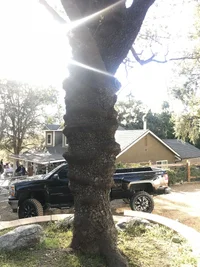
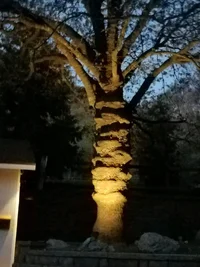
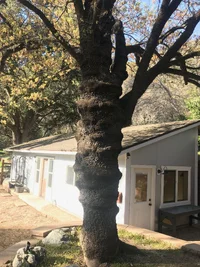
My uncle has this oak tree in his yard that is mysterious, to say the least. He's had various arborists take a look and they've all left scratching their head.

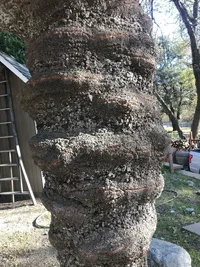
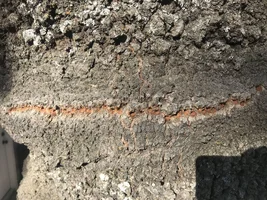
The gals and burls seem to spiral up the trunk and main branches, with each burl having tiny holes along it's outmost ridge.

The holes are too small and shallow to be from a woodpecker. The burls are unlike any I've seen on any tree.

Any ideas?
 

Attachments
  • IMG_1222.webp
    IMG_1222.webp
    929.7 KB · Views: 51
  • IMG_1223.webp
    IMG_1223.webp
    652.8 KB · Views: 39
  • IMG_1225.webp
    IMG_1225.webp
    1.1 MB · Views: 41
  • IMG_1227.webp
    IMG_1227.webp
    1.1 MB · Views: 35
  • IMG_1228.webp
    IMG_1228.webp
    1.3 MB · Views: 40
  • IMG_1229.webp
    IMG_1229.webp
    259 KB · Views: 40
Last edited:
The holes along the reaction wood look to be sap sucker, which is a little wood pecker. They are known for their systematic lines of their holes. As for the burls, I have a question... how long has your uncle lived in this house. The reason I ask is the reaction growth is very similar to......... Christmas light damage. The lights are wrapped on the tree too tight, then left on for an extended period (or forgotten) and the tree simply over takes the lights. Fast growing trees such as Beech can “eat” lights quickly, and re connect conductive tissue on the outside and the tree doesn’t miss a beat (as long as it’s vigorous enough). And actually the lights (or girdling device) don’t necessarily have to still be there, it could have made a scar been removed and this is the trees reaction.

Nonetheless it’s an interesting feature and adds a cool conversation piece to the yard.
 
I don't know much about sap suckers, but the photos of their holes online suggest straight vertical or horizontal lines of holes instead of a spiral form up the tree.

I originally assumed it had been bound to create the effect, but when I asked, he said it's always been that way.

My uncle has lived there for 19 years and the tree has been that way since he's lived there.

Thanks for the insight. The Christmas light damage and sap sucker theory make good sense!
 
I don't know much about sap suckers, but the photos of their holes online suggest straight vertical or horizontal lines of holes instead of a spiral form up the tree.

I originally assumed it had been bound to create the effect, but when I asked, he said it's always been that way.

My uncle has lived there for 19 years and the tree has been that way since he's lived there.

Thanks for the insight. The Christmas light damage and sap sucker theory make good sense!
For a generality yes but they also will go wherever they like. If the bark is thinner in certain areas they will go for that. I like the Christmas light theory it’s a legit consideration!
 
Have to say I've never seen burls or galls like this on an oak.

Foreign object idea is interesting for sure.
 
Last edited:
I wonder whether the sapsuckers are targeting the closure of previous sapsucker wounds on the tree, kind of like re-injuring a scab over a healing wound. The new wound-wood may be full of sap. Similarly to a scab, if it's reopened constantly, it might build a larger and larger scar).

Just a hypothesis.
 
I wonder whether the sapsuckers are targeting the closure of previous sapsucker wounds on the tree, kind of like re-injuring a scab over a healing wound. The new wound-wood may be full of sap. Similarly to a scab, if it's reopened constantly, it might build a larger and larger scar).

Just a hypothesis.

Kinda like pollarding. The callus wood continues to form with each consecutive injury.
 

New threads New posts

Back
Top Bottom