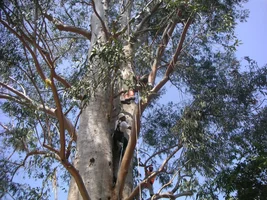
Aerial Rescue Incident at the ETCC

I'm sorry Dawwg, but if I understand you, this won't help the problem of ascent without a backup.

Sorry to hear of your accident Rupe. I hope that you heal up fast. Some brew could help speed it up! /forum/images/graemlins/beerchug.gif

Mark B., have you seen how I backup my ascenders for ascent? I have a real sense of security using that system and use it daily. My guys use it as well and we all feel more secure. We will not footlock any distance on a dynamic system. The risk is too high and great climbers have had the same type of trouble. I would like to see the dynamic system retired for good.
 
Not really, because whatever work may be done on the way up is bonus. I believe the method involves mainly ascent to the top to then work back down, probably "conventionally". But either way, it's once up, once down. The rig is then lowered from the ground.

I don't mind working entirely off a doubled-as-srt line but the weight of the ropes can be a bit of a drawback.

[edit] Okay; I'd read your comment as a pain to "re"-ascend. Don't know why...

It's not necessarily necessary to haul the rig all the way up to the point where the single line drapes from. So if you were to use that method you could set it to the height you were going to climb to anyway and it wouldn't be any additional burden then to switch over to the conventional doubled rope system once there.
 
Well I've hesitated long enough on this one, because of so many issues and lack of time (several long winded posts never get through because my computer times out - a deliberate fail safe to demonstrate I'm wasting time from my priorities). However, out of moral obligation and a duty of care from hard won knowledge, and since you've asked for it Mark....I'll be as objective as possible.

What a can of worms!

I competed in the ISA international comps from its first truly international event in 1993 at Lahnstein.

I think that event spelled the end for the body thrust and saw the rise of footlocking. It introduced the modified bodythrust, the twin ring false crotch (courtesy of Franscois Dussiene), the fairlead micro pulley and a couple of others I can't think of.

The comps originated to show what a climber could do over a MEWP with next to nothing. They are supposed to demonstrate good climbing practice.This goes right back to planning the event. 'Making do' when no back up is available is asking for trouble. There are many inconsistencies in planning and operating the comps. It needs going over as a complete risk assesment. There is an un-healthy amount of the blind leading the blind.


My passion has always been to promote the concept of 'The professional Climbing Arborist'.

Yet time and again we shoot ourselves in the foot, by inappropriate choice of equipment and techniques, without understanding the limitations and consequences. As long as its new and looks cool, its going to get used. Are people appointed to check the events as well as equipment prior to them kicking off? If so, what are their credentials? If not, why not - isn't that what the foreman does on the job site? Because we cannot back-up anchor points easily, we need to make sure they are sound. Because we can only work with one line effectively, shouldn't that be a careful choice?

I tend not to support the comps nowadays, because of issues such as this one. I have seen and commented on many such unnecessary risks in the past, only to be given the rolling eyes because I'm not the latest 'God' of tree climbng, or laughed at as a nervous kill joy. Earlier this year the inconsistencies in footlock protection were highlighted to me by a fellow pro, who had his comments dismissed as quick as they came. In fact I mentioned it to Tom a couple of months ago, and look what we're discussing (?).

A wise yoda advised me a couple of years ago to move on and accept the comps only as an extreme sport.

With all this discussion of back-ups for the footlock - its quicker, safer, more productive and bio-mechancally efficient to replace it with a prusik free SRT event.

Nuff said?
 
Paolo

You've pointed out many things there that I agree with.

There has been an ongoing discussion, within the group that I am lucky enough to be part of, about ascending systems.

I am certainly less vocal than you about the negativities of footlocking. I use both FL and SRT in my work, depending on which technique I feel suits the situation that faces me. Within that group are folk that successfully change leading foot and hand when footlocking in an attempt to maintain balance. I feel that footlock has its place in shorter ascents, maybe SRT matches the longer ascents? Some SRT systems don't feel any more balanced to me than footlock though....but that's only part of the story.

Building back-ups into footlock is really not difficult. The big issue seems to be that many don't feel the need to change.

For the TCC's, I would prefer to see a 'climbing the standing rope' event. A pure 'footlock' or 'SRT' event seems to stifle inventiveness. Surely what we are after is efficient and safe ascent? Set the height limit and let's get creative - doubled, twin or single rope!

I have no idea how it would be incorporated, but it might also be meaningful to set time limits on installation of the system on the rope. Equally, the ability to move from ascent to descent quickly in case of an incident is an important parameter that should somehow be assessed. There's no point using a fast ascent system that leaves you vulnerable in other situations. Being able to demonstrate installation/deinstallation within a 2 minute time limit at gear check (for example) may be the factor which dictates whether a system is permissable or not......

Extreme Sport? Maybe the balance is too far towards spectator entertainment vs good work practice. Agreed. Finding the balance is not so easily done, but worth pursueing. As you say, the TCC's have given so much to the industry, we shouldn't perhaps give up on them. But the decision ultimately lies with the ISA and what they want. Maybe their objectives are no longer clear?

Having agreed on most things...here's one thing I don't agree with. Why should SRT be Prusik free?

Chris
 
At the TCC event in L.A in the rescue event i climb a DRT w/ my Kong's Double Ascender, once i got to top i ascended right from my Double Ascender to the victim , i did put a carabiner under my KDA just in case... That work for me and i felt secure enough to do a rescue.. I will try and send a pic ... Here's a pic from the TCC in June, also i ran out of time on this climb 5min not long enough. Had a great time doing the TCC for the first time.. Later from SO-CAL
 

Attachments

  • 52338-PICT0059.webp
    52338-PICT0059.webp
    604.5 KB · Views: 107
Chris

There are many issues that can't be discussed adequately through this medium.

The issues with footlock, are based toward encouraging correct bio-mechanical function rather than encouraging proprioceptive dysfunction. Avoiding footlocking has had no detrimental effect to my contracting business - quite the opposite.

Footlockers swapping leading feet and hands is quite an achievement, but not to be expected - its difficult enough for most grass roots to get one side sorted. Despite that, it is still a technique that requires excessive upper body movements and strength that, on a repetitive scale, are damaging if not corrected. Plus other areas of the body. Not least the ankles, knees, hips and entire spinal components. To reduce the effects, smaller reach and bites are required, making it slow. And, of course, there are safety issues.

This compared to using mechanical devices on a single line, that keep the bodies ankles, knees, hips and shoulders in alignment, won't slip to the ground if touched, are backed up, quick to apply and fast to use - its a logical conclusion.

Applying prusiks to SRT has no back up, or has three prusiks that slows everything down, and they can slide if touched and disable all the others.

I'm a prusik fan of DbRt, because its the only thing that works properly out on a limb. On a Dbrt system, the safety issues aren't the same. The lockjack has the same safety issues.

An SRT event would rapidly evolve the best systems.

I am in a very good position to understand all of the risks and benefits associated with this issue. And I will be sharing it very objectively to any that want to work healthier as well as safer. Thats not turning my back on the competiton and competitors - its prioritising my energies where they are required.

I hope this leads to discussion and proactive results for everyone of us.
 
Some more thoughts on the subject an observer asked me to post:

"The thing that amazes me is that the best practitioners are ambassadors (if they like it or not) / role models to the countless lesser experienced members of our industry (who are all watching eagerly from the side lines). Whilst I am in awe of the skill and grace of the top guys it still amazes me that, for many, they must fundamentally believe that because an access system ( with no logical back up and all the variables) has consistently worked successfully it will surely continue to do so( the words ' Emporour and New Clothes' spring to mind).The analogy to me is to say that because a coin-toss has fallen heads 50 times its going to land heads on the 51st: when infact the odds remain at 50/50. Now I'm obviously not claiming a 50 / 50 risk of failure in a none backed up system but generally,that is the short and long of it. What is a fact though, is that the consequences for a tails coin- toss are a lot less severe than when your system lands tails!......

Any one fancy a gamble?"
 

New threads New posts

Back
Top Bottom