
One of our crew leaders had to walk away from this tree on friday. He had a 3 man manual crew with 2 trainees. He was also limited on equipment. So I asked him what do we need? he responded with " A bunch of rope and rigging equipment". So we loaded up and headed out. The Ash is about 25" dbh and about 65' tall. The failed portion was real easy. We set a static retrievable in the neighboring Box Elder and started cutting from the ground. The hard part was going to be the rest.

Navigation
Install the app
How to install the app on iOS
Follow along with the video below to see how to install our site as a web app on your home screen.
Note: This feature may not be available in some browsers.
More options
You are using an out of date browser. It may not display this or other websites correctly.
You should upgrade or use an alternative browser.
You should upgrade or use an alternative browser.
A first for me
- Thread starter tod_k
- Start date
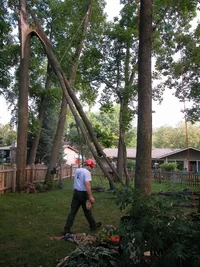
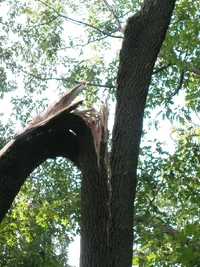
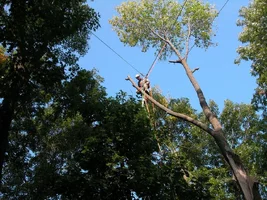
So I headed up one tree to establish a tip. Looking at the tree to be removed from the tree I was in my rope would be horizontal so the tip needed to be backed up to another tree behind it. Mean while Jose, the crew leader was setting up a guy line for the removal. He was able to do that from the ground. He first tied the rope to the tree then ran the rope through 2 other tree with really good angles, he then ran to another GRCS. I established another tie in point In another tree to create a fall back prevention to my original tie in point. The work positioning was going to be totally horizontal. My plan was not to be secured to the removal. I used a Hitch Climber for the two climbing systems witch was real nice and clean.
Attachments
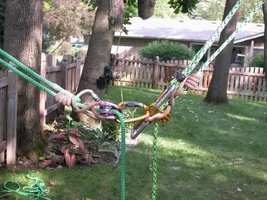
Once I got up there I ended up above both the tie in points and was forced to tie into the tree for a bit. 3 tie in points never did that before. I did feel very secure mostly because of the really good angles on the guy rope. We were able to fell a large 20' piece into the yard. We used the guy rope to control it's falling speed and another GRCS to pull it over that worked well untill Jose over cut the hinge and it fell the last 10' or so. By for now.
Attachments

- Location
- Titirangi, Auckland, NZ
Nice job Tod, well explained and backed up with some good pics


- Location
- Glasgow, Scotland, UK
[ QUOTE ]
what was the plan if the tree failed while you were still tied in to it?
[/ QUOTE ]
I reckon the tree would be held up by Tod's weblike lifesupport system, not sure where Tod would be though.

Nice work Tod,
Takes a good climber to work there way through a job like that.
what was the plan if the tree failed while you were still tied in to it?
[/ QUOTE ]
I reckon the tree would be held up by Tod's weblike lifesupport system, not sure where Tod would be though.
Nice work Tod,
Takes a good climber to work there way through a job like that.
Great questions MB. I did not use rachet straps because I felt is was more important to protect the actual load (the top) as in cabling. Now the real question. I will try to answer as best I can. The origial plan we can up with was to tie into the two tie in points and if you had to bomb out you would end up is space with no problems. I told the crew it looked really difficult and a lanyard would probably be nessacary as well. So I took out the stopper knot of the lanyard and if the tree failed the rope would just run out. All of the worked except for the lower limb. I was having a real hard time getting out fall enough beacuse of the tie in angle. That is when I tied into the tree keep in mind the top is guyed back. I have learned in my twenty years that sometimes you have to go by gut or instinct and I know you are a Master at that. This work is all about measuring risk and bringing to an aceptable level to the end user? Keep in mind I am no cowboy and have walked away from many trees until we had the right equipment but I felt well protected.

- Location
- Home of the New Jersey Devils
Nice work Todd. Now I see another use for the Hitch Climber.

- Location
- Bloomington, Indiana
[ QUOTE ]
Nice work Todd. Now I see another use for the Hitch Climber.
[/ QUOTE ]
Why? I thought that a HC was just used as the slack tender for both of the tie-in points.
Did I miss something???
Nice work Todd. Now I see another use for the Hitch Climber.
[/ QUOTE ]
Why? I thought that a HC was just used as the slack tender for both of the tie-in points.
Did I miss something???
The HC does tend slack for both ropes. The advantage was that it made for super clean and organized anchor points on the harness. Plus it did not split the brigde of the harness in different directions. So then it sorta feels like you have one tie in point and not two pulling you in different directions and you do not have to be watching all of these caribiners so closley because when wieghted they all align if your using ovals.You still have to check but you do not have to fix. It simply made it easier.

- Location
- Longmont, CO
Nice work. Sometimes it is necessary to use an extra ammount of caution. You made good choices.
BTW. Are you going to mill the wood?

BTW. Are you going to mill the wood?

Norm_Hall
New member
- Location
- Wauconda, (Chicago),IL,USA
Nice TK. Scary!!

- Location
- Chapel Hill, NC
This is my kinda thread. Intelligent problem solving, excellent illustration. Thanks.
Good Day.
Hello
Roy here and just saying hi (new).
Roy
Hello
Roy here and just saying hi (new).
Roy

Gerald_Beranek
New member
- Location
- Ft. Bragg, Ca.
Re: Good Day.
Nicely done, Tod.
Double TIP's. Don't see it used very often. It's not everytime your target tree falls between the tip's. But even when it does a lot of people don't consider using the two tie in points to work from.
I took down some dead Bishop pine like that a few years ago. Tip's were near a hundred feet apart. Target trees were a few feet out of lead, but there was enough scope in the lines that not too much pressure was exerted on the trees. Worked them down starting from the tippy tops.
They came apart as well as could be expected. Wouldn't have done it anyother way. I used a micro pulley to fairlead the climb lines to a pantine, and just kind of walked up in the air right beside the trees.
Got it all on helmet cam. Ought to shorten it up and post it on the Tube.
Again, nicely done.
Nicely done, Tod.
Double TIP's. Don't see it used very often. It's not everytime your target tree falls between the tip's. But even when it does a lot of people don't consider using the two tie in points to work from.
I took down some dead Bishop pine like that a few years ago. Tip's were near a hundred feet apart. Target trees were a few feet out of lead, but there was enough scope in the lines that not too much pressure was exerted on the trees. Worked them down starting from the tippy tops.
They came apart as well as could be expected. Wouldn't have done it anyother way. I used a micro pulley to fairlead the climb lines to a pantine, and just kind of walked up in the air right beside the trees.
Got it all on helmet cam. Ought to shorten it up and post it on the Tube.
Again, nicely done.
New threads New posts
-
test
-

-
What's on your mind? TCI Magazine wants to know
- Started by Tree Care Industry Assoc.
- Replies: 12
-
 Apr 09 (Free CEUs) & May 07 - 'Urban Forestry Today' Webcasts @ Noon (Eastern)
- Started by UFT
- Replies: 0
-

-
-

