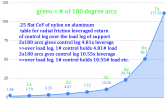
Correctamundo, water, oil, corrosion etc. change key CoF factor of mating surfaces coumpounding frictions calculated on.
Light corrosion will increase frictions until enough runs 'burns it off', then might need another turn to compensate..
.
i do tell grandson that is not age spot, that is patina' boy, whars yours?

they're all portable bollards.
I've seen Viking age bollards and Phoenician too.
Yeah, that is right, just needed to carry around a ship as portable,
Instead of carry around tree as portable!
For capstan/bollard type frictions, my reference is:
Dr. Attwater's 1999 research paper "The Mechanics of Friction in Rope Rescue" (original link not available again, and this time MIA for quite some time, using Wayback Machine reference)
He calls these generically 'brake tube', we always said 'rope brake' also descriptively to function.
Right or wrong i never called it by by proper name of Porta-Wrap(had original version) unless to someone looking to buy etc. Dave Spencer ISA posts also helped theories too!
.
The research paper describes how pipe can be any diameter of same material mated to same rope and present the same amount of radial friction; for radial friction compounds by degrees not distance as flat friction does.
>>larger rope brake is softer arc on rope/retaining more efficiency
>>larger rope brake gives same brake force so more spread out frictions/heat
>>larger rope brake metal then is also bigger heatsink to the now less concentrated frictions also
BUT same frictions
.
As example it uses a CoF of nylon on steel .25 as base,
this is a global standard/range shown in many guides(the EngineeringToolbox link)
Works also with amount of 180arcs as another multiplier
On page_6 shows 5x180arcs gives compounded friction value of 50, i read this as:
Control Leg/tailer man, has 50x the leverage over Load Leg>>2# Control Leg pull holds 100# Load (Leg)
>>like Control Leg in rigid lever of 50" with a rigid Load Leg of 1", 50:1 ratio
>>this and other numbers shown should ring bells and match experiences and link between experiences.
>>showing matching expectations in things not dealt with etc. as free confident expansion..
i have common flat/linear CoF's and also radial
spreadcheat(link) made some time ago
>>the linear CoF's should match driving etc. experiences, and the radial arc CoFs should match rope brake experiences as well
.
i do call the turns a Friction Buffer, for if try to then pull load thru brake turns, they then work equally against you
>>a buffer region in either direction of pull
After rope brake/brake tube examples the paper seamlessly shows same math to rappel rack and fig.8
>>by virtue of collective arcs , even if sum is 1.74 180arcs
.
Verifed a lot of things for me at the time and also beckoned on with new light
>>also very key to my own sense of all this the 180arc
>>that also lends into my directional axis 'argument' of a retained directional affect from source focused linear force input forced into dispersed radial control
>>so force load is imposed on vertical or horizontal axis, and the 180s just change direction of force on that directional axis
This gives pulley effects, compounding/best nip etc. but all directionally
>>whereby i say all rope arcs have some of each reciprocal extreme effects of capstan vs pulley effects
>>compounding either dispersed radial frictions or directional axis force more
>>in reciprocal type trade off if one effect is shown more, the other recedes
Rope Brake study focuses on just one extreme end of arc power bandwidth
>>pulley the opposite at loss of (almost) all capstan effect
.
i call these out as all rope control mechanics are dispersed/radial controlled
>>Round Binding is nothing but, but then does not have the pulley and capstan effects(no linear input)
i define this as Round Binding against radial swell evenly, directionless, dispersed around
>>has no conversion to likewise dispersed radial control arcs, thus no conversion loss nor directionality from source input force
But ALL Hitches and Bends are focused, directional input of linear force thru Standing Part
>>converted to arc control, then see capstan friction loss
>>and pulley compounding directional as remaining directional influence from source input
Thus, a Constrictor or Bag Knot used to control radial input in Round Binding
>>loads rope evenly to nips w/o friction, as just a reflection force back w/o conversion, nor direction
Than if SAME Constrictor or Bag Knot used as hitch, now showing degrading frictions radially of capstan arc effects, and directional pull thru of pulley arc effects.
.
Blake's Hitch wikipedia quote: The first known presentation of this knot was made by Heinz Prohaska in an Austrian guides periodical in 1981; in 1990, he presented it in a
caving journal,
Nylon Highway. Separately, Jason Blake discovered the knot for himself and presented it to the arborist community in a letter to
Arbor Age in 1994, after which it was enthusiastically adopted by arborists. It has since become well known under the name "Blake's hitch".
.
Thus called ProHaska by some IGKT etc., especially knot guru knudeNoggin; in respects, even tho he says that Heinz is not offended etc. by the Blake's name making the great hitch even more known, expanding usage quickly etc.