3.5 acres of tree care

Location
usa
I have a lot of dead ash trees falling over in southwest Ohio. Hackberry
and hickory seem to be the survivors but I am not great at identification. We are completely overrun with honeysuckle here which seems like the most obvious threat to the forest. I don't really know how to care for this plot of land and would like to do more than nothing.

We cleared about 1/2 acre of honeysuckle last year using cut and poison but there is also ivy, and other vines I haven't identified killing some of the biggest trees on my own plus nearby plots.

Does anybody have great ideas for how to promote a troubled forest ecosystem? Maybe more honeysuckle and vine killing? Manure or some fertilizer stakes for the best specimens?
 
Last edited:
ODNR Service Foresters are not doing site visits now (edit to add: "now" is during this Covid19 stuff...hopefully that no longer applies to someone who finds this thread in the future!) They may or may not do a small acreage visit like that. (I used to be one...small wood would depend on schedule backlog.) But if you can get them out, that is a great resource: http://forestry.ohiodnr.gov/serviceforesters

Otherwise, a visit from a private consulting forester could be very helpful as well. That will cost, but if you are just looking for a site visit and advice without follow-up management plan/report, it will probably be pretty reasonable.
 
Last edited:
More direct answers to some of your questions:
*Yes...keep taking out honeysuckle. That is the biggest threat to the forest. It will bounce back from EAB (though with different species) if there is room in the understory for regeneration. Honeysuckle often means there isn't room for anything else in the understory.
--Cut and treat
--Foliar spray in the fall for smaller shrubs
--Cut and let them sprout, planning to foliar treat the sprouts.
*Ivy doesn't kill trees. (most of the time...what kind of ivy are you seeing?)
*Grapevines can be very harmful to trees....but they are also beneficial for wildlife, so that is a balancing act. I generally hit them pretty hard, but leave them along an edge or in low quality trees...just a few per acre - knowing you will need to keep fighting them.
*Consider whether you want to plant some native trees and shrubs. This is costly in the woods, but depending on what your hopes/expectations are, might be a good investment. Use smaller stock and protect from deer. Before you make that decision, wait a couple of years and see what comes back after you fight back the honeysuckle.
 
Renting or hiring a brush cutter would be beneficial. we do all that @ATH mentioned in conjunction with brush cutting to add a mechanical element. There have been a lot of times I wish we had a forestry mulching set up as well.
 
  • Like
Reactions: ATH
+1 on ATH advice as well as the forestry mulching option mentioned above. I’ve worked successfully with a guy that does forestry mulching. I ID’d desirable trees the landowner wanted to keep and the guy cleared the area with his mulcher. He did an outstanding job. Not too sure how it would work on forest restoration as your operator would need to be selective to avoid unnecessary clearing but if the honeysuckle is in dense thickest you could ask him to hit only those spots. In my area of VA the cost is 200.00/hour.
 
I am hesitant to recommend a machine...too many operators just read through everything. However, I do agree when there is nothing but honeysuckle in the understory, it is probably a good option...just be very aware of what you want to keep and soil conditions when you are in there - making sure it is very dry or frozen. The other thing I see with a that is not is hard to get all the stumps treated. It may make sense to only treat the largest stumps after the machine has fit a small area (they need to be treated within a few minutes of cutting, no more than 30). Then come back the next fall and treat the sprouts with foliar spray. Regardless of how you make the first pass through, you will need follow-up treatments for a few years (OK... probably forever - it came from somewhere and will come back if allowed!). But treating seedlings is pretty easy if you stay on top of it.

Closing thought:. If I were being hired to do it, a machine is very tempting to be in and out. If it were my backyard, I'd pluck away at it over the year a few hours here and there with a chainsaw or clearing saw.

I've done it with a chainsaw...no fun to spend a whole day on you hands and knees cutting that stuff, but doable. I've done it with a clearing saw (big weed eater with a saw blade) and that is better than a chainsaw for everything less than 2-3" diameter. I've worked with a crew using a mower on a skid steer. Certainly the fastest. It is a good option, just be aware and try to mitigate the downsides.
 
We had really good results with our cut and poison treatments, almost 0% regrowth over the whole 1/2 acre we cleared. Cut with a chainsaw, leaving a pretty tall 1' or 2' stump, drill vertical holes in the stumps with a standard wood drill bit and i believe we were applying a squirt of 5% glyphosate solution (it may have been 20% too, it's been a while and i don't remember anymore). One person on the saw, one person on the drill and a third on the sprayer. I think we were adding a drill hole for every 2-3" diameter on the stumps.

I have been wondering about using girdling cuts and/or intentionally applying infection producing pruning cuts and how honeysuckle would respond to that. On some of the vine growth i snipped this year, i ran the saw along the vine 'stumps' opening up large wound channels, thinking this might allow more pathogens and fungi to enter. Essentially taking the lessons from the shigo book i just read, and doing the opposite on purpose, hoping for the infections to do the work instead of using glyphosate. So far i don't know if this will work, but it seems like it might be cheaper / easier than recruiting extra people and a sprayer full of roundup.

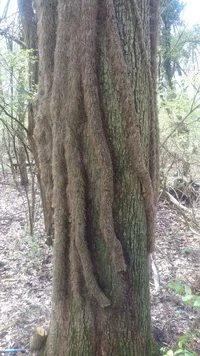
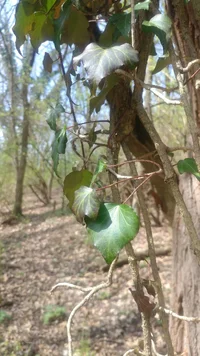
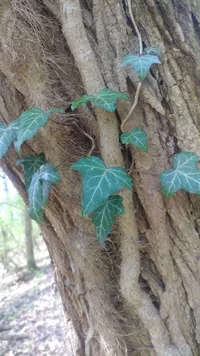
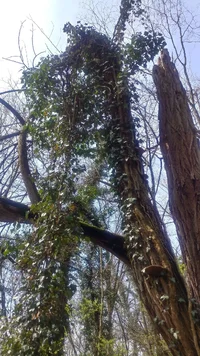
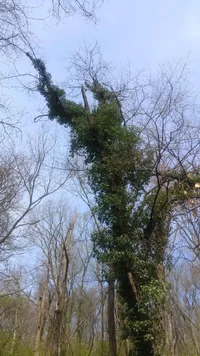
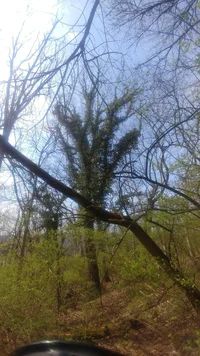
I will go take some pictures of these 'ivy vines' later and maybe somebody can identify them. Some have gotten huge, they keep their leaves all winter, and seem to be completely outcompeting the tree foliage, essentially starving the tree of light. They grab the tree tight with little orange hairs, and it takes a lot of force to pull them off the trunk. They are slowly creeping toward me, probably originally from someones garden, and they put a dark greenish / redish foliage the whole length of the tree, trunk to top. It looks bad to me personally though maybe someone would like it, trees are definitely dying from it.

There are other types of vines that seem less aggressive and i don't really have any good criteria for selecting ones to keep or kill. Generally i'm thinking i want to promote big healthy trees i can climb on so if a vine is going to put extra stress on the tree i'm inclined to pull it off and cut it. On some trees, the entire canopy is knotted with vines and it seems unlikely that would be beneficial to them even if the vine isn't strangling or starving the tree. Using vines for work positioning is occasionally useful and you get to feel like Tarzan :)

I get the impression that honey suckle compete for nutrients / water, so clearing out honeysuckle (or even a less healthy / desirable tree) near the drip zone and canopy of my favorite trees could be beneficial and more realistic, than clearing the entire forest. Clearing honeysuckle around fallen ash trees might give new saplings the advantage of extra sunlight and a boost for getting up and into the canopy.

Mulch sounds nice but getting machinery anywhere off the beaten path seems like it would be very difficult. Fertilizer stakes sound easier since i can carry everything i need in a backpack. I've seen some references to nurse logs before, but still don't understand the details on that. Does that mean a log or a pile of dead brush underneath a tree counts as slow release fertilizer? When mulching you pretty much go from the root flare out to the drip zone but if i have log or a bunch of brush is there a right or wrong place for it?

 
Is the other ivy hedra helix, English Ivy?

you just as likely stimulated new growth with intentional wounding, I would not be confident in that at all. Honey suckle is tough as hell, any results from that would be way long term and give them plenty of time to continue establishing themselves, perhaps even expedite it

the method I was doing all winter was cut and paint for honey suckle, multiflora rose, burning bush and ailanthus. A 50/50 rate of glyphosate until the city had us switch to a different product (blanking in the name) after the lawsuits. We were making cuts as close to ground as possible and painting the whole stump, or on the really big ailanthus the vascular zone. Everyone had a saw and chemicals for the most part and worked autonomously.

Your method with 3 guys, all doing different things, doesn’t seem very efficient to me. I would consider two guys on saw and paint duty while one, if a good operator as @ATH mentioned, runs a mulched/brush cutter.

There’s also the wound and squirt method, that I haven’t tried, but might be worth trying. It seems fast and easy for the big stuff.

 
  • Like
Reactions: ATH
I'll try to run through paragraphs in order:
*The drill is unnecessary. Just treat fresh cut stumps. Put dye in the herbicide so you know what you treated. Glyphosate at 20-30% works. I'd be surprised if you were getting control with 5%...but if you were putting enough holes in and really soaking it, I guess it could. Tordon works really well...BUT it can spread in the soil. I use it for a tree here and there, but not when there are hundreds per acre to treat. Triclopyr (Garlon 3A or Garlon 4 Ultra...or generic equivalents) is a really good option. Better kill than glyphosate, but it will cost more. I'll spend the money on herbicide to avoid re-treating. I agree with the 2 people on saws and one with herbicide. I've done both myself, but it really slows things down to switch from saw to spray bottle to saw to spray...

*You could girdle (and treat the girdles - otherwise you'll be back treating sprouts), but that sounds like a rather unpleasant task for honeysuckle - I don't want to have to crawl around the entire tree! (Same with hack and squirt as suggested by @Jzack605 - that certainly works well...I do it on trees often, but not on bushes).

*The vine sounds like maybe Oriental bittersweet? If so, congratulations....you have another great invasive! :confused: We'll see what pics look like.

*If it is a vine that is "rooted" to the tree, it is probably not adding a lot of strain. Virginia creeper and Poison ivy are 2 examples. Of course, feel free to get rid of all the poison ivy you'd like!

*Honeysuckle certainly competes for resources....water and nutrients in the soil and sunlight for seedlings. There was some research from Ohio University that found reduced growth of canopy trees by 30% where there was a dense understory of honeysuckle. I'll see if I can find that...

*You don't need to mulch in the woods. Leave debris on the ground. Once the honeysuckle is gone, the tree leaves will persist on the ground year round. When we mulch in the landscape, we are trying to replicate what happens when we leave the woods alone. Mulching mower...the point isn't to create the mulch, per say, but rather to get rid of the trees (by turning into mulch on site). Like this:
 
My idea of wounding or girdling happens after I've already cut the tree clear off its trunk. It may not be effective but my thought is that the tree would now have to use additional energy compartmentalizing these wound channels or become infected and become depleted from that, or both, instead of having the luxury of just sprouting up the new growth immediately.

I know that I've sometimes succeeded in over pruning a honeysuckle to death, and those trees never resprouted or required repeated visits. This was unintentional to an extent, and i don't have a good explanation for why that happened, but I suspect some combination of pruning cuts was involved that just left the tree at too much of a disadvantage to recover.
 
There was some research from Ohio University that found reduced growth of canopy trees by 30% where there was a dense understory of honeysuckle. I'll see if I can find that...

30% sounds like a lot, is that going to be the trunk diameter growth in a season. I'm sure there are a million other variables to worry about in a study like that but it makes sense that you would see a difference. If you find the study I'd definitely look it over.
 
*The vine sounds like maybe Oriental bittersweet? If so, congratulations....you have another great invasive! :confused: We'll see what pics look like.

It looks a lot like the English ivy pictures on google. I believe it is marbled with white lines, waxy texture, clusters of 3 leaves. I can probably get some pics tomorrow.
 
30% sounds like a lot, is that going to be the trunk diameter growth in a season. I'm sure there are a million other variables to worry about in a study like that but it makes sense that you would see a difference. If you find the study I'd definitely look it over.
Loss of basal area growth (which correlates to diameter). There is also talk of radial growth. Basal area is a measurement in forestry. Imagine if all of the trees were cut off at 4.5' high. Now look down from a helicopter. The basal area is the surface area of wood that you see on the stumps. It is easily measured with a prism which is why we use it in forestry.

OK...took some digging, but I think I found what I was looking for:

WARNING: It is a PhD dissertation. Not safe for late night time reading. I'm not going to pretend I did more than scan it!

Start at page 40. Page 57 makes reference to 15.8% loss of basal area...but that was average loss. Chart on page 61 shows loss of growth based on tree ring analysis - a couple of sites were over 30%. I think that is where the number I remember comes from.
 
Here's those images of the "ivy" vines. They have probably been growing here for a while given the size
 

Attachments

  • 20200327_120042.webp
    20200327_120042.webp
    810.9 KB · Views: 10
  • 20200327_120356.webp
    20200327_120356.webp
    282 KB · Views: 9
  • 20200327_120400.webp
    20200327_120400.webp
    376.6 KB · Views: 10
  • 20200327_120512_HDR.webp
    20200327_120512_HDR.webp
    703.7 KB · Views: 9
  • 20200327_120307.webp
    20200327_120307.webp
    671.3 KB · Views: 9
  • 20200327_120748.webp
    20200327_120748.webp
    662.5 KB · Views: 10
  • Like
Reactions: ATH
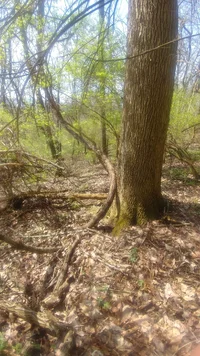
I also got a picture of this monster vine on my way. It's definitley not the same as the ivy vines. When i snipped some others that looked similar to this they hiss and drip sap / wet wood for days to weeks afterwards.
 

Attachments

  • 20200327_121043.webp
    20200327_121043.webp
    733.9 KB · Views: 14
  • Like
Reactions: ATH
English ivy. That probably looks worse than it is. Likely it really exploded in growth after the tree declined from other factors.

The second post is grapevine. They certainly cause problems as they spread over the canopy of the trees.
 

New threads New posts

Back
Top Bottom