












Navigation
Install the app
How to install the app on iOS
Follow along with the video below to see how to install our site as a web app on your home screen.
Note: This feature may not be available in some browsers.
More options
You are using an out of date browser. It may not display this or other websites correctly.
You should upgrade or use an alternative browser.
You should upgrade or use an alternative browser.
Lucky Garage Moments
- Thread starter Bart_
- Start date
Unlucky moment.
Piece of .875 steel shaft bushing/lube crapped out gouges 0.020 to 0.030 deep so I tried to resurface the about 2 1/2" long section by mig welding about 0.080 onto surface followed by "tool post grinding" because I couldn't fit it in a lathe, instead gear reduced motor w/coupler on one end snug bushing far end.
The 2 1/2 section is about 5" from the end. I tested the "lathe" drive pre-welding and all seemed true. I remounted post-welding and didn't notice any off center. By the time I got down to .875 the shaft definitely wasn't true as the ground weld was non-concentric to the original shaft and you could see the shaft wobble.
Q: where did it go wrong? I know welds order/pattern affect cool down shrinkage pull, but I didn't notice any nonconcentricity post weld/pregrind. Maybe it was there and I just didn't spot it. Could uneven stress have built up from the weld and released weird to bend the shaft during the diameter grind?
Two bushings are housed in the same casting so I've got to get it straight.
Not sure I can get a $$ replacement shaft and machining a new one - I can't get the impeller and worm drive gear off, and there's two holes (easy) threaded hole in end (can't do no lathe) and two round profile woodruff keyways ( don't have and don't want to buy keyway cutter).
I need a trick to straighten it out.(?)
@davidwyby maybe you've encountered this sort of thing?
Piece of .875 steel shaft bushing/lube crapped out gouges 0.020 to 0.030 deep so I tried to resurface the about 2 1/2" long section by mig welding about 0.080 onto surface followed by "tool post grinding" because I couldn't fit it in a lathe, instead gear reduced motor w/coupler on one end snug bushing far end.
The 2 1/2 section is about 5" from the end. I tested the "lathe" drive pre-welding and all seemed true. I remounted post-welding and didn't notice any off center. By the time I got down to .875 the shaft definitely wasn't true as the ground weld was non-concentric to the original shaft and you could see the shaft wobble.
Q: where did it go wrong? I know welds order/pattern affect cool down shrinkage pull, but I didn't notice any nonconcentricity post weld/pregrind. Maybe it was there and I just didn't spot it. Could uneven stress have built up from the weld and released weird to bend the shaft during the diameter grind?
Two bushings are housed in the same casting so I've got to get it straight.
Not sure I can get a $$ replacement shaft and machining a new one - I can't get the impeller and worm drive gear off, and there's two holes (easy) threaded hole in end (can't do no lathe) and two round profile woodruff keyways ( don't have and don't want to buy keyway cutter).
I need a trick to straighten it out.(?)
@davidwyby maybe you've encountered this sort of thing?
Last edited:
Merle Nelson
Been here much more than a while
- Location
- SF Bay Area, CA
I don't have any ideas on this. But, I had a chuck and duck once that had bearings go bad on an appropriate 3 inch shaft of the chipper drum. A machinist friend had had good results with torching off the stuck bearing races on many types of farm equipment. So he does that and I put it all back together with new bearings etc. I started it up and gently run up the RPM and it was out of balance enough to make it seem the body of the chipper would hop off the ground at full RPM.
I took it all apart and he chucked it up in a big lathe checking run out etc. It was only slightly off. His shop had a huge press and we tried numerous times pressuring up and straightening it out. Never got it just right. Our best guess was that in spite of him having many successful repairs with this method on my drum and shaft the heat released stress in the metal and caused the shaft to bow. In retrospect I wish that I had used an angle grinder to cripple two sides of the bearing race and then used a cold chisle to break it off.
My buddy was willing to turn the whole shaft down and downsize bearings but I ultimately chose to upgrade to a nicer chipper rather than sink more time and money into that one.
I took it all apart and he chucked it up in a big lathe checking run out etc. It was only slightly off. His shop had a huge press and we tried numerous times pressuring up and straightening it out. Never got it just right. Our best guess was that in spite of him having many successful repairs with this method on my drum and shaft the heat released stress in the metal and caused the shaft to bow. In retrospect I wish that I had used an angle grinder to cripple two sides of the bearing race and then used a cold chisle to break it off.
My buddy was willing to turn the whole shaft down and downsize bearings but I ultimately chose to upgrade to a nicer chipper rather than sink more time and money into that one.
Found some heat distortion tips from practical machinist:
Merle Nelson
Been here much more than a while
- Location
- SF Bay Area, CA
Wow, very interesting.
Holding odd small parts in the vise
Had 6 small bolts to cut 3 threads off of today. Normally if there's enough coming off the threaded end you hold that end in the small V-groove of your vise jaw but no such luck here,
2nd plan hold it by the flats of the hex head. almost, but the vise jaw rocks sideways and there's not enough grip force on the hex faces.
Anti-jaw-rocking plan place equal size stock on the opposite location as the hex head ie another bolt head right hand side near bottom while target bolt left side near top - balances force across the feed screw. Still fails grip force.
final eureka: place a nut on the target bolt and get two spots for vise jaw contact. voila stability and the bolt won't spin because it's head is one of the squeezed pieces. Only catch is you have to grind the cut end pretty to let you get the nut off - but it had to be prettied up anyway to use it.
edit - Merle, I found a video where they were heat/shrink straightening in situ bridge girders that were hit and very bent by an "up" dump truck box!
edit 2 - girder vid
Had 6 small bolts to cut 3 threads off of today. Normally if there's enough coming off the threaded end you hold that end in the small V-groove of your vise jaw but no such luck here,
2nd plan hold it by the flats of the hex head. almost, but the vise jaw rocks sideways and there's not enough grip force on the hex faces.
Anti-jaw-rocking plan place equal size stock on the opposite location as the hex head ie another bolt head right hand side near bottom while target bolt left side near top - balances force across the feed screw. Still fails grip force.
final eureka: place a nut on the target bolt and get two spots for vise jaw contact. voila stability and the bolt won't spin because it's head is one of the squeezed pieces. Only catch is you have to grind the cut end pretty to let you get the nut off - but it had to be prettied up anyway to use it.
edit - Merle, I found a video where they were heat/shrink straightening in situ bridge girders that were hit and very bent by an "up" dump truck box!
edit 2 - girder vid
Last edited:
Merle Nelson
Been here much more than a while
- Location
- SF Bay Area, CA
Would love to see it just to know what is possible.

evo
Been here much more than a while
- Location
- My Island, WA
My only thoughts are to oven preheat before welding then post weld bring it back up near a dull red (critical temp like non magnetic) and cool down slowly in a oven or covered in some insulating material.
Grind or shape as needed and hope to hell you don’t need to harden the whole thing.
Grind or shape as needed and hope to hell you don’t need to harden the whole thing.
In an ideal world  The Inheritance Machining guy made a lead screw, hardened it, sproing, then snapped it trying to press the bend out. Must have been disheartening. This twigs me to hitch/frame/chassis in situ repairs and the -beneficial- stresses left behind to make sure it doesn't re-crack - I made a funny. Well, not really. I'm now convinced that my tool post grind released the pent up stresses and sproing. I undersized the shaft to the bushing and said it is what it is hope it doesn't deteriorate too quickly. Better than it was.
Aluminum bike and mx frames are case studies in post treatment or not.
Evo I think the compressive distortion at the molten weld pool followed by shrinkage is a fact of nature that can't be removed by procedure. I think it can only be influenced.
The Inheritance Machining guy made a lead screw, hardened it, sproing, then snapped it trying to press the bend out. Must have been disheartening. This twigs me to hitch/frame/chassis in situ repairs and the -beneficial- stresses left behind to make sure it doesn't re-crack - I made a funny. Well, not really. I'm now convinced that my tool post grind released the pent up stresses and sproing. I undersized the shaft to the bushing and said it is what it is hope it doesn't deteriorate too quickly. Better than it was.Aluminum bike and mx frames are case studies in post treatment or not.
Evo I think the compressive distortion at the molten weld pool followed by shrinkage is a fact of nature that can't be removed by procedure. I think it can only be influenced.
evo
Been here much more than a while
- Location
- My Island, WA
That I don’t know, I am just thinking of welded cast iron (or steel) repairs. Got to preheat nearly the whole damn thing and post heat with a controlled slow cooling process.In an ideal world
Aluminum bike and mx frames are case studies in post treatment or not.
Evo I think the compressive distortion at the molten weld pool followed by shrinkage is a fact of nature that can't be removed by procedure. I think it can only be influenced.
Bringing up the temp to roughly a dull cherry red would allow for the grain structure to recrystallize into a more homogeneous structure. But depending on the type of steel it would need to be rehardend and tempered. A good weld can handle this but there are chances I would warp or crack too.
With cast this is the only real chance of limiting stresses and having a weld ‘take’. Still probably not a long term structural fix, but I’ve gotten away with it on a few exhaust manifold cracks. I’m just assuming a different material which is way more ductile could behave similarly?
Just brainstorming as there are many variables including filler weld material compatibility and much more way above my head.
Welding is one of those cauldrons of knowledge where the more you learn the more you realize you don't have a clue about. Cast metals are pita ferrous or not. Then there's learning by rote, nothing particularly wrong with that. But. One time I offended a welder in his shop. I asked him to put together some stainless into a bracket shape and said the only reason I was there was because I just moved and didn't have 220V for my tig. So he hands me a torch and helmet and says "go ahead". So I do a fillerless weld because I designed the bracket 20x overstrength, didn't need the fillet strength and furthermore didn't know the metallurgy to pick correct filler rod. I was happy. No fillet further benefitted the project design too. "Harrumph. You didn't use filler and under cut it. Let me fix that" So he lays in extra bead to eliminate any sign of undercut. I bit my tongue. I had money and time in the material and wanted to get out of his shop with minimal problems. I explained very briefly my rationale and he looked at me like I was an idiot who never learned to weld "proper". In the end the project quality was compromised and I learned a valuable lesson about welder pride. Also turns out fillerless welding is pretty high tech in hindsight.
I once tried to weld a broken crankshaft pulley and machine it smooth. Aaaaaaa wrong answer
I learned recently that my mig has arc establishment and ramp up unlike other machines that just hit at rated settings. Thought I was getting bad at spot/tack welds! But you adapt.
I once tried to weld a broken crankshaft pulley and machine it smooth. Aaaaaaa wrong answer
I learned recently that my mig has arc establishment and ramp up unlike other machines that just hit at rated settings. Thought I was getting bad at spot/tack welds! But you adapt.
False lean 4 stroke carb condition
I was checking out the stable of snowblowers for the early fall snowstorm, maybe oil change etc and one sop is to flush the tank, fuel lines and carb with alcohol to pull any trace condensation etc water that's just waiting to freeze when you don't want it to. Part of the sop is drain the system after "soaking" and sloshing around. I use 1/4 to 1/2 coffee cup.
Draining isn't 100% and I found a machine lean backfiring and surging on it's fresh gas. First thought, yay time to pull and clean the carb idle circuit but then I on a hunch drained about 2 bowls worth of gas on the bowl drain. Likely purged the line and bowl of excesssively % alcohol gas. Jetting for alcohol is much richer than for gas, hence gas jetting with alcohol is lean. After the 2nd purge, proper gas cleaned up the popping and surging and smooth idle.
Lesson remindered/learrned
I was checking out the stable of snowblowers for the early fall snowstorm, maybe oil change etc and one sop is to flush the tank, fuel lines and carb with alcohol to pull any trace condensation etc water that's just waiting to freeze when you don't want it to. Part of the sop is drain the system after "soaking" and sloshing around. I use 1/4 to 1/2 coffee cup.
Draining isn't 100% and I found a machine lean backfiring and surging on it's fresh gas. First thought, yay time to pull and clean the carb idle circuit but then I on a hunch drained about 2 bowls worth of gas on the bowl drain. Likely purged the line and bowl of excesssively % alcohol gas. Jetting for alcohol is much richer than for gas, hence gas jetting with alcohol is lean. After the 2nd purge, proper gas cleaned up the popping and surging and smooth idle.
Lesson remindered/learrned

Jehinten
Been here much more than a while
- Location
- Evansville
I thought I'd add this here, maybe it belongs in tips and tricks. I found that if you have a can of spray that runs out of propellent you can remove the nozzle and recharge it with an air gun.
I've thrown so many cans of pb and wd40 away that would no longer spray. The other day I was using oven cleaner for a project and it quit spraying. Removed the cap, put the air gun directly over the stem and push air for about 10 seconds. I recommend you wear safety glasses. The can worked again like new.
I've thrown so many cans of pb and wd40 away that would no longer spray. The other day I was using oven cleaner for a project and it quit spraying. Removed the cap, put the air gun directly over the stem and push air for about 10 seconds. I recommend you wear safety glasses. The can worked again like new.

flushcut
Been here much more than a while
- Location
- Delavan, WI
You can also cut open the can and still use the contents.
I'v only ever seen youtube evidense of repressurising a spray can. What line pressure was on your air nozzle and how good do you think you got it coupled to the can?
edit - maybe worth taking a spare fitting and drilling a couple holes to make an adapter
edit - maybe worth taking a spare fitting and drilling a couple holes to make an adapter
Last edited:
Jehinten
Been here much more than a while
- Location
- Evansville
I didnt check the gauge but probably around 90 psi. The air gun i used probably limited the psi actually going in the can. It has additional holes near the tip to increase the amount of air flow. Although when pressed against the can would allow excess pressure to blow out. It didnt require an air tight connection, so no adapter needed. The pressure depressed the valve on the can and allowed air in.I'v only ever seen youtube evidense of repressurising a spray can. What line pressure was on your air nozzle and how good do you think you got it coupled to the can?
edit - maybe worth taking a spare fitting and drilling a couple holes to make an adapter
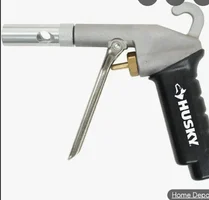
I did look away once it was in place and before pulling the trigger in case of any blow back. But I didn't see any signs of any.












New threads New posts
-
test
-
-
-
-
 Light 14 or 16" narrow kerf bar for 200t or 201t
- Started by southsoundtree
- Replies: 9
-

-








