How to Get Power from a Pulley

chris_girard

Branched out member
Location
Gilmanton, N.H.
So, here's a question that I thought that I knew the answer to and found out that I was completely off base: How does a block-and-tackle provide mechanical advantage? That is, what mechanism is at work, such that you can pull on a rope with a certain amount of force at one end, and move a corresponding or greater amount of weight at the other?
 
So, here's a question that I thought that I knew the answer to and found out that I was completely off base: How does a block-and-tackle provide mechanical advantage? That is, what mechanism is at work, such that you can pull on a rope with a certain amount of force at one end, and move a corresponding or greater amount of weight at the other?
Turn your brain off and don’t overthink.

Ok when a load of 100lbs is suspended by a pulley the non load side has to hold 100# so the load stays put in the air.
Therefore each leg is experiencing 100lbs of force to keep things in balance. This means the pulley and attachment must see 200lbs of force.
(In the real world numbers are off due to friction and loss of efficiencies)

So in a mechanical advantage such as a 5:1 there are 5 legs of rope that all are holding / pulling with 100 lbs of force. These added together make for 500# on the output side.

I did a demo of this for the kids school. Hung a block in a tree and had a cinder block tied off to each leg about 3’ off the ground. So the force on the block is x2 cinder blocks.
Next I untied one cinder block and had each kid try to lift using the other leg of line. A few were able to slightly pick it up.
Then I had two kids lift, all teams or two picked it no problem.
Next I set it up as a 2:1 and had the individual kids try again. They all whined and complained about how tired they were and how they couldn’t pick it up by themselves. With coaxing they eventually tried and cheered with amazement.

Each leg of moving rope as it’s pulling the tackle together is experiencing equal force as what is being input.
 
You get power from a pulley by increasing distance.

Twice the power, double the distance pulled.

Etc.
That is an interesting way to think of it, but that isn't exactly true. before I understood how pulleys work to create MA, I was just adding in more and more redirects, and gaining zero MA. The key to making power is in the pulleys that are moving. If you don't have a pulley/block on the thing that is supposed to move, you are simply using the pulley as a redirect. The thing to be moved can function as a low efficiency block if the rope can move around it, but as mentioned by Evo, the friction costs you a lot of your MA, so if you lose half of your power to friction on a 2:1, it is still pretty pointless. You only count the legs of rope that are acting on the moving object.
 
Phenomena at work, is direction change from 1 direction to 2 directions of linear rope travel, when the rope opposes directions it loses 1 direction travel distance, but if energy isn't lost, it most go somewhere, so it is nearly doubled in its pulling power before the direction change. Lol, just me trying to explain this more difficult to explain aspect.

The physical mechanics taking place is, once you have a rope that goes around a fixed object, and travels in the opposite direction, parallel to itself, there is a constant leverage "prying" effect, happening from the outer most part of the rope radius bend, to the hypothetical center of the axle of the pulley.
 
Phenomena at work, is direction change from 1 direction to 2 directions of linear rope travel, when the rope opposes directions it loses 1 direction travel distance, but if energy isn't lost, it most go somewhere, so it is nearly doubled in its pulling power before the direction change. Lol, just me trying to explain this more difficult to explain aspect.

The physical mechanics taking place is, once you have a rope that goes around a fixed object, and travels in the opposite direction, parallel to itself, there is a constant leverage "prying" effect, happening from the outer most part of the rope radius bend, to the hypothetical center of the axle of the pulley.
I like that mental image of the rope prying on the pulley.
 
Someone had a long post on this a while ago where they had color drawings and described pulleys as being a type of ramp simple machine. Either knudeNoggin or treespyder iirc
 
You get power from a pulley by increasing distance.

Twice the power, double the distance pulled.

Etc.
Interesting, I explain it as doubling the power, halving the speed.
I remember at college 30 years ago an instructor showing it and me not understanding, he said ‘you don’t understand do you?’ I had to admit I didn’t and still don’t really grasp the real essence of it.
I use it lots, and show it to the youngsters, who like me get it, but don’t get it.
 
What spun my head was compound or piggyback MA systems

Having the Sailing Smacks page with gifs and charts helped me grok how it works

In my applications I would use 2:1 or 3:1 mostly. The addition of MA took friction and rope stretch out of my calculations. That was all I needed to make it useful for pulling a tree over

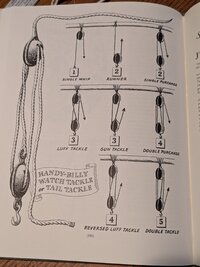
On the tour of Portsmouth I was aboard or if the ships. Name escapes me. The gunports were rigged with a compound system to open. At that moment I didn’t understand why use compound so I took a pic to study. I looked at the MA many times Til I grokked the setup. In order to open the gunports quickly ghe initial lift needed power not speed Once the port was up so far the ‘heavy lift was done and less power but more speed was needed to open the port and run out the guns.

Brion Toss shared a VERY clever two speed 4:1-8:1 handy billy that I use.

There’s lots to glean from old working sails ships built before the compact winches we love
 
That's a great book, Patrick. I have one of the newer ones but yours looks like a first edition.


So, there are a lot of answers that have been listed here, but the one that I was looking for was provided to me years ago by the late Brion Toss, who said the answer to how you get power from a pulley/block and tackle is as follows:

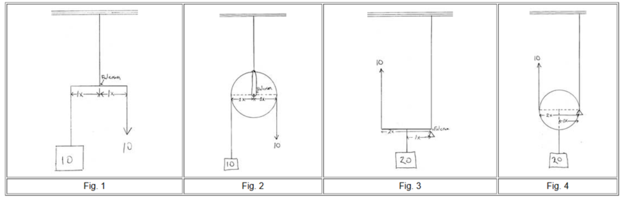
"A block and tackle is either a first-class or second-class form of lever, depending on whether the block is moving or fixed in place. If the block is fixed, it is a lever of the first class, in which the fulcrum lies between the load and the force. The fulcrum is between force and load, so this is a first-class lever. Think of it as a seesaw lever. And since the fulcrum is right in the middle, a load and force of equal amounts are balanced on the fulcrum; the mechanical advantage is 1:1. (See Fig. 1 & 2)
1738110687873.png

Ah, but look at fig.3, in which the load is between the force and the fulcrum. This is a second-class lever, a "can opener" lever, and in this case the force is twice as far from the fulcrum as the load is. This means that half of the load rests on the fulcrum, so we only have to pick up half the load with the force. Voila, a 2:1 mechanical advantage. Finally, in fig.4, we have a load suspended from a block. The block, in turn, is suspended from a point overhead -- not by its axle, but by a line passing around the sheave. Yup, the same 2:1 mechanical advantage.

That is why we count the parts coming out of the moving block(s), because for each part we gain one part of purchase. That is also why we don't count any parts coming out of a fixed block, because all of those parts simply represent redirected leads (As in Fig. 1 & 2).

There's a bit more to mechanical advantage gained with block-and-tackle, like the effect of angles, of friction, of compounded purchases, etc. But the basic mechanism is always the same elegant application of leverage.”


Fair leads,

Brion Toss

 
Eh, for conversation sake if that is true a bigger sheeve will give more leverage. That doesn’t make sense to me
 
If a pulley is a rotary lever, then increasing the sheave diameter doesn't increase the leverage because both the input side and the output side of the lever are always equal in size, equal to the radius of the pulley. It is a seesaw lever, with both sides equal on either side of the fulcrum. The pulley is always kept in it's own category of classical simple machines (lever, wheel and axle, pulley, inclined plane, wedge, screw). It's not a lever in the traditional sense, but when you use a large diameter pulley it does give the feel of traditional "leverage".
 

New threads New posts

Kask Stihl NORTHEASTERN Arborists Wesspur TreeStuff.com Teufelberger Westminster X-Rigging Teufelberger
Back
Top Bottom