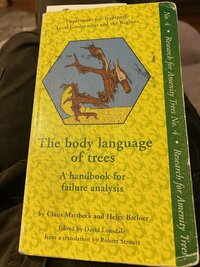
The Body Language of Trees - A handbook for failure analysis

Phil

Carpal tunnel level member
Location
Oak Lawn, IL
imagejpeg_0_20240422_200743.jpg

Buddy of mine found this book and sends me one passage a day. I've found them to be written in an interesting tone/perspective and have decided to share them here. I will add one per day, as I get them.

1. "Wound wood has a primary function to repair the mechanical support system, not to stop decay. Trees respond to decay by compartmentalizing infections on the inside. Wound wood adds strength on the outside."
 
Yes. Stupsi the Hedgehog. I saw him speak in Ft. Collins 20 years ago. "Shorten the lever-arm". He explains the biomechanics of trees. An engineer who walked his woods in Germany and wrote about what he saw. He was the first man I saw wear Uggs and purple glasses. I learned a ton
 
Yes. Stupsi the Hedgehog. I saw him speak in Ft. Collins 20 years ago. "Shorten the lever-arm". He explains the biomechanics of trees. An engineer who walked his woods in Germany and wrote about what he saw. He was the first man I saw wear Uggs and purple glasses. I learned a ton
See, if he dressed normal, like say, khaki’s and a button up shirt, I wouldn’t believe him.
 
This is hard to get my head around. So I can hang more weight from a vertical 2x4 than I can prop up with it? Is that right? What's happening inside the wood to fail under compression?
I had the same question when I heard this one. I would like to see some empirical data from compressive and tensile failure testing. Keep in mind that comparing the compressive strength of wood to tensile strength of wood does not equate to saying that wood is weak in compression. It's all relative. Wood can be exceptionally strong in both loading scenarios but comparing the two, the compressive would fail first... According to this quote anyways.
 
Could it also be that a lot of what initially appears to be failure of tension wood are actually shear failures, where most of the individual fibers haven’t actually failed but sheared apart allowing the tree to fail?
 
Found the attached doc. Couple choice excerpts:

"Mechanical properties of wood Parallel-to-grain properties. The parallel-to-grain direction is the strongest and stiffest from a structural perspective. The tensile strength of softwoods parallel to grain at 12% moisture content generally ranges between 70 to 140MPa. The compression strength is lower and is usually in the range 30 to 60 MPa. For hardwoods, these values are generally higher. These values are for clear, straight-grained wood samples."

"In compressive failure, the cells flatten and the cells walls touch resulting in a densification of the wood and increasing compressive resistance. However, this is also accompanied by large deformations which can occur even at relatively low load levels."
 

Attachments

6. "Can we fully appreciate that the anchorage of a tree in the ground is a stroke of genius on the part of nature. Here we have the weight of a tree, with all the bending forces from the wind, acting on it, and supported by the yielding ground, which has no more inherent resistance against tensile stress than it's feeble cohesion can offer! Even in this age of modern engineering science, this must surely draw admiration from us. The stem base ramifies into a multitude of the finest rootlet, each of which in turn transfers, its load to a particle of soil, conveying to it a tiny fraction of the wind load introduced from above. To understand all of this in exact detail will surely be beyond human comprehension for the foreseeable future."
 
This is hard to get my head around. So I can hang more weight from a vertical 2x4 than I can prop up with it? Is that right? What's happening inside the wood to fail under compression?

As I recall from informal study wood is an anisotropic composite material with the primary strength coming from lignin "straws" that are more weakly bound together by cellulose. As such it is only strong in one axis and it is susceptible to microstructure buckling, delamination/separation, and bruising.

You can see the microstructure buckling in the "parallel to grain" test in this video.
 
Weaker compressive strength was brought up in discussions of how hinge wood operates. Lots of crushing before the final tensile failure.

Webfoot, are you perchance an engineer?
 
Higher education is its own thing, but the spirit of learning coupled with the internet really opens things up :) Resources galore. Be an engineer in function without the cert, for your own stuff. But shy away from life critical liabilities. I like your posts.

If you want to melt your brain look up grammars of computing languages, np hard and Turing machine:O Hint - avoid!
 
7. "In an unpruned, healthy tree the relative area of the crown, stem cross-section, and the root plate will be perfectly matched to the wind load as 'measured' by the tree.
It would be life-threateningly extravagant for the tree to treat itself to an impressively thick trunk beyond the needs dictated by the windiness of the site or the size of its crown."
 

New threads New posts

Kask Stihl NORTHEASTERN Arborists Wesspur TreeStuff.com Teufelberger Westminster X-Rigging Teufelberger
Back
Top Bottom