More thoughts on the finer details of rope walking ascents

Richard Mumford-yoyoman

Been here a while
Location
Atlanta GA
Rope Walking Ascents​

For the last 10 years some might say I've been a little obsessed with the technology of rope walking. Most of us appreciate the efficiency that SRT rope walking provides but often the safety aspects are overlooked. I just published a video that touches on some of those but here I would like to highlight a few points.
Many climbers think rope walking to be as easy as riding a bicycle, but the similarities could not be more opposite.
The system of a doubled moving rope is inherently taut.
The system of an SRT rope is inherently non-taut.
It's a very bad habit that I see done all the time. Do not manually set your hitch or mechanical device at top of descent, let it prove that it will be there when or if you become weightless.
Tree climbing ascenders/descenders are designed for fall protection, but it is our responsibility to keep them oriented and clear and uninhabited to operate.
Foot and knee ascenders, even if not PPE life support, may provide a backup. Having a latch to keep the cam engaged may take a moment to operate but also may prevent an unintentional descent.


Do not manually set your hitch or mechanical device at top of descent,
That is my habit. Busted!
I will consciously 'test' the hitch to see if it automatically engages more often than just before the climb. Thank you.

Here's my question, if I can put it in words. It's about how to develop endurance in doing long ascents.
Where is the balance point in rope walking where the body can take its micro-rests between steps?
Is it possible to 'stand' balanced on the bottom foot so that the rest of the body can be relatively unstressed?
Or must the abdomen and arms and legs remain under stress all the time, with the only rest coming with a total stop and sitting in the saddle?
 
Open air ascents will be potentially faster and unencumbered, but requiring more energy output than ascents where your toes can make contact with the trunk.
Contact with the tree makes ascending ridiculously easy physically but branch structure and trunk curvature can often slow you down.
 
Open air ascents will be potentially faster and unencumbered, but requiring more energy output than ascents where your toes can make contact with the trunk.
Contact with the tree makes ascending ridiculously easy physically but branch structure and trunk curvature can often slow you down.
I have always felt that toes on the trunk make it at least 30% easier. It is an inevitable center of gravity issue unless we can pass the rope through our core. And as much as I like a knee ascender, once I get into the tree structure my knee ascender foot is pushing on the trunk or stepping on limbs.
 
That is my habit. Busted!
I will consciously 'test' the hitch to see if it automatically engages more often than just before the climb. Thank you.

Here's my question, if I can put it in words. It's about how to develop endurance in doing long ascents.
Where is the balance point in rope walking where the body can take its micro-rests between steps?
Is it possible to 'stand' balanced on the bottom foot so that the rest of the body can be relatively unstressed?
Or must the abdomen and arms and legs remain under stress all the time, with the only rest coming with a total stop and sitting in the saddle?
Unfortunately the balance point goes through us, think of a line that would run from the top of our head to the bottom of our feet. If we were hollow we could run the rope there.
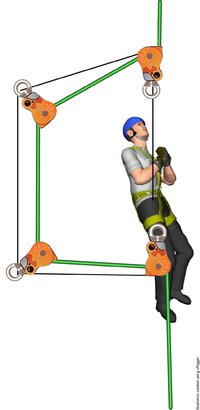
Now to a thought I have had for many years............but the extra hardware would probably negate any real advantage and I'm not sure it would actually work.

So we have this frame, it has about 4 pulleys. We are standing in the frame that is basically a 'C' shape, but our feet extend out the bottom of the shape. So now the rope does go out the top of our head and our feet are clear to walk.
It gives me a headache to wonder if this would work.
 

Attachments

  • CG rope walker.jpg
    CG rope walker.jpg
    107.5 KB · Views: 25
Last edited:
In 1996 I was judging at the ITCC in Cleveland, Ohio. If memory serves me right it was a Speed Climb event. The doubled rope was pre-installed. Remember, this is before SRT/multicenders, etc. SRT was used for ascent only.

This climb was setup with the lowest section was away from the trunk, in open air.

The middle section could be a combination of on-tree scramble and some open air ascent.

The top was totally on tree.

After watching many climbers solve the mystery of which way was the fastest I could tell that the climbers who stayed on rope for the middle portion got faster times. Having the potential for ready-made research was evident, though I missed out on collecting data. After I saw the differences I talked it over with the other judges too. Then we talked about what each of us saw at the end of the pre-lims.

Some time was lost be the bumbling around getting good footing and keeping the slack out of the system. Even the most fluid climber had mis-steps going on and off the tree. Then, we looked at which seemed faster during the actual ascent moments. All of the judges agreed...stay on the rope. Faster, more fluid and no slack in the ascending system.

With this little nugget I expanded it when I worked. I made a point to set my ascent lines in free air so I could stay out of the tree.

From '96 to now tools and techniques have changed dramatically. What is available now is worlds apart from then.
 
With this little nugget I expanded it when I worked. I made a point to set my ascent lines in free air so I could stay out of the tree.

From '96 to now tools and techniques have changed dramatically. What is available now is worlds apart from then.
True and so much has improved with rope walking to make it better and faster.
But, if I have the choice now going up a tree with a straight trunk and no limbs, think pine, redwood, poplar, I will set my line next to the trunk so my toes touch, feels just like a chest roller for keeping a climber vertical to the rope. Instant, 30% efficiency gain. A little different story, as you mention, when a climber gets into the limb structure.
 
Now to a thought I have had for many years............but the extra hardware would probably negate any real advantage and I'm not sure it would actually work.

So we have this frame, it has about 4 pulleys. We are standing in the frame that is basically a 'C' shape,
I figured you had many years of thinking about this, which is why I asked ... You put in words what my mind had yet been unwilling to accept. It's impossible to relax totally, since my body has to be behind the taut rope.

Your description - "basically a 'C' shape" - reminded me of one of my backpacks.
It's an old-school (pre-ultralight, 11 pounds empty) backpack made by McCale and Company (Seattle area), designed for major mountain hunting treks, able to carry 120 pounds of gear and meat. Its innovation was bending metal stays in both sides of the interior frame of the pack, which extend all the way from the hip belt to about 9 inches above each shoulder. There are two cinch straps that connect at the top through the pack material to the top of the bending metal stays, then travel down in front of the chest through channels in the front of the shoulder straps (like your SAKA), down to attach to the hip belt. (It's like a major extension of the tiny mostly worthless straps on smaller packs called 'load lifters.')
Essentially, the front straps are the strings on two bows. Tightening them bends the metal stays to become curved (the bows), thus transferring some or all the upper weight of the pack to the hip belt.

So, your 4-pulley design could actually be a large bending bow. A bow string could tighten it. The climber would be inside the bow, the tightening 'bow string' behind him, the 'bow' in front of him going through his legs and over his head. The three or four pulleys would be inside the bow. The top and bottom pulley need to be 12-18" from the ends, so the string of the 'bow' goes behind the climber's head and butt. The front pulley or pulleys are placed to keep the climber's hitch attached to the main rope a few inches out in front of his chest.
 

New threads New posts

Kask Stihl NORTHEASTERN Arborists Wesspur TreeStuff.com Teufelberger Westminster X-Rigging Teufelberger
Back
Top Bottom