Redundant Bridge vs. Second Bridge

Those petzl open rings are my go to. I’m a big fan of two bridges not for redundancy but for having two anchor points that don’t twerk the saddle as much. One is a bit longer than the other so when using a mechanical device for crane work, the device and the carabiner aren’t right on top of one another.

I used the TreeAustria for a time which comes with two shackles that can be opened just like most of this hardware. I ascended an oak 4 years ago and when I got to a working position in the tree, noticed one of the shackles had come loose and I was damn near close to losing my bridge and likely my existence on this planet. Ever since then I make sure to use loctite on the threads of hardware that connects the bridge to the saddle.

The open rings have a superior design to shackles- the bolt in the shackle takes direct force from the bridge or leg loop depending on how it’s oriented. The small opening on the open O will likely not take direct force because you can rotate it to a position where it doesn’t line up with a point of tension. Courants open rings have a puzzle piece design which similarly avoids putting direct tension on the connecting bolts, but it’s diameter is quite a bit more than the petzl and many eye terminations do not fit as well or at all.

I just checked the petzl open ring manual. It does not say anything about replacing the bolt after using a few times. I had that in my head but that must have been another piece of equipment.
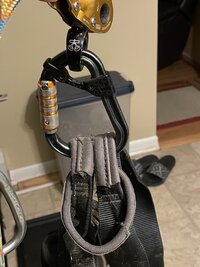
"Those Petzl open rings are my go to." Are you referring to the D rings in subject, the gold ones with the hex bolt? ""...superior design to "shackles"" Are you referring to the 4 holed aluminum plates most saddles have for the bridge attachment?

I do also like the feature of those gold D-rings, in that when hanging from them on a lanyard they have the same seating feel/support as hanging from the bridge. Much more comfortable. No other harness has that feature, from what I've seen.
 
"Those Petzl open rings are my go to." Are you referring to the D rings in subject, the gold ones with the hex bolt? ""...superior design to "shackles"" Are you referring to the 4 holed aluminum plates most saddles have for the bridge attachment?

I do also like the feature of those gold D-rings, in that when hanging from them on a lanyard they have the same seating feel/support as hanging from the bridge. Much more comfortable. No other harness has that feature, from what I've seen.
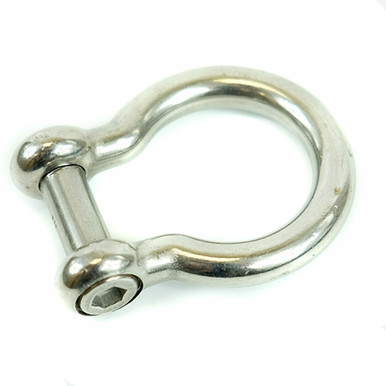
No and no.

Petzl Open O ring. https://m.petzl.com/US/en/Professional/Harnesses/RING-OPEN

Shackle, e.g, the one I specifically was using.
 
I agree it is innovative I like the aspect of the bridge Drings. Use them all the time. I just personally feel iffy touching them because they haven't been time tested. Lol, now the rope stress analogy is not really equivalent.
Sorry, sir you feel I bend everyone else's opinion, I simply try to have meaningful input, and people react to it too emotionally. I have not discredited other's opinion.

And, yes, The strength loss caused by removing is so minuscule, it's hard to quantify, but I just feel iffy about it, until it has lengthily time tested of undoing and doing up in the field.
I only ventured to this thread to get an input on my feelings on this new bridge hold design, and what others thought.
Those rings been around here for a long enough time brah
 
"Those Petzl open rings are my go to." Are you referring to the D rings in subject, the gold ones with the hex bolt? ""...superior design to "shackles"" Are you referring to the 4 holed aluminum plates most saddles have for the bridge attachment?

I do also like the feature of those gold D-rings, in that when hanging from them on a lanyard they have the same seating feel/support as hanging from the bridge. Much more comfortable. No other harness has that feature, from what I've seen.
TM
 
Those rings been around here for a long enough time brah
Oh, just the D ring design with the removable bolt design? Or, use of similar D rings incorporated in the strapping in each end of the bridge, enabling lanyard attachment, like the Petzl Sequoia?
 
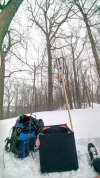
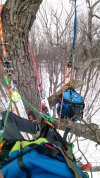
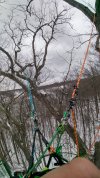
Rec climb yesterday, Tryon park, South end of Irondequoit Bay. Scoped it out Sunday, not a soul in site, except for an old timer who had been skiing about the trails. He had said this was his 19th day in a row on the trails! Great amounts of snow on the forest floor. Had a great time. Worked with the double bridge setup with some pretty horizontal TIP. It felt pretty darn comfortable. Check it:
 

Attachments

  • KIMG1890~2.JPG
    KIMG1890~2.JPG
    658.5 KB · Views: 62
  • KIMG1896.JPG
    KIMG1896.JPG
    442.4 KB · Views: 59
  • 1644340975409.jpg
    1644340975409.jpg
    711 KB · Views: 62
Those petzl open rings are my go to. I’m a big fan of two bridges not for redundancy but for having two anchor points that don’t twerk the saddle as much. One is a bit longer than the other so when using a mechanical device for crane work, the device and the carabiner aren’t right on top of one another.

I used the TreeAustria for a time which comes with two shackles that can be opened just like most of this hardware. I ascended an oak 4 years ago and when I got to a working position in the tree, noticed one of the shackles had come loose and I was damn near close to losing my bridge and likely my existence on this planet. Ever since then I make sure to use loctite on the threads of hardware that connects the bridge to the saddle.

The open rings have a superior design to shackles- the bolt in the shackle takes direct force from the bridge or leg loop depending on how it’s oriented. The small opening on the open O will likely not take direct force because you can rotate it to a position where it doesn’t line up with a point of tension. Courants open rings have a puzzle piece design which similarly avoids putting direct tension on the connecting bolts, but it’s diameter is quite a bit more than the petzl and many eye terminations do not fit as well or at all.

I just checked the petzl open ring manual. It does not say anything about replacing the bolt after using a few times. I had that in my head but that must have been another piece of equipment.
Good idea to use loctite!
I see the risky innate design of the TreeAustria shackles, coming unscrewed. The design on the DMM shackles is clever, in that they have a small set screw, that prevents the main shackle bolt, from allowing the U section, to ever be open, unintentionally.

I never use the bridge on the Sequoia SRT saddle. It's more productive and actually as comfortable to use the VAP.

I've being only using the Ventral Attachment Point of the Sequoia SRT, for all all my DRT work with the ZigZag.
I never have used integrated fabric loop, as intended by Petzl. I use a large Petzl H frame carabiner, connected through the 2 points where the fabric loop runs, in the VAP. It makes the VAP closer to the rope climbing device, and greatly reduces wear to the 2 (gray) Ventral Attachment Points.
Seems like a bad design that Petzl implies the use of that fabric loop. Using it frequently will cause the fabric contact points to abrade, to the degree that could cause failure of the VAP.
 
Last edited:
I’ve been running two bridges on my onyx. Both through the same ring. I unsewed the ends of the webbing and flipped the plates around. I am using 7/16 Samson 16 strand for both of them. One is adjustable with a roll’n’lock. I found I don’t extend the bridge way out, but I do suck it in on longer srt ascents.
The way I look at it is the adjustable is a redundant backup, unless it’s sucked in and then it becomes the primary with the fixed bridge as a backup.
Rarely I will have two TIPs and might use each bridge independently. Even more rare I use the adjustable one entirely independently as the only connection.
 
Many years ago. Many. I owned a couple sequoias. I used webbing bridges, as that is all they sold at the time. Those screws came out and went in. Blue loctite always. Or maybe red. The weaker one I know. But it is a thing one would inspect often. Never saw one loosen. I honestly would never go back to one bridge personally for work. I now own several EVOs because I love that damn thing. The two bridges just helps get proper work positioning in shitty spots without pulling at one bridge ring from countering angles. Those forces can be counterproductive. Just too much stressing in one spot. Two bridges allows for Forces to be dispersed properly throughout the harness and that transfers to a healthy and less stressed body.

 
Last edited:
Many years ago. Many. I owned a couple of sequoias. ...
Why do arborists use more than one bridge, for positioning, if, it seems it would require a whole secondary TIP with another rope, likely faraway, and if it's not too faraway, so that a lanyard could suffice, why not use a lanyard on bridge Drings?
Can't one simply have 2 long lanyards and use that for positioning, on bridge Drings, or typical hip Drings.
When I prune I use two lanyards, an 8' and 17', using them on the bridge Drings of the "Sequoia SRT Saddle", and the ZZ directly on the VAP.
It's comfortable and efficient to quickly relocate to the next cut position.

Just got some sweet custom lanyards from GAP. Scandere and a RING rope lanyards, with the CT Anodized aluminum blue rope snaps. The easiest to use and least likely to get stuck in tight branch areas.

IMG_3028.JPG
 
I do not climb with two ropes. But I use my lanyard SRT often. Two bridges allows for a way better ergonomic position for my body. Having one bridge and ring does not distribute forces properly and creates twisting. Guy I could never run that ventral point setup you are using. I am not caving. I move laterally out to tips often, multiple times in a day. That setup cannot work with my style of climbing. Go to a tree competition and see what type of setups are being used. All climbers will be using rope bridges and most will be SRT with 2 bridges. It is 2023 after all. Not 2000.
 
I've been using a second, adjustable bridge as needed on my MB, and remove it when not needed.


Typical bridge is a standard rope bridge, the temporary adjustable bridge is an ART snake tail that I keep on me primarily for redirects. The spliced ring blocks against one lower Dee and then I set a carabiner in the desired pocket on the outside of the other Dee.


This setup is only used as a redundant bridge. If I need multiple attachment points, I clip into my camp gyro.


Quick, easy, has other purposes, and it's already on my saddle.
 
Have been running two and sometimes three bridges for quite a few years now. Usually climbing with once wire core flip, a 60-75ft positioning (16 strand), and my climbing line.

It became a regular occurrence on crane removals where I’d find myself in a crane assisted pruning situation (ie no spikes). Making the transition from the ball back to drt tree-set climbing line is much easier from the 2nd bridge than your D rings. Essentially you’re not nut-hugging the trunk.

Even when free climbing, positioning off the bridge I have found is the most energy effective solution. Especially for those really long lateral limbs. It keeps both my hands positioned in a similar area, so when I twist or change positions quickly I don’t have to deal with one arm in the center and the other messing around towards my hip. I think it helps too when you need to switch sides of the limb you’re working on which could mean ducking under your lines. Just my two cents. Once I made the switch to two will never go back. Running an Ergo saddle.

Saw someone mentioned the sequoia on this thread… hope you had better luck with it than I did. Couldn’t stand that harness, so lightweight and thin it kept cutting my circulation.
 
Random thought, I could see some advantages to a steel core bridge. It could offer SOME protection, but the primary thought is running smoothly with a tight cover.
It would be practically indestructible if done right.
 
Random thought, I could see some advantages to a steel core bridge. It could offer SOME protection, but the primary thought is running smoothly with a tight cover.
It would be practically indestructible if done right.
Metal fatigues pretty badly when constantly flexed in one area over a short radius.
 
  • Like
Reactions: evo
A Kevlar/polyester composite double braid would get my vote. Kevlar core polyester jacket.
The whole Kevlar core idea I believe was found to be bad for the same reasons. I think that's an aramid thats self abrasive too. I think a while back they made some bridges with aramid cores and they would be used for too long and there were failures.
 

New threads New posts

Kask Stihl NORTHEASTERN Arborists Wesspur TreeStuff.com Teufelberger Westminster X-Rigging Teufelberger
Back
Top Bottom