Pulley One

I have not tried these, and frankly they look heavy and cumbersome. I have used on a regular basis, these:
They work very well on ropes with little friction, and you can install them on a normal rigging carabiner. Handle anything up to 5/8" rope, and relatively inexpensive. I usually have half a dozen in my kit for rigging 4 to 1s to pull storm damaged trees out of other standing trees with my truck mounted winch.
 
This confused me, I was not aware of this company.

I am familiar w/ @Height, Inc; At-Height.com - which is in Louisville, KY. (Totally different)
Good People there in KY. They've been in business for many years; founded by arborists.
 
Yes the canopy climbing collective is where I first seen it. Their some arbs from Europe I think. That's their you tube channel. They have 2 videos about it. One they lift a small chipper with an MA SYstem and then next vid they do an official review. Looks cool for MA systems
 
I have not tried these, and frankly they look heavy and cumbersome. I have used on a regular basis, these:
They work very well on ropes with little friction, and you can install them on a normal rigging carabiner. Handle anything up to 5/8" rope, and relatively inexpensive. I usually have half a dozen in my kit for rigging 4 to 1s to pull storm damaged trees out of other standing trees with my truck mounted winch.
Data sheet says 140 grams which in my book wouldn’t be heavy. Expensive on the other hand at 85 bucks.
 
That ring looks like a good value.

Does it function like a rigging ring or does the center rotate like Pulleyone?
It is solid, like a rigging ring. The difference between these and the rigging rings are that the sides near the outter edges are narrower than close to the center so the rings do not rub on the rope, only the curved center contacts the rope for less friction.
With a soft shackle you can put them almost anywhere when you need a bit of M.A. Midline attachable so you can throw a soft shackle over a branch and haul up your saw. I find myself using them all the time. No bearings to collect dirt and debris. You can drop a stem on them, dig them out of the dirt and they are like new.
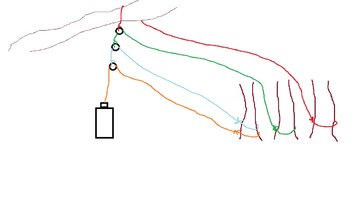
I have three bull ropes with the rings spliced onto them (through the opening). I can't draw for crap but I use them like this with a winch to pull trees down quite often. Base tie the bull ropes to tree bases and run the winch line through the last one. With that set up I can pull just about any hung up tree out of there with very little winch force.
 

Attachments

  • winch tree down.jpg
    winch tree down.jpg
    38.5 KB · Views: 24
I think @flushcut made a good point about the rope coming out of the sheave. I can see a pre-rigged MA system made with these pulleys being a tangle every time you go to use it.
If I were using them I'd de-rig after each use. Simpler and more compact.

I have a pre-rigged 4:1 MA system that stays built. If it gets bagged without compressing the system it will always turn into a tangle. If the attempt to untangle is done with haste it gets worse.
Yeah that’s how I’d envision using them too Tom.
 
@Dan Cobb
@Tom Dunlap
@Barc Buster
As my crappy diagram above, I keep 3 150' 5/8" bull ropes with a ring spliced on the end of each. They are stored separate as I sometimes use only one or two. However many I need I put together and hoist them up with the last one.
This set up does not bode well for keeping them together as a block and tackle arrangement. That is 450' of 5/8th rope. That would be some mess.
I have a stored set of fiddle blocks for when I need to use such a thing. My rig shown above would tear apart a set of fiddle blocks. Those are rated for something under a thousand pounds ish. The rig in the diagram I suspect I have pulled close to the breaking strength of the 5/8th Polydyne, which is somewhere around 22,000 pounds.
Rings are a good thing for the right use, but they aren't meant to replace what we already have that works well. Just an addition to our arsenal.
 
The difference between these and the rigging rings are that the sides near the outter edges are narrower than close to the center so the rings do not rub on the rope, only the curved center contacts the rope for less friction.
The contact area does not affect the force lost to friction.

"Although a larger area of contact between two surfaces would create a larger source of frictional forces, it also reduces the pressure between the two surfaces for a given force holding them together. Since pressure equals force divided by the area of contact, it works out that the increase in friction generating area is exactly offset by the reduction in pressure; the resulting frictional forces, then, are dependent only on the frictional coefficient of the materials and the force holding them together."
 
The contact area does not affect the force lost to friction.

"Although a larger area of contact between two surfaces would create a larger source of frictional forces, it also reduces the pressure between the two surfaces for a given force holding them together. Since pressure equals force divided by the area of contact, it works out that the increase in friction generating area is exactly offset by the reduction in pressure; the resulting frictional forces, then, are dependent only on the frictional coefficient of the materials and the force holding them together."
Fart
 
The contact area does not affect the force lost to friction.

"Although a larger area of contact between two surfaces would create a larger source of frictional forces, it also reduces the pressure between the two surfaces for a given force holding them together. Since pressure equals force divided by the area of contact, it works out that the increase in friction generating area is exactly offset by the reduction in pressure; the resulting frictional forces, then, are dependent only on the frictional coefficient of the materials and the force holding them together."
However, the friction further from the center (larger radius) increases to force of the friction bearing on the motion of the object. ei. longer breaker bar, more rotational force applied. If I put my finger against a spinning wheel near the center of the wheel not much will happen. If I put my finger near the outside edge a lot will happen. Not really talking about surface area, but location of the friction relative to the center of a rotational object. Apples and oranges, sort of.
 

New threads New posts

Kask Stihl NORTHEASTERN Arborists Wesspur TreeStuff.com Teufelberger Westminster X-Rigging Teufelberger
Back
Top Bottom