Pruner's Remorse: a tale of my Honeylocust

My wife planted a honey locust in our front yard many, many years ago. Best pruning cut I made on it was the one close to grade, i.e. I removed it. I always hated trying to clean up the tiny leaflets off the front walk and lawn. What a pita. It was extremely prone to splitting in a barberchair sort of way during removal.
Oh, Dan! It does take all of us to make the world go round. I know other locust haters. But honeylocusts were among a handful of "northern trees," as I thought of them, I first learned and loved. Coming to Ohio and then Indiana from a Florida beach town in my mid 20s, I undertook a crash course in trees of all kinds.

What I loved first about honeylocusts was their winter profile. Those dark, snaky limbs and angles. The named varieties I've planted don't seem to have quite the same drama as the species. I have planted a couple species type here, though thornless. And selected for heavy pod production for wildlife or livestock.

So whoever succeeds me on this hill will call them dirty and call you to cut them down. So be it. The world goes round . . .
 
I have an out of state arborist buddy whos driveway is lined with small, 4-8" dbh honey locusts. About 9 total....all thorned. When I first went to visit him he was showing me around the property. As we came to the thorned locusts, he just chuckled and described his plan to care for them with a sort of masochistic laugh as he described it. I can promise you these these will be the best taken care of thorned honey locusts in the midwest.
 
I like that you have heavy seed producers for wildlife. Certain years, those can produce so heavily they will self prune. It's amazing the amount of seed pods get made.
 
. . . they have been screwed up previously at the nursery or when they interfere with human structures or activities. You have given your tree some character and it will be fine with it.
I agree with you on nurseries and thank you for the kind word.

On the one hand, it is an incredible gift that we can pot trees and keep them for extended periods that way, ship them, mail them, throw them in the back of pickups. On the other, nurseries prune almost always only for sales, and bushy trees sell. So trees are repeatedly headed and many have multiple leaders.

Second, most potted trees need root pruning because otherwise the roots will keep circling as if in the pot. A school near me has multiple trees on the playground with strangle roots. When I started planting trees, bare root stock was the norm, and bad rooting seemed rare.

Third, in the growing-on and repotting process, many trees get planted too deep. Homeowners plant according to the soil line in the pot and bury the root flare. I am sure I have done it many times.

I know most arborists know these things because you deal with resulting problems every day. I prune basically once a year. And jobs kept us moving about once each decade so I didn't see many trees I've planted get old enough to show issues. Embarrassing how much I have learned in old age.
 
Last edited:
My understanding of honey locusts is that they are especially native to the open grassland... woodlandgrassland interface ecosystem. One that might have grazers. Bison and others. They are not a dense forest tree per se They have some fire resistance. They do better in open areas with sun. There are some absolute monstrosities of honey locust in SE michigan. topping 100 feet. There are quite a few cultivars. There seems to be different fads from different eras.

My feeling is that you did just fine with your tree, it for sure evolved to handle a giant sloth or mamoth munching on it periodically. It's really hard to screw up a tree with just pole pruners beyond what it can handle. Pole saws on the other hand can mess up a tree pretty quickly. You really do have the liberty to guide it to be any way you want it over the next many years with small cuts over time.
 
treebing, I've seen some big locusts in woods in Ohio. But it's possible they were there and then the woods regrew when cropland or pasture was abandoned.

When I walk past a certain woods almost daily I look at a monster white oak and wonder about its history. I reckon that woods has been cut at least three times and was pasture for decades. That oak maybe was spared because it is at the edge of a steep drop off. I bet its early life was shaped by other trees but then it was alone out there for a long time before trees were allowed to come back. It has an interesting structure, including a few heavy limbs that look like widowmakers. One is right over a fairly busy rural road.
 
Pin Oak 2-23.jpg

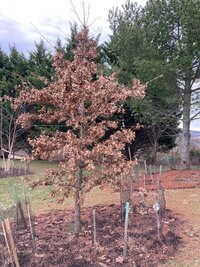
This pin oak is more typical of my pruning. Planted at the same time as the locust, the only branches removed so far are 1-2 multiple leaders that shoot out annually. Of course any arborist looking at it will notice I have reduced or headed the lower branches as well.

I have pruned it this year but it looks like it has at least two leaders. Actually there is a whorl of four branches around the leader. This year I nipped the ends of two, and the angle seems okay on the other two. I thought I'd see how they grow this year and decide which two to take out this time next year, so there's not such a whorl. I wish this tree, about 12' now, would stop with the whorls.

In the past I would've removed at least a couple of the lowest branches already. But under Dr. Gilman's influence, I am keeping them longer to build trunk taper.

I've got another tree almost identical to this 30' away, both on the west side of my house, and also a pin oak whip that I transplanted after it volunteered, apparently from my daughter's two pin oaks across the pasture. I think a jay dropped it or planted it by my house. It's still got its leaves too, and I bet will catch these nursery trees really quick.
 
Honeylocusts were cultivated by North American indigenous folks for sugar production. An incredibly important and highly revered tree. What Europeans stumbled upon when they got here was actually the results of generations of careful tending. I’m hoping to find some survivor honeylocusts around here which would generally indicate a former Cherokee settlement… something with a high sugar content that would probably have monster thorns…

I got my start in nyc deadwooding thornless honeylocusts (among other trees of course), and they remain one of my favorite trees for the urban environment.

Great tree!
 
Honeylocusts were cultivated by North American indigenous folks for sugar production. An incredibly important and highly revered tree. What Europeans stumbled upon when they got here was actually the results of generations of careful tending. I’m hoping to find some survivor honeylocusts around here which would generally indicate a former Cherokee settlement… something with a high sugar content that would probably have monster thorns…

I got my start in nyc deadwooding thornless honeylocusts (among other trees of course), and they remain one of my favorite trees for the urban environment.

Great tree!
Cool history, I did not know that. I love the locusts. I fell asleep under one in a park last summer, I've never fallen asleep in public before that I can remember. I was lying on my back looking up at the branches swaying in the wind and it put me right to sleep.
 
Honeylocusts were cultivated by North American indigenous folks for sugar production. An incredibly important and highly revered tree. What Europeans stumbled upon when they got here was actually the results of generations of careful tending. I’m hoping to find some survivor honeylocusts around here which would generally indicate a former Cherokee settlement… something with a high sugar content that would probably have monster thorns…

I got my start in nyc deadwooding thornless honeylocusts (among other trees of course), and they remain one of my favorite trees for the urban environment.

Great tree!
Same here with our oak savanna’s. The First Nations would regularly do ‘prescribed’ burnings. Nearly the whole Willamette valley in Oregon was oak savana, large ones in Olympia, and the San Juan islands. Even in some places in BC..
fire scars indicate that these burns were about every 10 years. With an increase of time post contact. Or the disease contact pre settlement
 
Around here black locust has thorns, maybe pods I can't recall and honey locust no thorns or pods but millions of tiny leaves. Honey locust I'll call 3/4 dense firewood, black locust is like oak.
 
Same common name but different species. Robinia psuedoacachia is black locust and honey locust is gledetsia triacanthos (3 pronged thorn) they have huge crazy thorns natural. Var. inermis are the thornless/ seedless cultivars.

I've heard honey locust is some of the highest btu firewood in n. America. Along with mulberry and maybe osage? Sure seems like it.
 
I'd plant black locusts too if they weren't such a short-lived succession tree everywhere I've lived. I believe it's a beetle that causes so many to decline. But the ones that persist are craggy trees with a lot of character, including many holes for bluebird nests.

I read our native black locust is an invasive species in Italy. When I was traveling by train across Italy some summers ago, I recognized the delightful fragrance of black locusts in bloom. The Italians planted them along railways to hold the soil.

Amazes me how many nurseries selling honeylocusts describe qualities they don't have but black locusts do. Such as that fragrance. Hence black locust honey is prized.

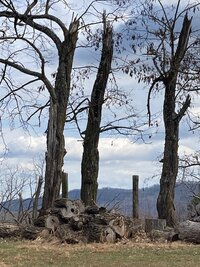
Here are three I photographed a few days ago beside my daughter's barn:

Broken But Standing.jpg
 
I believe it's a beetle that causes so many to decline.
Leaf miner I believe. If we have a good cold winter they aren’t too bad the next summer but they definitely have shortened the lifespan of locust in this region, judging from the quality of locust lumber I dig out of old barns.

Still a great idea to plant in really ravaged sites to begin building soil.
 
Black locust, Robinia pseudoacacia, is a lovely tree around here. We don't have (that I have seen anyway) the species of longhorn beetle, Megacyllene robiniae, that hits them so hard in other states.

Also agree that the inermis honeylocust is one of the easiest trees for leaf cleanup. They can also be highly fragrant during bloom.

We have both planted in our limited landscape.
 
A honeylocust is rather shade intolerant. Usually a tree’s leaf or needle size and density will inform you of what it’s preference is, and the amount of natural internal branch shedding in older age also gives this away.

I don’t think trees want to break and fall over. If that was the case, they wouldn’t be spending so much time building up reaction wood. So we can generally help a tree reach a ripe old age with good structure even after the nursery tried their best to wreck it.

A shade intolerant tree grown in full sun can end up with just as many issues as a shade tolerant tree grown in full sun. Take a dogwood for example…it’s an understory species with an opposite bud pattern. A recipe for a disaster of inclusions that we often can’t fix with a few choice, small pruning cuts at low dosage and higher frequency by the time a client calls.

Now take the shade intolerant tree with an overstory potential and give it full sun without touching it through its whole life. If grown under shelterwood, despite its more decurrent habit, you will likely likely not see that manifest until the crown gains enough light. So in full sun, it will generally create several leaders destined to become inclusions.

The way I try to prune trees is to first consider their habit and overall potential. I also consider “how” they grow with the analogy of a very thick layer of paint with extensions from each terminal.

If a tree has a the potential to be very large (overatory) my approach would be to avoid numerous cuts on the periphery, but rather aim for ideal structure with cuts that thin out overly dense nodes and immediately get inclusions out of the picture. I also consider available light and where any branch will likely go, including the effects of its own upper crown on lower branches. A lateral branch may end up steering more upright if shad is removed from above it.

I think the art of pruning is how well you consider the science and apply a skilled hand.

As others have said, a young tree can be very forgiving, so don’t sweat too much over what you did. Just spend some time with the case study of the Aurthur Clough Oak and see what “tree time” can accomplish.
 
I have been following this thread and marveling at the conversation. Learned a lot I didn't know, and laughed a lot at comments, not because they were silly, but because they are so damn different from my part of this planet.
Town / Country
I live smack dab in the middle of the Chippawa National Forest with well over 2 million trees on my property. My nearest neighbor is 3/4 of a mile through the woods. All of my work revolves around storm damage, line clearing, hazard removal, and clearing for building sites. If I get called, the tree(s) coming down. No chipping or hauling. It remains where it fell, or it is piled and burnt on site if it needs to be gone. I think I would be calling my friends on the phone and sharing a good laugh if I ever got a call for a job to prune a tree for aesthetic value. A yard here is an opening in the forest just large enough so a tree will not hit your house when it falls. We don't plant trees, they just come up on their own. Quite often where you don't want them. Every year I have hundreds of cedar, maple, birch, spruce, white pine, and aspen trees coming up against the house and garage which I have to remove. The oaks sprout out of my raised bed gardens where the squirrels have managed to bury the acorns by the hundreds.
So, I am chuckling at the comments about buying trees at a nursery, and pruning trees to make them look better, or to help them along. I get it. But it is just so foreign to me.
Pray continue.
 
Last edited:

New threads New posts

Kask Stihl NORTHEASTERN Arborists Wesspur TreeStuff.com Teufelberger Westminster X-Rigging Teufelberger
Back
Top Bottom