Pruner's Remorse: a tale of my Honeylocust

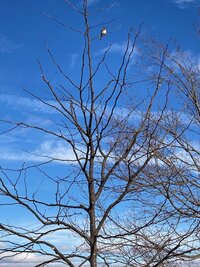
Having some pruner’s remorse over this tree, Locust 1—
Honeylocust 2-8-23.jpg

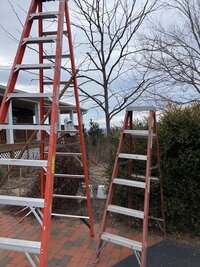
House Locust 2-23.jpg

This Imperial honeylocust was planted in front of my house as a 6’ containerized whip in late fall of 2018. It’s now almost 20’ going into its fifth growing season. I pruned it very little until this go-round. Last week, I reduced or headed the lowest, temporary branches and will probably take off two of the four temporaries next year.

The regret is over some reduction cuts I made to permanent branches higher up. No, not the cut midway up on the left—that’s where I reduced a storm-damaged branch. (And the blob in the upper right in the second photo is a bluebird.) But by using reduction cuts, in a couple of cases I changed the line of a branch enough that now I wish I’d considered that. The new angles aren’t awful, and maybe I can work with new sprouts in time if I want a better/different angle. Also, in one case a reduced branch is close enough to another permanent branch that it’ll need to be removed anyway, probably next year.

The reason I used reduction cuts was to favor the leader, and I now somewhat question that too! You can’t see it in the first two photos above but the leader angles about 30 degrees toward the camera. Last year I actually tried to force it to go straighter and failed, using rope and tree straps. A splint might have worked? But this is a decurrent tree, and the leader seems to want to make room for codominant branches and/or is angling to the south to hog more light instead of assuming a leadership role.

Per Ed Gilman’s teaching, I pruned to slow developing codominant leaders for better branch attachments. Revisiting his work, however, he says specifically regarding decurrent trees to think of these as scaffold branches. That may be working, so far, on Locust 2 by my patio. Treating Locust 1’s permanent branches other than the leader as scaffolds means to me I should have headed most of them. That would have slowed them as codominant leaders but preserved their lateral line. I also removed many upright shoots or reduced branches to remove them.

What Dr. Gilman shows as a properly trained decurrent tree, however, doesn’t look much different to me than an excurrent tree. Its scaffold branches are just bigger than they appear in his excurrent example. They don’t arch up with codominant leaders, like my tree wants to grow.

I hope I know more after what Locust 1 does this year, but I feel very uncertain. My hope is that the leader will straighten a bit, but I doubt it will. Another hope is the scaffold branches will grow like mad, giving me options, while also being slowed in diameter. What?! And also that I haven’t destroyed the nicely rounded shape this tree had and seems to want. Once a tree gets much over 20’, I turn it over to my arborist, so next year may be the last time I do any significant pruning.

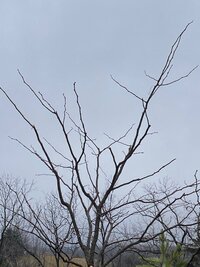
As you can see in the third photo, below, the leader is now kind of out there alone. Any insight or advice welcome for moving forward. Especially based on experience of structurally pruning a honeylocust over several years.

Honeylocust 1 side view from the house—leader angling to right:
House Locust Side 2-23.jpg
 
Last edited:
Remember that trees are very forgiving of storm damage and bad pruning. Before you beat yourself up too bad let the tree show you

Over my career I splinted a few central leaders that grew off at an angle when I wanted a vertical central leader. You’ll have to figure out the material for the splint. The first major splint I installed was made using a long piece of straight grained handrail. Probably Douglas fir. Make it long enough to go well below the ‘pivot point’. A mid grade quality duct tape was used to hold the splint. 2-3 round turns. Using duct tape was like using internal stitches. The tape will last outdoors for at least 2-4 years. Not like any more durable strapping. Not an issue in your yard but if a client sells the house or forgets to contact you you haven’t left a time bomb girdle.

Most straightening was initially done using 1” webbbing eith metal friction buckles. Webbing ratchet straps too. Once the angled leader is aligned you’ll add the duct tape. Don’t worry about too much but try to avoid scrunching the tape wraps

When the snow melts I’ll do this to a catalpa leader that’s angled like your locust. This will be the last orthoarbopedic surgery on this tree. My goals with this tree are similar to your locust goals.
 
Seeing this makes me echo my previously stated ethos, which is that most trees know how to grow for their conditions and basically need to be left alone. Let ‘em do their dance. Exceptions being much older trees, fruit production, clearance, really over extended limbs, and troublesome cultivars.

It looks to me like all those cuts have limited the natural beauty of your tree (in the short run) and were unnecessary.
 
Remember that trees are very forgiving of storm damage and bad pruning. Before you beat yourself up too bad let the tree show you

Over my career I splinted a few central leaders that grew off at an angle when I wanted a vertical central leader. You’ll have to figure out the material for the splint. The first major splint I installed was made using a long piece of straight grained handrail. Probably Douglas fir. Make it long enough to go well below the ‘pivot point’. A mid grade quality duct tape was used to hold the splint. 2-3 round turns. Using duct tape was like using internal stitches. The tape will last outdoors for at least 2-4 years. Not like any more durable strapping. Not an issue in your yard but if a client sells the house or forgets to contact you you haven’t left a time bomb girdle.

Most straightening was initially done using 1” webbbing eith metal friction buckles. Webbing ratchet straps too. Once the angled leader is aligned you’ll add the duct tape. Don’t worry about too much but try to avoid scrunching the tape wraps

When the snow melts I’ll do this to a catalpa leader that’s angled like your locust. This will be the last orthoarbopedic surgery on this tree. My goals with this tree are similar to your locust goals.
Tom I got burned using duct tape on a leader splint in a much smaller locust in my back yard last year. When I removed it, the tape took a bit of surface bark. Probably not a serious injury, but as it was on the south side of the trunk I painted it with dilute interior latex paint last fall.

Honestly I think splinting this locust is beyond my abilities at this point. I could have my arborist do it, but I am not sure he's got much of that experience and I don't think he'd like to try such shaping.
 
In my experience locust is very tough hard wood that won't bend if of any appreciable diameter. Picture those pesky upper multiple leaders decades from now with you in a hammock strung between them.
 
That tree is young enough and the cuts small enough that it will be fine. No need to worry. However, trees don't need to be pruned hardly ever. That is just a myth that arborists use to get work. Deterrent, excurrent, the tree knows what it is doing just fine. They don't need deadwood removed, they don't need crossing branches removed, they don't need to be thinned, they don't need to be elevated, apart for some highly domesticated and genetically screwed up trees like Bradford pears and Princeton elms, they have not evolved with pruning tools. The only reason to cut them is when they have been screwed up previously at the nursery or when they interfere with human structures or activities. You have given your tree some character and it will be fine with it.
 
Last edited:
I see self-flagellation is alive and well within the arborist community. So you guys who believe trees, for the most part, never need an arboricultural correction, is that what you tell your clients? Do you turn down trimming jobs because you 'know' it is unnecessary work or do you compromise your beliefs just to make a buck?

Trees do not 'know' what they are doing. They have a genetic coding that gives them a wide range of potential to exploit and defend as needed. All organisms reliant on such systems are subject to anomalies, some of which are detrimental and some advantageous. This creates the diversity for natural selection. Just because an organism can exist with anomalies does not make those anomalies beneficial or even desirable. A child can survive just fine with crooked teeth for example but most parents will choose to have them straightened, not just for vanity but to reduce future complications.

Any arborist that can't justify what they are doing with sound judgment and applied skills should seriously consider another line of work. We recommend to 'not' do work on many, many trees when asked by clients if the trees need it. If they don’t, they don't. The pruning we do leaves a tree with an improved future potential.
 
Last edited:
That tree is young enough and the cuts small enough that it will be fine. No need to worry. However, trees don't need to be pruned hardly ever. That is just a myth that arborists use to get work. Deterrent, excurrent, the tree knows what it is doing just fine. They don't need deadwood removed, they don't need crossing branches removed, they don't need to be thinned, they don't need to be elevated, apart for some highly domesticated and genetically screwed up trees like Bradford pears and Princeton elms, they have not evolved with pruning tools. The only reason to cut them is when they have been screwed up previously at the nursery or when they interfere with human structures or activities. You have given your tree some character and it will be fine with it.
Can you cite the research/source for this conclusion? This myth?
 
Deterrent, excurrent, the tree knows what it is doing just fine.

Politely disagree when talking in the context of the urban environment and especially anything that was grown in a pot, from anything grafted, or balled/burlapped then moved. Trees are living organisms and their growth rates and patterns are dictated by hormones, as well as site conditions. Something growing in the woods, naturally from a seed, doesn't need much input. The second we play god at a nursery, we are setting the tree up for a lifetime of needed care to even get close to a maximum life span. Look up the hormones auxin and cytokinin. One made in the buds, one made in the roots. They work together to regulate plant growth. Prune too many branches, there's now more cytokinin than auxin. Result is lots of epicormic sprouting. This is what leads to topping giving way to a large number of shoots at the cut point. The whole reason arborists exist is to manage the issues we force trees trees to deal with by making them grow in unnatural environments and originating from unnatural germination (grafting).
 
My wife planted a honey locust in our front yard many, many years ago. Best pruning cut I made on it was the one close to grade, i.e. I removed it. I always hated trying to clean up the tiny leaflets off the front walk and lawn. What a pita. It was extremely prone to splitting in a barberchair sort of way during removal.
 
I'm finding this to be an interesting conversation so I hope it continues. To the OP, Honey Locusts are tough trees and nothing in that picture looks to me like something that tree will even bat an eye at. I personally like them and find that the leaves are only hard to clean up if you try to clean them up! Everyone has a different sensibility about their yard though and I know @Dan Cobb likes a pristine finish on that front lawn by his own admission.
 
My wife planted a honey locust in our front yard many, many years ago. Best pruning cut I made on it was the one close to grade, i.e. I removed it. I always hated trying to clean up the tiny leaflets off the front walk and lawn. What a pita. It was extremely prone to splitting in a barberchair sort of way during removal.
I love the ol honey locust! Don't have a yard though. I do know what you mean about the splitting, a lot of tension in them trees.
 
Politely disagree when talking in the context of the urban environment and especially anything that was grown in a pot, from anything grafted, or balled/burlapped then moved.
I agree… and see human choices as the problem in your examples here. We think we know what the trees need better then they do. That strikes me as kind of hubristic. And I admit, that’s just a sense, not something backed by research that I’ve read.

So you guys who believe trees, for the most part, never need an arboricultural correction, is that what you tell your clients? Do you turn down trimming jobs because you 'know' it is unnecessary work or do you compromise your beliefs just to make a buck?
Generally what I’m seeing as far as tree needs, and what I’m bidding on, are corrections to things that have occurred because of human intervention, whether that be soil changes, grade changes, bad pruning practices, planting a tree in the wrong spot. Most of the estimates, though are for removals of trees that have large decays or are dead or dying, and clearly need to come down, and there’s quite a bit of work to do just with that. most of the pruning jobs are to try to maintain a large mature or over mature tree in an urban landscape, which requires thoughtful tip weight reduction. I think part of that has to do with the kind of canopy that we see in our area, which tends more towards the large, mature urban trees, rather than small to medium trees.
 
We get plenty of work cleaning out deadwood for the aesthetic and safety of our customers. Clearing roofs, cars, patios, gutters, overgrown fencelines, guiding away from other priority trees repairing grade, fixing problems created by previous over pruning or mechanical damage.

They almost always come out of a nursery with some sort of problem. There is plenty of work for us
We tell a lot of people that we don't need to touch their tree and they should spend their money on their gutters or roof or sewer system. When people ask me what sort of pruning needs to be done for the health of the tree, the answer is almost aways nothing, but it probably should be guided away from your roof and wires and there is a dead limb getting ready to fall on your picnic table. Do you mind the limbs in your face when you mow? Or can we leave them?
 
I am from the side that trees don't NEED to be pruned, its people that NEED trees to be pruned. Sure there are some cases where interference can be beneficial to the tree, such as subordinating a co-dom that would fail otherwise but that is rare.
Now there are many practices that are beneficial to the tree, and a good practitioner would cause the least amount of harm. In the landscape trees provide a role for humans, arboriculture is the means to that goal. Take a street tree as a easy example, what is the role, where is it planted? What do we need to do to the tree to keep the square peg in the round hole? Pick lowest permeant branches, clearance pruning, directional pruning... AND... yes take out crossers and deadwood with the least amount of harm. This incidentally benefits the tree changing the human perspective of the plant, from something 'ugly' to something with value. Stupid yes, but keeps the plant alive
 
That is more along the lines of what I meant to say. There is a school of arboriculture that prescribes TED to everything or TEDS... thin, elevate, deadwood, shape. Its the school in which I started work. And every tree needed it. I think a lot of trees are better off untouched. I used to hit silver maples harder than other trees until I realized the dangers of sunscald and frost damage..

Honey locusts in particular don't need any live branches removed except maybe messed up from the nursery. We deadwood the hell out of them though because it makes them look so much better and people like their trees more, so in that sense it is good for them. But do honey locusts need the deadwood removed? I don't think so.
 
Politely disagree when talking in the context of the urban environment and especially anything that was grown in a pot, from anything grafted, or balled/burlapped then moved. Trees are living organisms and their growth rates and patterns are dictated by hormones, as well as site conditions. Something growing in the woods, naturally from a seed, doesn't need much input. The second we play god at a nursery, we are setting the tree up for a lifetime of needed care to even get close to a maximum life span. Look up the hormones auxin and cytokinin. One made in the buds, one made in the roots. They work together to regulate plant growth. Prune too many branches, there's now more cytokinin than auxin. Result is lots of epicormic sprouting. This is what leads to topping giving way to a large number of shoots at the cut point. The whole reason arborists exist is to manage the issues we force trees trees to deal with by making them grow in unnatural environments and originating from unnatural germination (grafting).
You've encapsulated my belief. Lawns were not the evolutionary environment of almost all trees. In the forest they are generally forced to grow tall by competition, lose lower branches to shade, and gain protection from wind from other trees.

Trees truly go wild in domestication! They gorge on sunlight, sending competitive shoots up everywhere, and often grow structure that posses risk to humans and shortens their lives.

I have sympathy for "leave them alone," especially if someone is ignorant. I see stubs and flush cuts all over in town and country. It is stunning how little most people know about trees, their care, and basic pruning. Almost unbelievable.

But arboriculture seems based on the recognition that we owe trees and they need our informed help.
 

New threads New posts

Kask Stihl NORTHEASTERN Arborists Wesspur TreeStuff.com Teufelberger Westminster X-Rigging Teufelberger
Back
Top Bottom