













- Location
- Southwestern Virginia
Having some pruner’s remorse over this tree, Locust 1—
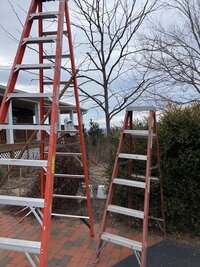
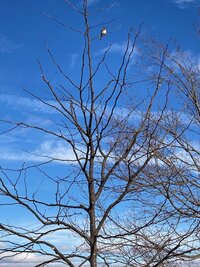
This Imperial honeylocust was planted in front of my house as a 6’ containerized whip in late fall of 2018. It’s now almost 20’ going into its fifth growing season. I pruned it very little until this go-round. Last week, I reduced or headed the lowest, temporary branches and will probably take off two of the four temporaries next year.
The regret is over some reduction cuts I made to permanent branches higher up. No, not the cut midway up on the left—that’s where I reduced a storm-damaged branch. (And the blob in the upper right in the second photo is a bluebird.) But by using reduction cuts, in a couple of cases I changed the line of a branch enough that now I wish I’d considered that. The new angles aren’t awful, and maybe I can work with new sprouts in time if I want a better/different angle. Also, in one case a reduced branch is close enough to another permanent branch that it’ll need to be removed anyway, probably next year.
The reason I used reduction cuts was to favor the leader, and I now somewhat question that too! You can’t see it in the first two photos above but the leader angles about 30 degrees toward the camera. Last year I actually tried to force it to go straighter and failed, using rope and tree straps. A splint might have worked? But this is a decurrent tree, and the leader seems to want to make room for codominant branches and/or is angling to the south to hog more light instead of assuming a leadership role.
Per Ed Gilman’s teaching, I pruned to slow developing codominant leaders for better branch attachments. Revisiting his work, however, he says specifically regarding decurrent trees to think of these as scaffold branches. That may be working, so far, on Locust 2 by my patio. Treating Locust 1’s permanent branches other than the leader as scaffolds means to me I should have headed most of them. That would have slowed them as codominant leaders but preserved their lateral line. I also removed many upright shoots or reduced branches to remove them.
What Dr. Gilman shows as a properly trained decurrent tree, however, doesn’t look much different to me than an excurrent tree. Its scaffold branches are just bigger than they appear in his excurrent example. They don’t arch up with codominant leaders, like my tree wants to grow.
I hope I know more after what Locust 1 does this year, but I feel very uncertain. My hope is that the leader will straighten a bit, but I doubt it will. Another hope is the scaffold branches will grow like mad, giving me options, while also being slowed in diameter. What?! And also that I haven’t destroyed the nicely rounded shape this tree had and seems to want. Once a tree gets much over 20’, I turn it over to my arborist, so next year may be the last time I do any significant pruning.
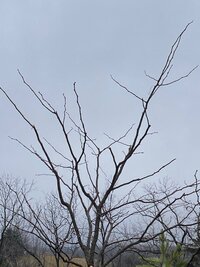
As you can see in the third photo, below, the leader is now kind of out there alone. Any insight or advice welcome for moving forward. Especially based on experience of structurally pruning a honeylocust over several years.
Honeylocust 1 side view from the house—leader angling to right:
This Imperial honeylocust was planted in front of my house as a 6’ containerized whip in late fall of 2018. It’s now almost 20’ going into its fifth growing season. I pruned it very little until this go-round. Last week, I reduced or headed the lowest, temporary branches and will probably take off two of the four temporaries next year.
The regret is over some reduction cuts I made to permanent branches higher up. No, not the cut midway up on the left—that’s where I reduced a storm-damaged branch. (And the blob in the upper right in the second photo is a bluebird.) But by using reduction cuts, in a couple of cases I changed the line of a branch enough that now I wish I’d considered that. The new angles aren’t awful, and maybe I can work with new sprouts in time if I want a better/different angle. Also, in one case a reduced branch is close enough to another permanent branch that it’ll need to be removed anyway, probably next year.
The reason I used reduction cuts was to favor the leader, and I now somewhat question that too! You can’t see it in the first two photos above but the leader angles about 30 degrees toward the camera. Last year I actually tried to force it to go straighter and failed, using rope and tree straps. A splint might have worked? But this is a decurrent tree, and the leader seems to want to make room for codominant branches and/or is angling to the south to hog more light instead of assuming a leadership role.
Per Ed Gilman’s teaching, I pruned to slow developing codominant leaders for better branch attachments. Revisiting his work, however, he says specifically regarding decurrent trees to think of these as scaffold branches. That may be working, so far, on Locust 2 by my patio. Treating Locust 1’s permanent branches other than the leader as scaffolds means to me I should have headed most of them. That would have slowed them as codominant leaders but preserved their lateral line. I also removed many upright shoots or reduced branches to remove them.
What Dr. Gilman shows as a properly trained decurrent tree, however, doesn’t look much different to me than an excurrent tree. Its scaffold branches are just bigger than they appear in his excurrent example. They don’t arch up with codominant leaders, like my tree wants to grow.
I hope I know more after what Locust 1 does this year, but I feel very uncertain. My hope is that the leader will straighten a bit, but I doubt it will. Another hope is the scaffold branches will grow like mad, giving me options, while also being slowed in diameter. What?! And also that I haven’t destroyed the nicely rounded shape this tree had and seems to want. Once a tree gets much over 20’, I turn it over to my arborist, so next year may be the last time I do any significant pruning.
As you can see in the third photo, below, the leader is now kind of out there alone. Any insight or advice welcome for moving forward. Especially based on experience of structurally pruning a honeylocust over several years.
Honeylocust 1 side view from the house—leader angling to right:
Last edited:






















