Where does the knot go on a tied prussik loop?

dmonn

Branched out member
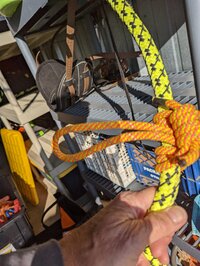
When I make a prussik loop out of rope, I always wonder where the knot should go. For a three wrap (6 wrap?) prussik, my knot could be captured:

Captured prussik knot.jpg

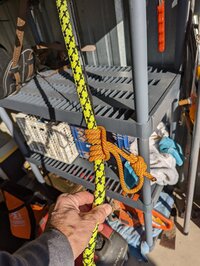
or in the loop you clip in to.

Prussik knot to the side.jpg

Which way is strongest and/or produces the best grip/easiest release?

TIA

Don
 
Okay, flipside/ Devil's Advocate view to you:

Mechanically most loaded, rigid rope part support logististic geometries will be the Standing Parts/SParts as raw linear force input positions into the controlling arc radial conversion reductions. Most rigid distortion against system possible at thickening of seam geometry.
.
Personally favor most loaded and rigid SParts as cleanest support needed and careful as a bendable region. Knot here can weaken most loaded and be more rigid against bend in this key region.
.
Prefer top form where seam is at lesser loaded/buffered from raw force position IF :
Doesn't distort flow of rope , nor of usable profile in system too obtrusively, being more 'discrete' by both measures. So, especially in smaller cords top form with enough turns to pull straight not bent just out of seam. Shorter SPart parts can make more likely for harsh bend in rigid portion of seam in lower example, where longer SPart leg inputs can give more relaxed and out of they way of bend distortion region in work flow. Similar model in other classics of wrap_2/pull_1 or wrap_3/pull_2 where favor seam not in raw support SPart legs, but in most buffered from raw force appearing on front pull side of anchor, if doesn't distort seam too much ( which is probably OK at buffered position, but in purist model...).
.
Can argue Scaffold etc. strong enough for raw primary position use, but still gives stiffer region at primary connection and raw load. Eyes to carabiner would eliminate this factor but then lose autonomous adjustability on loading angles to weaken system by not fully sharing load to legs evenly.
.
At end of day no warm fuzzy comfy puffy blanket statements, but rather tunable considerations for specific shituation to include some subjective facets of personal style and workflow.
 
Last edited:
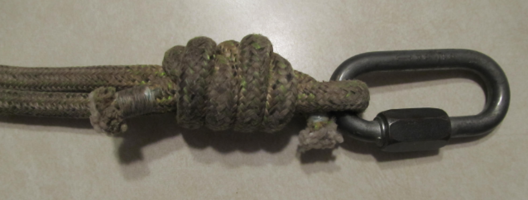
Another possible knot position.
View attachment 84865
I remembered reading a report on rappel knots that recommended an overhand over a figure 8. (I was a little surprised.) I'm not sure if that would apply to a prusik loop. Interesting configuration regardless of which bend is best.

 
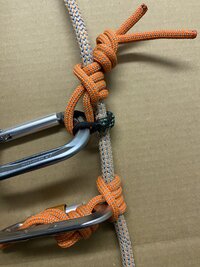
The two sections of cord coming out of the Figure Eight are mostly parallel, just being bent around the rope, they aren’t being pulled apart much.
72D3347F-02CE-45BE-8C5E-032C9B5D1748.jpeg
 
Personally prefer seam factored out of range of rawest, unbuffered forces as can; as a mantra or blind religion of faith to that ideal. Variances in strength, rigidity, elasticity etc. stirred into unbuffered region of most critical consideration otherwise, but will say is just not me as a pattern; especially to this scholar.


But to else,
For best seating of all Friction Hitches
>> i always/all ways just as ceremoniously pull hard perpendicular /cross-axis/lateral to loaded host as seat evenly around host grooming thru coils purposefully with other hand
>>then pull in reverse of the intended pull direction along axis of host lifeline
>>then finally fold all home to the final intended direction along axis of the host lifeline
for best performance. (may tweak bit looser then some in reverse strategy, to most b offered position) My arc0,90,180 analysis of all working/loaded ropes is similar as mnemonic across both and many other considerations:
a cross-axis/lateral pull shearing at Samson Angle across loaded axis(arc90), and then both directions on loaded axis(arc0/singular to primary axis, arc180/compound to primary axis)
.
In general find want to dress and seat in parts of rope machinery purposefully as a sound, tight mechanical works.
>>Harder to visualize as such in the soft, liquid form we play with at same room temperature.
>>But loaded is as rigid as steel, per task or load falls; but no more or load rises.
So want to seat to align squarely, so then NOT let treemen level forces IMPACT onto the working mechanical parts as only points of relief.
A running hard head start IMPACTING knot lock can jam knot much harder than needed or worser;
when this could have been minimized/stopped by not letting parts impact/but rather carefully seat firmly, just as if were metal didn't want to chip nor jam.


Rope is just another form-able material; subject to same laws of support geometry, dynamic forces, frictions, internal tensions on long axis, external compressions to host on cross axis etc. etc. like any other material.
Only can form lightly in had w/o chipping, grinding, heating, shaving etc. as it lends it self well until loaded rigid.
So, i think that is how are intellect in these things started, as nothing else lent it self so well, so easily, thru repeated re-uses and so light etc. not as a competing product, but only game in town to connect ideas and amounts to more than individual devices etc.

 
I use the fisherman’s and depending on the grabbyness, my first preference is to have the knot on the spine like the first photo. My logic is the knot reduces the strength and if it’s in this location the knot sees the least amount of loading. I know the logic is kinda silly as I only use a prussic loop like this in heavy rigging applications. Only when I know a mid like knot will bind, and I want the ‘overload’ safety factor of it slipping a little.
Funny enough I’ve never really had one slip, but I’ve had it weld to the rigging line.
 
I use the fisherman’s and depending on the grabbyness, my first preference is to have the knot on the spine like the first photo. My logic is the knot reduces the strength and if it’s in this location the knot sees the least amount of loading. I know the logic is kinda silly as I only use a prussic loop like this in heavy rigging applications. Only when I know a mid like knot will bind, and I want the ‘overload’ safety factor of it slipping a little.
Funny enough I’ve never really had one slip, but I’ve had it weld to the rigging line.
Yea, I have only had the ropes weld together. I think it's largely dependent on the combination of rope types and sizes. HowNot2 has a good video on it, and I think you could extrapolate from it enough to make a prusik that slips at the desired load, so as to act as a fuse of sorts.
 
Always a few Prusiks for small utility now, but lace on with the seam after the coils per experience making quickies whether throw away or quick release even loaded of simply using Square Knot(light utility only, tie downs etc.). It is always a very unloaded position in the chain, and holds.
As always , Square is classically easy to destabilize to release even loaded, perhaps even quicker loaded than unloaded release by by same trigger!
 
When I make a prussik loop out of rope, I always wonder where the knot should go. For a three wrap (6 wrap?) prussik, my knot could be captured:

View attachment 84842

or in the loop you clip in to.

View attachment 84843

Which way is strongest and/or produces the best grip/easiest release?

TIA

Don
I prefer the first combination.Wrapping cord create more friction and less force on knot.But also you can put some load and check what combination knot is easier to untie
 
I have this prusik on my position lanyard. I use the bottom setup because the prusik is often slack and just flopping around the lanyard rope. The bulk of the dbl fisherman's knot helps it to not back itself out if the knot gets a little loose and sloppy.

In regards to the strength discussion: It's important to understand the potential strength lose of each configuration but in no scenario should you put this prusik into a position to break fail when used in a life support application when it's in it's "weakest" configuration. So while the strength discussion is relevant, I would not choose one orientation over another based on that consideration. Even in it's weakest orientation, it will still be more than strong enough to handle what I'm throwing at it and then some.
 

New threads New posts

Kask Stihl NORTHEASTERN Arborists Wesspur TreeStuff.com Teufelberger Westminster X-Rigging Teufelberger
Back
Top Bottom