Wind and water powered craft, at low friction connected much trade in the old 'flat' world as a heritage; and it has given much to us, but for me mostly adding to a more ongoing thru all time
Rope Heritage as a greater unsung hero for much longer than boat usage, that even helped challenge and develop our intellect i think.
.
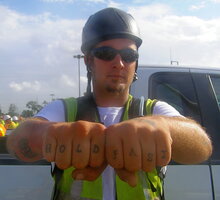
To me "Hold Fast" means immediately and and as if permanently/until willingly released immovable; as like not to get washed overboard by even sudden impacts of change. So, 'Hold Fast' as with the power of your own lion's roar yo!
Or until another "purchase" of rope from the loaded side increasing tension(less rope over same distance) in remaining loaded side and perhaps even moving the receiving target; to then 'hold fast' again the new 'purchase' with the rest of the bank of rope(in similar imagery for lowering/releiving we 'pay out' of the slacker rope bank to the loaded side) to the less or unloaded side of the friction buffer assisting.
Ratchetting gears make the hold easier in capstan, multitudes of many x leverage(note musicians in B&Ws to keep consistent time, in 'concerted' effort thru the grueling work and also let time pass as could be approaching a sweating and puking blood from the slave like labor).
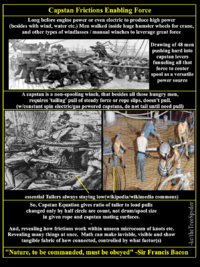
Even with 1 way ratchet capstan, still needed tailer to not let rope build in layers on capstan spool, that would be decreasing the leveraged ratio between the inputs and final output. Bottom 2 pix tailer really evident, either tucked away out of the travel, or with low rope able to be stepped over easily, for this essential position.
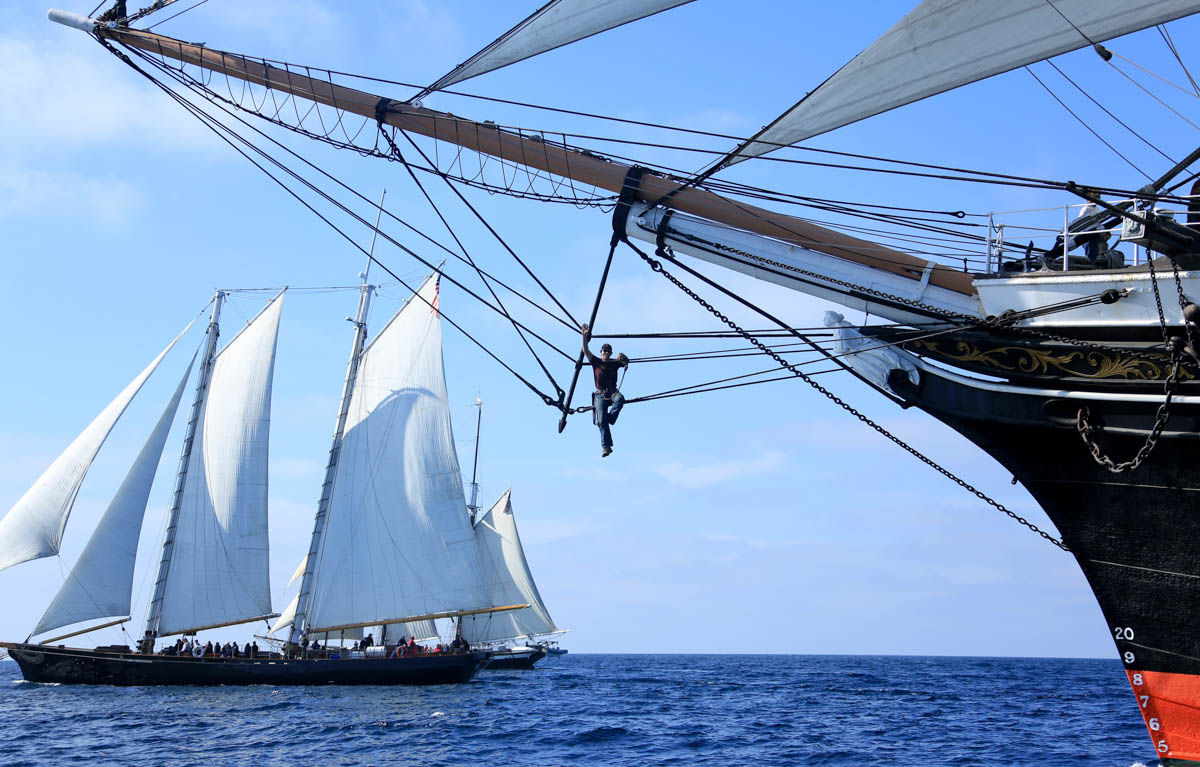
Perhaps in theses pix, can even smell the salt air. These are all shipside tho. MANY ports had capstans on shore, still some remain. A rowboat could drag light rope behind them to connect shore to boat then pull real rope or chain to shore for commerce the town needed, or even save lives. Same many men cranking away thru even great levers to get the raw, hard, gritty work done, even thru storm raging in; this was the life.
This can be taking a 'purchase' from loaded side of capstan, to the un or less loaded side of capstan or other friction buffer. Pulleys instead of capstan setup can give linear purchases, more nominal 1xCosine of each leg, but leveraging across at the Samson 90 degree angle bring MULTIPLICATION of force per leg(rather than pulley ADDITIVE that is also at more friction and rope cost$). So simplest single leg, minimal tools tension increase i think is to take the 'purchase' is via other old world terms of "swig/sweat".
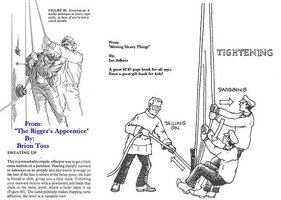 as like this broken to 2 lines of separate functions of sweat/swig and keep to 2 ropes (youtube link):
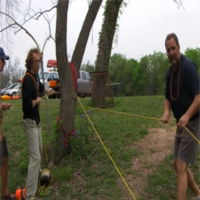
or this prized piece from the ol'daze of the original tree climber open chat site ISA.bbs, as what we call forum now;
where we see in a speedline the swig/sweat effect gathered to work against us if let it, suddenly tightening rope out of our hands without the Prussic as a 1 way capture, into the capstan as friction buffer to control the sudden pulses of the sweat/swig effect impacting line HARD.
So, so much brought to us in this sea heritage, but hardly not all.
For millions of years previously to even the idea of controlling boat so;
Rock, wood and homemaid rope where all the building materials available;
And the rope the most repeatable, reusable and easiest to form of the 3.
Thus have always tried to show, as see now echoed hear; that rope work as a MAJOR part of our understandings or engineering etc., that even challenged our brains to growth etc.
But alas, the least evidence, as vines and leather rot away much faster than the wood and stone; a byproduct of being the most usable and formable. But logically, gathering and even linking forces of individual parts aligned to single task, that must be done in specific order or fail; as the start of engineering outside of self, that even shows in computer programs of gathering and aligning in the correct order or fail hopelessly!
Rope got us linking several mechanics to one as like rock tied to stick for hammer and on, as rope helped clothe, shelter, feed etc. as it challenged the minds of our kind.
.
.
Thus i think an aim of or/or should be of scouting, is not just how many knots can tie, or for what for;
but rather to step young minds thru this heritage of mental development.
As like the reference have picked up over studies, of yoga tracing the animate stages of existence; gathering the best at different levels of 'evolution' , to bring in, and not lose across time. Scout knotting can as like , walk thru these stages of development, that brought us here, with less loss; in the 'journey not destination' type focus; as a heritage of such. Partially, because they are not all cut out to be tree nor old world boat folk; that can give this raw education.














 sdmaritime.org