Let's talk redirects

flyingmosstreen

Participating member
Location
Rochester
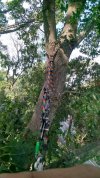
Recently went to a class called "Advanced Climbing Techniques."

I would have liked to hear more about redirects so I thought I would poke the bear here.

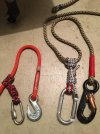
I'll start off with this retrievable option. It is finicky but when set correctly will fall right down to you once at your desired location... If not set properly you might have a sketchy haul back up, say if you went to retrieve and it only pulled through two of the half hitches and left you climbing on a single half hitch.

I would love to hear what people use on a regular day to day basis.

This is my weekend rec. setup usually I am running hitch based system for work.
 

Attachments

  • KIMG2142.JPG
    KIMG2142.JPG
    706.2 KB · Views: 127
I don't really use fancy retrievable redirects (RRDs), besides natural crotch or the ol' sling and 'biner (SAB), in production settings. I definitely see the purpose of using RRDs, but despite the fact that I know several different ways to do it, its almost never the way I decide to work a tree. I'm going to attempt to explore why I think that is in the wall of text below.

From what I've experienced, there are two main use cases for redirects: (1) Getting out into the fine tips of long branches or tops, or (2) working a whole second stem at a distance from the main tie in. I will assume we're discussing pruning here, and we can't just wrap our line around a stub, which is probably the least compromised redirect solution available. As long as you're not the tree.

(1) Using a redirect to get out into very small tips.
The thing that make this challenging is that you might break branches if you put a normal force on them, so you can't just lanyard in, slack out a bunch of your climbing line, and fiddle around tying elaborate knots while hanging off a 2" branch at a 45 degree angle. This is where I use a SAB, specifically an ORCA from Rock Exotica, because I can hold the tension in the climbing line while quickly pulling the line into the biner, and never take the branch out of compression. The ORCA lock allows me to preset the biner to make clipping it much smoother with one hand, since my other hand will be maintaining tension on the climb line. In this sort of situation, unweighting the climb line to tie an RRD may be impossible without damaging the tree and risking injury.

Further, if you did manage to construct an RRD, and you've moved down the canopy to work the tips below your redirect, and now you want to pull your redirect and swing back to below your TIP, its not going to work. You've just climbed over dozens of branches, and the only way you're getting your rope back is if you climb up and over all of that canopy, which will take you right back to your redirect, making its retrievability irrelevant.

(As a side complaint, many, but not all, RRDs require a certain amount of slop where they are tied to the branch. There's nothing explicitly wrong with this, but its something that does irritate me because it changes the rope angle slightly from how I usually imagine it before setting up. This happens with the SAB, but its easier to predict and trim.)

(2) Using a redirect to work a distant second stem.
This is where a retrievable redirect makes more sense, and my reasons for not using them is usually personal preference. Most RRDs require at lease a second leg of line to be running parallel with the leg you'd be climbing on. In some cases, there are 3 legs total, as in the SCAM. In most cases for RRDs, you need at least double or triple the height of your work in rope length. This is a personal gripe, but carrying around 3 times as much rope as I need makes my skin crawl. Its worse if there are big bights hanging below me waiting for branches to fall into them, and multiple parallel lines hanging around in front of my face and wrapping up on my climb line.

I'm not sure what the benefit of setting an RRD would be over using the tail of your rope as a second MRS system. I still rarely do this because I dislike the bight hanging below me, but I still think its more elegant than an RRD: Its easier to retrieve, it gives you more positioning options since you have two TIPs, and the fact that you don't have rope-walking capability is irrelevant since you're planning on retrieving it remotely anyways.

The techniques I usually use are still compromised, and I am in no way suggesting that they are the right way to do things, but its what I prefer. they all employ as second rope which some people find frustrating, however if you're using the tail of you're rope you're also using two ropes, they just happen to already be stuck to each other. I'd rather they be fully separate.

I use a captain hook a lot. I keep about 60' of rope on mine so I can work most of any tree with it as if it were a normal climbing system. obviously this is gear intensive, and it has like a 50% chance of being the biggest pain in the ass of your life, but its remotely settable and retrievable, doesn't leave extra rope dangling around, and offers SRT efficiency.

I also use a second climb line. I will either send it all the way down and nicely ask one of the earthlings to tie me a base anchor (making it remotely settable and retrievable!), or I tie an canopy anchor and walk my ass all the way back up there when I'm done. Again, both of these have obvious downsides, but its all on set up and take down. The actual working of the tree is streamlined by avoiding over crowding ropes and having bights and extra rope hanging around in my work space.

That last sentence pretty well sums up the big deal for me. I like the actual working of the tree to be as efficient and intuitive as possible, so that I can do the best work. I'm fine with adding a little bit of extra gear or effort at the end of a climb if it means I save effort throughout the day by not wrestling with a spiderweb of complex rope systems which are all trying to do what a simpler rope system can achieve. Usually, there's a block I need to go get anyways.

 
I don't really use fancy retrievable redirects (RRDs), besides natural crotch or the ol' sling and 'biner (SAB), in production settings. I definitely see the purpose of using RRDs, but despite the fact that I know several different ways to do it, its almost never the way I decide to work a tree. I'm going to attempt to explore why I think that is in the wall of text below.

From what I've experienced, there are two main use cases for redirects: (1) Getting out into the fine tips of long branches or tops, or (2) working a whole second stem at a distance from the main tie in. I will assume we're discussing pruning here, and we can't just wrap our line around a stub, which is probably the least compromised redirect solution available. As long as you're not the tree.

(1) Using a redirect to get out into very small tips.
The thing that make this challenging is that you might break branches if you put a normal force on them, so you can't just lanyard in, slack out a bunch of your climbing line, and fiddle around tying elaborate knots while hanging off a 2" branch at a 45 degree angle. This is where I use a SAB, specifically an ORCA from Rock Exotica, because I can hold the tension in the climbing line while quickly pulling the line into the biner, and never take the branch out of compression. The ORCA lock allows me to preset the biner to make clipping it much smoother with one hand, since my other hand will be maintaining tension on the climb line. In this sort of situation, unweighting the climb line to tie an RRD may be impossible without damaging the tree and risking injury.

Further, if you did manage to construct an RRD, and you've moved down the canopy to work the tips below your redirect, and now you want to pull your redirect and swing back to below your TIP, its not going to work. You've just climbed over dozens of branches, and the only way you're getting your rope back is if you climb up and over all of that canopy, which will take you right back to your redirect, making its retrievability irrelevant.

(As a side complaint, many, but not all, RRDs require a certain amount of slop where they are tied to the branch. There's nothing explicitly wrong with this, but its something that does irritate me because it changes the rope angle slightly from how I usually imagine it before setting up. This happens with the SAB, but its easier to predict and trim.)

(2) Using a redirect to work a distant second stem.
This is where a retrievable redirect makes more sense, and my reasons for not using them is usually personal preference. Most RRDs require at lease a second leg of line to be running parallel with the leg you'd be climbing on. In some cases, there are 3 legs total, as in the SCAM. In most cases for RRDs, you need at least double or triple the height of your work in rope length. This is a personal gripe, but carrying around 3 times as much rope as I need makes my skin crawl. Its worse if there are big bights hanging below me waiting for branches to fall into them, and multiple parallel lines hanging around in front of my face and wrapping up on my climb line.

I'm not sure what the benefit of setting an RRD would be over using the tail of your rope as a second MRS system. I still rarely do this because I dislike the bight hanging below me, but I still think its more elegant than an RRD: Its easier to retrieve, it gives you more positioning options since you have two TIPs, and the fact that you don't have rope-walking capability is irrelevant since you're planning on retrieving it remotely anyways.

The techniques I usually use are still compromised, and I am in no way suggesting that they are the right way to do things, but its what I prefer. they all employ as second rope which some people find frustrating, however if you're using the tail of you're rope you're also using two ropes, they just happen to already be stuck to each other. I'd rather they be fully separate.

I use a captain hook a lot. I keep about 60' of rope on mine so I can work most of any tree with it as if it were a normal climbing system. obviously this is gear intensive, and it has like a 50% chance of being the biggest pain in the ass of your life, but its remotely settable and retrievable, doesn't leave extra rope dangling around, and offers SRT efficiency.

I also use a second climb line. I will either send it all the way down and nicely ask one of the earthlings to tie me a base anchor (making it remotely settable and retrievable!), or I tie an canopy anchor and walk my ass all the way back up there when I'm done. Again, both of these have obvious downsides, but its all on set up and take down. The actual working of the tree is streamlined by avoiding over crowding ropes and having bights and extra rope hanging around in my work space.

That last sentence pretty well sums up the big deal for me. I like the actual working of the tree to be as efficient and intuitive as possible, so that I can do the best work. I'm fine with adding a little bit of extra gear or effort at the end of a climb if it means I save effort throughout the day by not wrestling with a spiderweb of complex rope systems which are all trying to do what a simpler rope system can achieve. Usually, there's a block I need to go get anyways.

This is all the most reasonable advice I have heard. A sling and biner usually is the go to. I pretty much know I will be back to that point in the tree in my work setting most of the time.

And a basal anchor definitely gives you as many redirects as you want through a natural crotch
 
This is all the most reasonable advice I have heard. A sling and biner usually is the go to. I pretty much know I will be back to that point in the tree in my work setting most of the time.

And a basal anchor definitely gives you as many redirects as you want through a natural crotch
Yep, I’m 100% in line with Flying-Squirrel’s redirect manifesto.

All the innovation going into retrievable redirects is so cool but… not there yet for me. The cost (of dragging an extra leg or loop of rope around) exceeds the benefits of a retrievable redirect for the way I climb.

I really want the tail of any line that I’m using free not captured.
-AJ
 
Last edited:
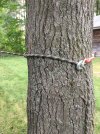
This is an idea that I only tested a little, but seems promising. First tried a snap hook with a gate to prevent snagging when retrieving. Then went to a small grab hook that the rope snuggly fits in, and is on a friction hitch to be able to squeeze the tree. As long as the climber stayed below the hook, adding slack to either side of the redirect didn’t loosen it. It took a little effort to release it, and there may be a optimal spread around the tree for best holding???
3D7FA1DF-3329-4716-9A82-480FB38CB880.jpeg
6123FC13-6CA4-458F-B0CB-C3E0391EEB36.jpeg
 
I don't really use fancy retrievable redirects (RRDs), besides natural crotch or the ol' sling and 'biner (SAB), in production settings. I definitely see the purpose of using RRDs, but despite the fact that I know several different ways to do it, its almost never the way I decide to work a tree. I'm going to attempt to explore why I think that is in the wall of text below.

From what I've experienced, there are two main use cases for redirects: (1) Getting out into the fine tips of long branches or tops, or (2) working a whole second stem at a distance from the main tie in. I will assume we're discussing pruning here, and we can't just wrap our line around a stub, which is probably the least compromised redirect solution available. As long as you're not the tree.

(1) Using a redirect to get out into very small tips.
The thing that make this challenging is that you might break branches if you put a normal force on them, so you can't just lanyard in, slack out a bunch of your climbing line, and fiddle around tying elaborate knots while hanging off a 2" branch at a 45 degree angle. This is where I use a SAB, specifically an ORCA from Rock Exotica, because I can hold the tension in the climbing line while quickly pulling the line into the biner, and never take the branch out of compression. The ORCA lock allows me to preset the biner to make clipping it much smoother with one hand, since my other hand will be maintaining tension on the climb line. In this sort of situation, unweighting the climb line to tie an RRD may be impossible without damaging the tree and risking injury.

Further, if you did manage to construct an RRD, and you've moved down the canopy to work the tips below your redirect, and now you want to pull your redirect and swing back to below your TIP, its not going to work. You've just climbed over dozens of branches, and the only way you're getting your rope back is if you climb up and over all of that canopy, which will take you right back to your redirect, making its retrievability irrelevant.

(As a side complaint, many, but not all, RRDs require a certain amount of slop where they are tied to the branch. There's nothing explicitly wrong with this, but its something that does irritate me because it changes the rope angle slightly from how I usually imagine it before setting up. This happens with the SAB, but its easier to predict and trim.)

(2) Using a redirect to work a distant second stem.
This is where a retrievable redirect makes more sense, and my reasons for not using them is usually personal preference. Most RRDs require at lease a second leg of line to be running parallel with the leg you'd be climbing on. In some cases, there are 3 legs total, as in the SCAM. In most cases for RRDs, you need at least double or triple the height of your work in rope length. This is a personal gripe, but carrying around 3 times as much rope as I need makes my skin crawl. Its worse if there are big bights hanging below me waiting for branches to fall into them, and multiple parallel lines hanging around in front of my face and wrapping up on my climb line.

I'm not sure what the benefit of setting an RRD would be over using the tail of your rope as a second MRS system. I still rarely do this because I dislike the bight hanging below me, but I still think its more elegant than an RRD: Its easier to retrieve, it gives you more positioning options since you have two TIPs, and the fact that you don't have rope-walking capability is irrelevant since you're planning on retrieving it remotely anyways.

The techniques I usually use are still compromised, and I am in no way suggesting that they are the right way to do things, but its what I prefer. they all employ as second rope which some people find frustrating, however if you're using the tail of you're rope you're also using two ropes, they just happen to already be stuck to each other. I'd rather they be fully separate.

I use a captain hook a lot. I keep about 60' of rope on mine so I can work most of any tree with it as if it were a normal climbing system. obviously this is gear intensive, and it has like a 50% chance of being the biggest pain in the ass of your life, but its remotely settable and retrievable, doesn't leave extra rope dangling around, and offers SRT efficiency.

I also use a second climb line. I will either send it all the way down and nicely ask one of the earthlings to tie me a base anchor (making it remotely settable and retrievable!), or I tie an canopy anchor and walk my ass all the way back up there when I'm done. Again, both of these have obvious downsides, but its all on set up and take down. The actual working of the tree is streamlined by avoiding over crowding ropes and having bights and extra rope hanging around in my work space.

That last sentence pretty well sums up the big deal for me. I like the actual working of the tree to be as efficient and intuitive as possible, so that I can do the best work. I'm fine with adding a little bit of extra gear or effort at the end of a climb if it means I save effort throughout the day by not wrestling with a spiderweb of complex rope systems which are all trying to do what a simpler rope system can achieve. Usually, there's a block I need to go get anyways.

Nailed it 110%. I couldn't have ever put it in to words but this is exactly how I feel.
I use a sling, carabiner, and a prussic. I'll use the prussic on the climbing line and sling on the tree and now I can tension everything to load the redirect exactly how I want.
 
This is an idea that I only tested a little, but seems promising. First tried a snap hook with a gate to prevent snagging when retrieving. Then went to a small grab hook that the rope snuggly fits in, and is on a friction hitch to be able to squeeze the tree. As long as the climber stayed below the hook, adding slack to either side of the redirect didn’t loosen it. It took a little effort to release it, and there may be a optimal spread around the tree for best holding???
View attachment 83499
View attachment 83500
That hook based trunk choke is pretty interesting. Gives me ideas, thx Brocky!
-AJ
 

New threads New posts

Kask Stihl NORTHEASTERN Arborists Wesspur TreeStuff.com Teufelberger Westminster X-Rigging Teufelberger
Back
Top Bottom