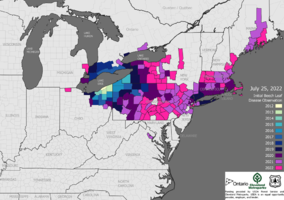
Beech Leaf Disease

I’ve been involved in 3 different trials now and none have been promising. Trunk macro Injections, foliar and soil injections.

Will be visiting a trial site next week. But I’ve already been there earlier in the year and things did not look good.
 
I’ve been involved in 3 different trials now and none have been promising. Trunk macro Injections, foliar and soil injections.

Will be visiting a trial site next week. But I’ve already been there earlier in the year and things did not look good.
Well, that isn't promising.

Using what products? (Or if you can't say what specific products, what were the treatments targeting? - fungicides, insecticicides, miticides, etc...)
 
Well, that isn't promising.

Using what products? (Or if you can't say what specific products, what were the treatments targeting? - fungicides, insecticicides, miticides, etc...)
I’m not sure if I can mention the products, but all three were insecticides trying to target the nematodes. There’s no intention to keep anything under wraps if a treatment is found.

Best recommendation right now that I’m being told is fortify the trees natural defense systems with high potassium ferts or a potassium phosphate fungicide like reliant or agrifos.
 
I did the PHC program on a Fagus sylvatica hedge of 6000 plants planted 12" on center, planted in 2004. As of last year the hedge was kept at 6 feet in height, in a row of 3, a 3rd of a mile in length. A sort of Labyrinth and Art on a high value property in New Jersey.

Last season still no BLD symptoms. As preventative measure Potassium Phosphite was used in a cover spray in July......I understood the Fungistatic properties as well as the insecticidal properties of K-Phite. A nice PHC tool to have in the toolbox........

Over the winter I was keeping an eye on the Label of Luna Experience, in Hopes that some supplemental labeling would come out, allowing application on Ornamentals in the Landscape setting.

Fluopyram was the A.I. of interest.

The Timing of Foliar Application "Timing Window" was also in my Thought process, as the Nematode enters the next seasons buds in Late Summer, early Fall. Leaf litter, Bird Vectors??? ect.

Here is a study on Fluopyram Half-Life on Pepper leaves in the open field:

https://www.tandfonline.com/doi/abs/10.1080/03067319.2019.1704745?needAccess=true&journalCode=geac20

13-15 days on leaf before degradation. Perhaps with Nu Film P that could be extended (UV Protection) Slowing of Redox Reactions perhaps as well???

I will be following this topic as well as elsewhere to see what will work, and how we can legally protect the Beech from this Eelworm/Nematode pest.
 
That was our foliar trial, poor results. I want to say no efficacy. My test tree was a very large weeping copper beech, and I did not hear if it was better with smaller trees.
Wonder if it would be better as a systemic (I know mauget has Abacide 2, for example). The only nematode mention on the label is pinewood wilt nematode. However, suppose if you wanted to preventatively treat for gypsy moth, or if you saw some evidence of bark beetles, roundhead beetles or beech blight aphids...
 
Wonder if it would be better as a systemic (I know mauget has Abacide 2, for example). The only nematode mention on the label is pinewood wilt nematode. However, suppose if you wanted to preventatively treat for gypsy moth, or if you saw some evidence of bark beetles, roundhead beetles or beech blight aphids...
We were able to stay on label with the presence of beech aphids. The other stuff we needed research permits for off label applications.
 
@GregManning can this be re-named beech leaf disease?
Done - Beech Leaf Disease

Hope this doesn't confused too many folks, since the original reference has been quoted numerous times.

 
Last edited:
Has there been any testing on Litylenchus crenatae with this product for BLD to anyone's Knowledge?

None to mine but I will ask around. There’s some promising products and trials upcoming.

My one concern is safety of applicator with the nemocides. According to a colleague nemotodes are most closely related to humans and those products can be much more toxic to humans. Some products are labeled as fungicides but have nemocidal properties. Not sure how vigorous testing for safety is if they’re labeled as the latter.
 
None to mine but I will ask around. There’s some promising products and trials upcoming.

My one concern is safety of applicator with the nemocides. According to a colleague nemotodes are most closely related to humans and those products can be much more toxic to humans. Some products are labeled as fungicides but have nemocidal properties. Not sure how vigorous testing for safety is if they’re labeled as the latter.
Any pesticide will have SDS data including mammalian toxicity for ingested, dermal, eye, and inhalation exposures.
 
Any pesticide will have SDS data including mammalian toxicity for ingested, dermal, eye, and inhalation exposures.
I know that. I think my concern stems from does their sds sheet only look at it as a fungicide, if that’s what it’s labeled as, or will it go further. Do they test nematocides the same as a fungi?

I could see the different label changing signal words.
 
I know that. I think my concern stems from does their sds sheet only look at it as a fungicide, if that’s what it’s labeled as, or will it go further. Do they test nematocides the same as a fungi?

I could see the different label changing signal words.
I don't know with certainty...but I'm pretty sure the SDS material and information remains the same regardless of intended use or application method. I think it is a chemical analysis, not a product as it is used thing

Even if a product were only labeled for trunk injected, for example, it would still have the same inhalation data as a product that is labeled to be applied with a fogger.

(same data as in the product has been researched for inhalation hazarda - not the same information in that data, obviously)
 
I don't know with certainty...but I'm pretty sure the SDS material and information remains the same regardless of intended use or application method. I think it is a chemical analysis, not a product as it is used thing

Even if a product were only labeled for trunk injected, for example, it would still have the same inhalation data as a product that is labeled to be applied with a fogger.

(same data as in the product has been researched for inhalation hazarda - not the same information in that data, obviously)
Good to know. Thanks for clearing that up. That’s what I had hoped but was not too sure.
 
  • Like
Reactions: ATH
I don't know with certainty...but I'm pretty sure the SDS material and information remains the same regardless of intended use or application method. I think it is a chemical analysis, not a product as it is used thing

Even if a product were only labeled for trunk injected, for example, it would still have the same inhalation data as a product that is labeled to be applied with a fogger.

(same data as in the product has been researched for inhalation hazarda - not the same information in that data, obviously)
I would agree with that - the SDS will not change, as the SDS is a Safety Data Sheet, it concerns only the health and safety of the chemical, and has nothing to do with its use or efficacy.

The label may be different if it’s blended in a formulation for nematodes rather than fungi, and the safety recommendations there may be different due to a difference in the application method, but the SDS for the active ingredient will not change.
 

New threads New posts

Kask Stihl NORTHEASTERN Arborists Wesspur TreeStuff.com Teufelberger Westminster X-Rigging Teufelberger
Back
Top Bottom