












Navigation
Install the app
How to install the app on iOS
Follow along with the video below to see how to install our site as a web app on your home screen.
Note: This feature may not be available in some browsers.
More options
You are using an out of date browser. It may not display this or other websites correctly.
You should upgrade or use an alternative browser.
You should upgrade or use an alternative browser.
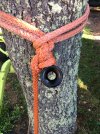
Is this tied wrong?
- Thread starter Wrangler
- Start date

TreeVB
Branched out member
- Location
- Boise, Idaho
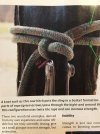
The tail is exiting away from the bight. What you are seeing is the half hitch which is required as a backup to finish the knot, although I do believe there are supposed to be two half hitches. I would still consider this tied wrong as a cow hitch is still directional. This being a block and the force pulling down, the first wrap around the terminating end should have come from the bottom up, not from the top down.

Serf Life
Been here much more than a while
- Location
- Maine Island
I had a question about that article too. It says the cow hitch is in basket configuration and doubles the strength while also stating it is effectively a girth hitch. I thought cow hitch was a girth hitch configuration which would be less than double?
I would think of cow hitch as closer to choker configuration than basket configurationI had a question about that article too. It says the cow hitch is in basket configuration and doubles the strength while also stating it is effectively a girth hitch. I thought cow hitch was a girth hitch configuration which would be
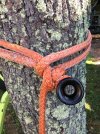
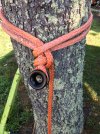
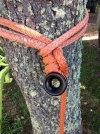

That’s what I’m wondering, what are the details that make a difference with this knot? I have never had a problem with it loosening , has anyone else?That said, I'm not super sure that it has any effect on strength

Tony
Carpal tunnel level member
- Location
- Lancaster, PA
You are all right! Many details here. In my in-field experience, the half hitch direction does not make a difference in strength or stability when the knot is loaded normally. years ago in some very unscientific knot breaking sessions, I found the same. I mention those sessions not as proof of anything, but I did notice the cow hitch did behave in breaking much more like a basket hitch, than a true choked configuration. I always attributed this to the amount of rope in the not comparably.That’s what I’m wondering, what are the details that make a difference with this knot? I have never had a problem with it loosening , has anyone else?
Futhermore, years of teaching in the field have led me to describe the cow hotch as more basket than choker. Seems gals and guys just seem to grasp it better When describing how to tie and how to load the knot. I would agree in it truest form it is a choking type knot.
However, much like breaking sessions those fine details make little difference in the field. There are so many variables that cannot be accounted for when you are deliberately trying to break rope in a controlled setting. The materials we have access to are very strong and “testing” numbers are often way more than a thoughtful arborist with good judgement would ever generate while rigging. Not to mention the weakest link is often the tree!
It has always been a challenge in writting artilces trying to find a practical balance between theory and practice, data and in-field experience. I appreciate the comments/ feedback and mostly the time you chose to spend with me and my thoughts vicariously through the medium of reading.
Tony

flyingmosstreen
Participating member
- Location
- Rochester
Two half hitches in opposition is just a girth hitch?
Two half hitches in parallel is a clove?
Two half hitches in parallel is a clove?
Tony
Carpal tunnel level member
- Location
- Lancaster, PA
I would say no.Two half hitches in opposition is just a girth hitch?
Two half hitches in parallel is a clove?
2 half hitches is indeed a clove.
A girth hitch lacks the change in direction of a loaded half hitch.
Tony

When I tie a cow hitch as a termination of a crane sling,, I’ve been thinking about my last half hitch finish to be around the stem, and in the opposite direction of pull, not the standing part of line.
One would rarely have enough sling length to accomplish this when tying off a block to a larger diameter trunk section. I do think the effect of the tail doing something “useful” beyond the bar would make a difference. Testing would be required, but I often have a marl or two above the cow hitch anyway, so it probably makes no difference.
Subjective. Personal taste so long as it is truly safe and effective.
One would rarely have enough sling length to accomplish this when tying off a block to a larger diameter trunk section. I do think the effect of the tail doing something “useful” beyond the bar would make a difference. Testing would be required, but I often have a marl or two above the cow hitch anyway, so it probably makes no difference.
Subjective. Personal taste so long as it is truly safe and effective.












New threads New posts
-
test
-
 Free CEUs: February 05 & March 05 - 'Urban Forestry Today' Webcasts @ Noon (Eastern)
- Started by UFT
- Replies: 0
-

-

-
-
-








