













Oslo was a terrible tragedy for sure. In the 3 days since that shooting there have been 11 mass shootings in the US, with 6 dead and 53 wounded.D. At least I would be able to protect myself from a potential rapist, then.
Have you heard about what occurred in Oslo, Norway two days ago? I also believe Norway, which I would consider a first world country, has fairly strict gun laws.
Sent from my SM-G970U1 using Tapatalk
Navigation
Install the app
How to install the app on iOS
Follow along with the video below to see how to install our site as a web app on your home screen.
Note: This feature may not be available in some browsers.
More options
You are using an out of date browser. It may not display this or other websites correctly.
You should upgrade or use an alternative browser.
You should upgrade or use an alternative browser.
Roe v Wade overturned
- Thread starter Boomslang
- Start date
You're right, I don't live in the USA...thankfullyPretty sure that you don't live in the USA, so you don't have a say in our law, constitution or way of life. Thankfully.
The cowardice and dishonesty flows out of you like water out of a faucet. TTFNHere let me help you some. Here is a screen shot of the first few quotes you put above...you missed a line and also repeated things..
View attachment 82611
I am actually blaming both parties. I think the other one was earlier in the thread. Which is also a true state. There are a lot of cities with very strict gun laws but that hasn't prevented gun violence, gang shootings etc.

climbhightree
Branched out member
- Location
- Lebanon, Pa USA
Your entitled to your opinion, and I am entitled to mine. I have not been dishonest to my beliefs etc. I'm not sure where the cowardice comes in here. I'm surely not being a coward and bending in the face of your agression, to believe in what you believe.The cowardice and dishonesty flows out of you like water out of a faucet. TTFN
BTW did you leave yet?


Reach
Been here much more than a while
- Location
- Atglen, PA
I would concur with that. Life beginning at conception, while the Bible affirms it to be true, seems to be a clearly defined fact by modern secular science. The articles cited in previous posts prove that.I think life begins at conception on logical grounds: not religious or moral.
The religion and morality come into the question of terminating it or not.
I guess most of the advocates of abortion , a strangely agitated and excited group , focus on trying to come up with a more illogical time to call it life because they can't deal with the moral or religious ramifications of that.
Morality, and the religious basis that defines the moral absolutes I hold to be true, sets my personal standards which determine the murder of an unborn child to be wrong.
In order to justify abortion as right and murder of a person after birth as wrong, one must define a point where that person is not living, or it is impossible to differentiate between abortion and murder. It is not logical, but it has become commonplace because we humans want to justify our sins and so we must make up our own rules to match our desires.

Based on science is a fine response. There's no correct or incorrect answer. I'm only seeking further understanding of how people developed views different than my own, not an argument. If your interpretation of science contributed to forming your views or affirms your views, that's valid.Here's another:
I Asked Thousands of Biologists When Life Begins. The Answer Wasn't Popular
The U.S. abortion debate has raged for generations, and remains divisive to this day.quillette.com

Sent from my SM-G970U1 using Tapatalk
I get tickled by a close friend who always has definite opinions on current political events. However, he rarely watches or reads anything that would allow him to have an informed opinion. He apparently just grabs an opinion from the aether that fits what he wants to be true.
P.S. - A survey that says 92% [of the American] respondents were democrats makes me raise an eyebrow. I wonder about how the sample group was chosen and if the "usable" responses weren't cherry picked. Sure doesn't seem like a random group would be 92% democrats.


Quillette - Bias and Credibility
QUESTIONABLE SOURCE A questionable source exhibits one or more of the following: extreme bias, consistent promotion of propaganda/conspiracies, poor or no
 mediabiasfactcheck.com
New Texas abortion laws will be forcing young women who were the victims of rape and incest to carry their pregnancies to term.
Governor Abbotts says he is gonna fix it all by ending all rape in Texas, so I would be remiss if I didn’t point out the fact that in 2020 Texas lead the nation in forcible raped cases…
https://www.insider.com/texas-abortion-ban-would-block-teen-raped-by-grandfather-2021-5
https://www.cbsnews.com/news/texas-abortion-law-governor-abbott-rape-victims-six-weeks/
https://www.statista.com/statistics/232524/forcible-rape-cases-in-the-us-by-state/#:~:text=In 2020, Texas had the,States, with 13,509 reported rapes.
Welcome the the stone ages folks. Tyranny by the minority courtesy of the American Taliban
Governor Abbotts says he is gonna fix it all by ending all rape in Texas, so I would be remiss if I didn’t point out the fact that in 2020 Texas lead the nation in forcible raped cases…
https://www.insider.com/texas-abortion-ban-would-block-teen-raped-by-grandfather-2021-5
https://www.cbsnews.com/news/texas-abortion-law-governor-abbott-rape-victims-six-weeks/
https://www.statista.com/statistics/232524/forcible-rape-cases-in-the-us-by-state/#:~:text=In 2020, Texas had the,States, with 13,509 reported rapes.
Welcome the the stone ages folks. Tyranny by the minority courtesy of the American Taliban
Last edited:
Thanks for posting that. Gee, why am I not surprised?Quillette - Bias and Credibility
QUESTIONABLE SOURCE A questionable source exhibits one or more of the following: extreme bias, consistent promotion of propaganda/conspiracies, poor or no
With the overwhelming amount of misinformation online, I find it surprising that so many people put faith in information that appears suspect or is proven false by a cursory fact check.
If it's important to me (and the accuracy of Quillette is not), I'll do enough investigation to have reasonable confidence in what I'm choosing to believe.

evo
Been here much more than a while
- Location
- My Island, WA
Doesn't matter in my book, we all know there are peer pressures from other students and staff alike. I really don't think my schoolin years was very unique from other places in the country. Now if the kids choose to hold their own, that is a different matter entirely. Coming from a federal institution a much better approach would be "alright kids, if any of you want to pray now's the time".. "leading" a prayer is a different matter all together in my book.Another win for the Constitution, today.
The coach wasn't forcing anyone to pray. They joined (or didnt join) him by their own choice.
WE all know the sub text "come pray to our god if you like..." first few lines of the prayer generally contain something like "and we pray for those who didn't join us so we can save their souls from the fires of hell and condemnation"...
evo
Been here much more than a while
- Location
- My Island, WA
I think you might have misspoken? Did you say Roe vs Wade was a constitutional change? I always thought it was a LEGAL case presented to the court because the constitution mentions rights in which women have the right to choice.I have no problem with that. The Constitution was created in a way that it can be adjusted and changed, through a legal process of the government and the states. Not just judges ruling one way or another. What the current justices did was correct the illegal change, and put back to the states where it belongs. There is a legal process to create law/ammendments.
Please tell me what rights do you feel are allowed to women? Obviously they have the right to do as they wish with their bodies? OR do you feel that the rule of thumb is a constitutional right to men? That was legal in some states too!
It took a legal case and a war to abolish slavery, the constitution didn't mention slavery just like it doesn't have the word 'abortion' but it took a legal interpretation..
Tell me where does the constitution mention women specifically at all?
climbhightree
Branched out member
- Location
- Lebanon, Pa USA
Look up how an amendment can be added to the constitution. Looks up how the 13th amendment was added to the constitution. Look up, how federal laws are created.I think you might have misspoken? Did you say Roe vs Wade was a constitutional change? I always thought it was a LEGAL case presented to the court because the constitution mentions rights in which women have the right to choice.
Please tell me what rights do you feel are allowed to women? Obviously they have the right to do as they wish with their bodies? OR do you feel that the rule of thumb is a constitutional right to men? That was legal in some states too!
It took a legal case and a war to abolish slavery, the constitution didn't mention slavery just like it doesn't have the word 'abortion' but it took a legal interpretation..
Tell me where does the constitution mention women specifically at all?
Judges are not supposed to make laws, just interpret the laws.
Anyone has a right to do what they want with their body, to the medicine they take, the things they eat, even the things that they do or say (as long as it not breaking an established law. The problem is they shouldn't have a right, in my opinion, to kill an innocent life that started to grow inside side them. A life that is just as special and unique as the mother. Right now (as before roe) the power of laws to protect, or not, that innocent life is in the states hands. This is how it should be, not because I think abortion is wrong, but because roe was not a federal law...it was never put through the law process. Even Ruth Bader Ginsburg, and other pro-abortion people, have said there are serious legal issues with Roe and it wasn’t the best way to do it.
Last edited:
climbhightree
Branched out member
- Location
- Lebanon, Pa USA
There are peer pressures in almost all aspects of life (religious ones and non-religious). No one can protect their kid from all peer pressures (heck it happens inside the house too). Plus not all peer pressure, or pressure from authority, is bad. One just has to raise their kids with the strength and fortitude to not bend to it.Doesn't matter in my book, we all know there are peer pressures from other students and staff alike. I really don't think my schoolin years was very unique from other places in the country. Now if the kids choose to hold their own, that is a different matter entirely. Coming from a federal institution a much better approach would be "alright kids, if any of you want to pray now's the time".. "leading" a prayer is a different matter all together in my book.
WE all know the sub text "come pray to our god if you like..." first few lines of the prayer generally contain something like "and we pray for those who didn't join us so we can save their souls from the fires of hell and condemnation"...
40 plus years as a Christian, and most of those as a Mennonite, and I never been part of a prayer like that. Does it happen in some places, yes.
As I stated before, there is evil people in almost every religion, race, and place.
Last edited:
How do you come up with the "judges are not supposed to make laws, just interpret the laws" argument? Roe v Wade isn't a law, it's an interpretation of the law. A slight knowledge of the legal case and ruling should make that obvious.Look up how an amendment can be added to the constitution. Looks up how the 13th amendment was added to the constitution. Look up, how federal laws are created.
Judges are not supposed to make laws, just interpret the laws.
Anyone has a right to do what they want with their body, to the medicine they take, the things they eat, even the things that they do or say (as long as it not breaking an established law. The problem is they shouldn't have a right, in my opinion, to kill an innocent life that started to grow inside side them. A life that is just as special and unique as the mother. Right now (as before roe) the power of laws to protect, or not, that innocent life is in the states hands. This is how it should be, not because I think abortion is wrong, but because roe was not a federal law...it was never put through the law process. Even Ruth Bader Ginsburg, and other pro-abortion people, have said there are serious legal issues with Roe and it wasn’t the best way to do it.
If you wanted to guarantee the right to abortion, Roe v Wade was definitely not a good way to do it precisely because it's NOT A LAW.
I'm at a loss to figure out what changed between Roe v Wade and now to change the interpretation of the law. I think the Constitution is the same. No breakthrough discovery in Biology. The only change seems to be our Supreme Court Justices.
I understand and appreciate the reasoning behind a woman's rights not trampling the rights of an unborn child.
As divided as our country is at this time, I don't envision any constitutional amendments being added in my lifetime. We couldn't get Casual Fridays in congress if the opinions were different across the aisle.

southsoundtree
Been here much more than a while
- Location
- Olympia, WA
So... no men stood up to say if they have or haven't been pressured into sex or raped.
Why?
I'll start. No I know nothing about it from personal experience.
I would be talking out if my ass.
Why?
I'll start. No I know nothing about it from personal experience.
I would be talking out if my ass.
climbhightree
Branched out member
- Location
- Lebanon, Pa USA
I haven't read the recent Supreme Court brief on the abortion case yet. I do plan to. I have heard most of it being read, but I want to read it myself.How do you come up with the "judges are not supposed to make laws, just interpret the laws" argument? Roe v Wade isn't a law, it's an interpretation of the law. A slight knowledge of the legal case and ruling should make that obvious.
If you wanted to guarantee the right to abortion, Roe v Wade was definitely not a good way to do it precisely because it's NOT A LAW.
I'm at a loss to figure out what changed between Roe v Wade and now to change the interpretation of the law. I think the Constitution is the same. No breakthrough discovery in Biology. The only change seems to be our Supreme Court Justices.
I understand and appreciate the reasoning behind a woman's rights not trampling the rights of an unborn child.
As divided as our country is at this time, I don't envision any constitutional amendments being added in my lifetime. We couldn't get Casual Fridays in congress if the opinions were different across the aisle.
But in general here is my take on it. This is a map of the general abortion laws in states prior to Roe v Wade.
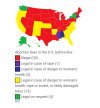
Does it look like abortion was popular with the general public or states at the time? Does it look like it was a time honored tradition or history? That is the stuff the judges are supposed to be looking at when deciding if something is changing, and whether it can be read into the constitution as a right (from my understanding). The 9 judges, on Roe v Wade panel, based their decision on nothing other than they wanted it to be a right...there were no precedents that they based it on.
There is a reason why it is a process to make laws, and an even harder process to make an ammendment. It is to protect against huge swings policies changes at every election. It makes sure the individual states and entire population has a say and voice. Just like the 13th ammendment was added to free slaves (though I feel that the Constitution in general was enough for that...this just made it completely clear) so too an ammendment can be added for abortion and any other topic.
Last edited:
Somehow, I developed the crazy idea that judges are supposed to rule on cases based on a scholarly interpretation of current laws, legal precedent and the Constitution. Having judges rule according to what's popular with the general public sounds scary to me.Does it look like abortion was popular with the general public or states at the time? Does it look like it was a time honored tradition or history? That is the stuff the judges are supposed to be looking at when deciding if something is changing, and whether it can be read into the constitution as a right (from my understanding). The 9 judges, on Roe v Wade panel, based their decision on nothing other than they wanted it to be a right...there were no precedents that they based it on.
If the general public wants change to support popular opinion, I believe the plan calls for that to take place through the Legislative branch, not the Judiciary. Constituents should push lawmakers to make laws or change laws. If those lawmakers won't oblige, vote 'em out and get new ones.
Your statement about the Justices ruling on Roe v Wade based on nothing other than they wanted it to be a right makes me think you've not read the opinion. Here's an excerpt:
"This right of privacy, whether it be founded in the Fourteenth Amendment's concept of personal liberty and restrictions upon state action, as we feel it is, or, as the District Court determined, in the Ninth Amendment's reservation of rights to the people, is broad enough to encompass a woman's decision whether or not to terminate her pregnancy."
[page 153 of the October Term, 1972]
It's interesting reading, but I've not yet made it through all 66 pages. It's a few clicks away at the Library of Congress.
You didn't say if you're still standing by your "judges are not supposed to make laws, just interpret the laws" statement. Care to address that?
P.S. - Landmark cases are usually that because of the lack of precedent.
climbhightree
Branched out member
- Location
- Lebanon, Pa USA
As to the role of Supreme Court judges.Somehow, I developed the crazy idea that judges are supposed to rule on cases based on a scholarly interpretation of current laws, legal precedent and the Constitution. Having judges rule according to what's popular with the general public sounds scary to me.
If the general public wants change to support popular opinion, I believe the plan calls for that to take place through the Legislative branch, not the Judiciary. Constituents should push lawmakers to make laws or change laws. If those lawmakers won't oblige, vote 'em out and get new ones.
Your statement about the Justices ruling on Roe v Wade based on nothing other than they wanted it to be a right makes me think you've not read the opinion. Here's an excerpt:
"This right of privacy, whether it be founded in the Fourteenth Amendment's concept of personal liberty and restrictions upon state action, as we feel it is, or, as the District Court determined, in the Ninth Amendment's reservation of rights to the people, is broad enough to encompass a woman's decision whether or not to terminate her pregnancy."
[page 153 of the October Term, 1972]
It's interesting reading, but I've not yet made it through all 66 pages. It's a few clicks away at the Library of Congress.
You didn't say if you're still standing by your "judges are not supposed to make laws, just interpret the laws" statement. Care to address that?
P.S. - Landmark cases are usually that because of the lack of precedent.
From WH.gov
Although the Supreme Court may hear an appeal on any question of law provided it has jurisdiction, it usually does not hold trials. Instead, the Court’s task is to interpret the meaning of a law, to decide whether a law is relevant to a particular set of facts, or to rule on how a law should be applied.
From SupremeCourt.gov
The complex role of the Supreme Court in this system derives from its authority to invalidate legislation or executive actions which, in the Court’s considered judgment, conflict with the Constitution. This power of "judicial review" has given the Court a crucial responsibility in assuring individual rights, as well as in maintaining a "living Constitution" whose broad provisions are continually applied to complicated new situations.
When the Supreme Court rules on a constitutional issue, that judgment is virtually final; its decisions can be altered only by the rarely used procedure of constitutional amendment or by a new ruling of the Court. However, when the Court interprets a statute, new legislative action can be taken.
Last edited:
I appreciate the factual posting. It agrees perfectly with my views, but does not much support your view, as I understand it. I see nothing about ruling to support what's popular with the public or states, or in accordance with tradition or history.As to the role of Supreme Court judges.
From WH.gov
Although the Supreme Court may hear an appeal on any question of law provided it has jurisdiction, it usually does not hold trials. Instead, the Court’s task is to interpret the meaning of a law, to decide whether a law is relevant to a particular set of facts, or to rule on how a law should be applied.
From SupremeCourt.gov
The complex role of the Supreme Court in this system derives from its authority to invalidate legislation or executive actions which, in the Court’s considered judgment, conflict with the Constitution. This power of "judicial review" has given the Court a crucial responsibility in assuring individual rights, as well as in maintaining a "living Constitution" whose broad provisions are continually applied to complicated new situations.
When the Supreme Court rules on a constitutional issue, that judgment is virtually final; its decisions can be altered only by the rarely used procedure of constitutional amendment or by a new ruling of the Court. However, when the Court interprets a statute, new legislative action can be taken.
Prior legal precedent is considered, as is obvious if you read the Roe v Wade opinion.
And for the 2nd time...
You didn't say if you're still standing by your "judges are not supposed to make laws, just interpret the laws" statement. Care to address that?
I do stand by my earlier statement that Roe v Wade was not making a law, but striking one down (the Texas abortion law) for being unconstitutional. I see that as indisputable.

Bucknut
Carpal tunnel level member
I think you’re getting hung up on semantics a bit. Judges are finders of law. Juries (if applicable) are finders of fact. As the Supreme Court is the appellate court of last resort, there are no juries and the justices sit solely to determine matters of law, and mainly Constitutional law.
You’re both right. Judges don’t make law, they interpret it. Legislatures make law. Of course, when the Supreme Court interprets existing law differently than the legislature, voila! A new law is born. This is known as common law, and is precedent until RE-interpreted or the legislature makes new law which is not in conflict with either existing law or the Constitution.
You’re both right. Judges don’t make law, they interpret it. Legislatures make law. Of course, when the Supreme Court interprets existing law differently than the legislature, voila! A new law is born. This is known as common law, and is precedent until RE-interpreted or the legislature makes new law which is not in conflict with either existing law or the Constitution.












New threads New posts
-
test
-

-
-
-
-
 Light 14 or 16" narrow kerf bar for 200t or 201t
- Started by southsoundtree
- Replies: 9
-








