












Navigation
Install the app
How to install the app on iOS
Follow along with the video below to see how to install our site as a web app on your home screen.
Note: This feature may not be available in some browsers.
More options
You are using an out of date browser. It may not display this or other websites correctly.
You should upgrade or use an alternative browser.
You should upgrade or use an alternative browser.
Silver Maples - Dead Leaders
- Thread starter Dan Cobb
- Start date

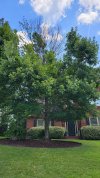
Strikes me as sort of like the situation of a birch tree. You make a cut, instigate rot and "x" years later it comes back to haunt you. However, if you leave a buffer length/zone, you buy more time but I think you eventually lose. You could hope for sprouting or already present live branches below your cut and just monitor for more die back. Good luck

Reach
Been here much more than a while
- Location
- Atglen, PA
In my opinion, yes, remove the dead wood if it is large, as it will become soft and fall on somebody. Keep your cuts in the dead wood, and it’s not topping, even if it looks like it - removing dead wood does not affect the tree the way removing live wood does, and really won’t benefit the tree in a case like that, but it will benefit the guy walking under the tree when that limb falls.

RopeShield
Carpal tunnel level member
- Location
- Ontario, Canada
Canker?

Bucknut
Carpal tunnel level member
That’s a red maple, not that it matters much. Gotta get rid of the dead to start with. Then try to discern why it died. Not always easy.

Reach
Been here much more than a while
- Location
- Atglen, PA
I vote girdling roots. That’s usually what we find, especially on a tree that size.Girdling roots? I don't think Reds are prone to that but I know Norways are.
Looking closely at that photo, I can see a few starting, I would say it’s a safe guess there are more on the other side that I cannot see.
Bucknut
Carpal tunnel level member
Reds definitely prone to SGRs. Real pain sometimes. Can be almost impossible to excavate around because of a thick matted layer of fibrous roots around the flare.
The tree above has a nicely exposed flare, unlike what I’m describing. The problem trees in my experience tend to be in mulch volcanos.
The tree above has a nicely exposed flare, unlike what I’m describing. The problem trees in my experience tend to be in mulch volcanos.

southsoundtree
Been here much more than a while
- Location
- Olympia, WA
It is NOT topping.
Could be the central trunk is crushed by included-bark forks. Drought.
Be mindful that pruning out that hazard wood might need a lift to protect the rest of the tree, or possibly a crane. Look really well and make a solid Plan A, and solid Plan B before bidding. Set the price for Plan B. If plan A works, give them some gravy, if you like. Keep the money.
Could be the central trunk is crushed by included-bark forks. Drought.
Be mindful that pruning out that hazard wood might need a lift to protect the rest of the tree, or possibly a crane. Look really well and make a solid Plan A, and solid Plan B before bidding. Set the price for Plan B. If plan A works, give them some gravy, if you like. Keep the money.
Last edited:

Stumpsprouts
Been here much more than a while
- Location
- Asheville
That looks pretty terrible. So you’re talking the central lead. That’s never going to be a good looking tree no matter what you do. I was hoping it would be a silver, which all have 3-7 independent leggy leaders and very wide growth habits. Losing a lead is no problem for something with that kind of structure. This is a different story.This is one in my neighborhood, but it's not the only one I've seen in the same condition.
A quick look showed some small root girdling roots, but nothing significantly impacting the main trunk. At least above grade.Reds definitely prone to SGRs. Real pain sometimes. Can be almost impossible to excavate around because of a thick matted layer of fibrous roots around the flare.
The tree above has a nicely exposed flare, unlike what I’m describing. The problem trees in my experience tend to be in mulch volcanos.
Tree may not recover a decent shape after dead wood is removed, but at least it won't present a hazard.
Mulch volcanoes are not uncommon here.

evo
Been here much more than a while
- Location
- My Island, WA
Dead is dead, but on large dead I tend to reduce to habitat stubs and don’t bother with ‘proper’ cuts. Just reduce the breakage hazard!
If the tree has girdling roots, or some other stressor. I’d advise against any live wood pruning! Unless that dead top tip is the only way to make a good reduction on a scaffold. But limit live wood pruning! Address the root crown, and soil compaction, mulch!
Beyond that it’s up to the tree… budget….
If the tree has girdling roots, or some other stressor. I’d advise against any live wood pruning! Unless that dead top tip is the only way to make a good reduction on a scaffold. But limit live wood pruning! Address the root crown, and soil compaction, mulch!
Beyond that it’s up to the tree… budget….

Daniel
Carpal tunnel level member
- Location
- Suburban Philadelphia (Wayne)
It matters... making accurate distinctions can be a matter of life and death in this industry. It all matters...That’s a red maple, not that it matters much.
On those maples with really busy ings of branches you will often find that as all the branches in a circle on the main stem grow in diameter, they will girdle the top of the tree. Something is definitely messing with the flow in that tree. I've got a much bigger red maple in my backyard with a lot of dead in the top. Usually means the tree is a goner, but maybe not quite so soon on this one, especially if the girdle is in the branch structure.
Bucknut
Carpal tunnel level member
I take your point Daniel. What I meant was that I wasn’t going to unnecessarily belabor the OPs trivial and probably accidental misidentification.
If we’re speaking of SGRs it really doesn’t matter. Unless you know of a species that benefits from them remaining in place.
If we’re speaking of SGRs it really doesn’t matter. Unless you know of a species that benefits from them remaining in place.
The homeowner said it was a silver maple and I didn't give it any additional thought. (I'm slowly working on my tree ID skills; they suck.) Might have delved into it more, but it's difficult to be away from home for any length of time right now. I'm caring for my mom in her final days and my wife can't physically move her when that's necessary. I'm grateful for the distraction of TreeBuzz.I take your point Daniel. What I meant was that I wasn’t going to unnecessarily belabor the OPs trivial and probably accidental misidentification.
If we’re speaking of SGRs it really doesn’t matter. Unless you know of a species that benefits from them remaining in place.

Dan Thornton
Participating member
- Location
- Smithsburg
Reach
Been here much more than a while
- Location
- Atglen, PA
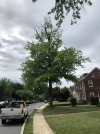
I would look into why the top is dying - does it have a disease, root problems, a nutrient deficiency of some sort? That would make a difference to me. I see it has been cut back up top before, so the decline is probably not new.Here's the pin oak I've been asked to prune. Again the problem is a dying top. Would you recommend keeping anything with even the slightest amount of life, or reduce the large dying tops to the main leader?
In this area, that would mean likely it’s Bacterial Leaf Scorch, in which case we would cut out what dead was necessary for safety, and leave the tree as untouched as possible until it was time to remove it entirely.
Edit: Corrected spelling error.
Last edited:
The Green One
Participating member
- Location
- Frenchtown
Just a quick look from your photo, looks like the tree is dealing with a "common issue" with Pin Oak near roadways that use a lot of salt. MD sure does as in NJ.Here's the pin oak I've been asked to prune. Again the problem is a dying top. Would you recommend keeping anything with even the slightest amount of life, or reduce the large dying tops to the main leader?
Iron Chlorosis.
Some vertical cracks on the trunk as well....so stress is not new to this tree I would think. Could even be from past Herbicide used on the lawn, or sidewalk cracks..........
Get someone good out there to help with improving the Vigor and address Plant Health Issues.
Those pruning cuts were not done to a good lateral either, ....Topped. The tree is in a downward spiral.
Perhaps some Vertical Mulching, some trunk injected Verdur from Rainbow Ecoscience, and some Shortstop growth regulator to turn it around.....
Sorry for the Silver Maple thread hijack.
Back on topic.
Bucknut
Carpal tunnel level member
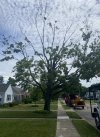
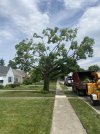
Happened to do this one last week. Tree in serious decline. Roots likely compromised by driveway and sidewalk, with more sidewalk work to be done soon by the city. Customer is fully aware of prognosis, but wants to preserve the tree for as long as possible.
Attachments












New threads New posts
-
test
-
-
-
-
 Light 14 or 16" narrow kerf bar for 200t or 201t
- Started by southsoundtree
- Replies: 9
-

-








