












Navigation
Install the app
How to install the app on iOS
Follow along with the video below to see how to install our site as a web app on your home screen.
Note: This feature may not be available in some browsers.
More options
You are using an out of date browser. It may not display this or other websites correctly.
You should upgrade or use an alternative browser.
You should upgrade or use an alternative browser.
jamming knots
- Thread starter J.Tree
- Start date


- Location
- Retired in Minneapolis
Please clarify what you mean by jamming knots.

For example: using an alpine butterfly to jam against the small ring of a friction saver to climb SRTPlease clarify what you mean by jamming knots.

Stumpsprouts
Been here much more than a while
- Location
- Asheville
With a carabiner in the eye of the AB for backup I’d climb on that, probably not without. What about a bowline on a bight? That sucker takes a lot to untie and is fat as all heck.For example: using an alpine butterfly to jam against the small ring of a friction saver to climb SRT


Chris Schultz
Carpal tunnel level member
- Location
- Minturn
I climb on two “stopper” knots daily, Like @Tuebor alluded to…. Also, I haven’t heard “don’t” or “why not” use a stopper/jam knot before.
I feel like having them on your bridge is a bit different as you're able to carefully inspect them as they're taking weight vs 50 ft up in the tree and assuming everything is good, too me it just seems like another possible failure you don't need to add.
Chris Schultz
Carpal tunnel level member
- Location
- Minturn
For the sake of argument(discussion) what about basal anchors?I feel like having them on your bridge is a bit different as you're able to carefully inspect them as they're taking weight vs 50 ft up in the tree and assuming everything is good, too me it just seems like another possible failure you don't need to add.
I usually do two hitches followed by a bowline with a figure 8 loop to attach a lowering rope to if I were to critically injure myself, very little pressure on the actual knot which I also get to closely inspect.For the sake of argument(discussion) what about basal anchors?
dmonn
Branched out member
- Location
- Port Washington Wisconsin
As a sidebar, what stopper knots work well for Class II rope, like Amsteel?
Diggity
New member
- Location
- State College
I almost always climb SRT. I almost always use a friction saver for a canopy anchor and jam the small ring with a butterfly with a binder that captures the loop and the retrieval side of the rope. I have not heard of any arguments against the use of jams. My bridges are also rope bridges with double fisherman jams on each side.
Why are you questioning the jams?
Why are you questioning the jams?
I'm not questioning them, I'm a fan of using jamming knots. In conversations with other arborists I've ran into some people who avoid using them but have never been given a good argument as to why so I thought I'd pose the question here to see if this deep pool of experience had anything further to say on the subject.I almost always climb SRT. I almost always use a friction saver for a canopy anchor and jam the small ring with a butterfly with a binder that captures the loop and the retrieval side of the rope. I have not heard of any arguments against the use of jams. My bridges are also rope bridges with double fisherman jams on each side.
Why are you questioning the jams?

evo
Been here much more than a while
- Location
- My Island, WA
None, knots in rope like amsteel severely weaken itAs a sidebar, what stopper knots work well for Class II rope, like Amsteel?
dmonn
Branched out member
- Location
- Port Washington Wisconsin
What if the Class II fiber core has a cover, like endurabraid? Also, why does the very tight knot used in a soft shackle not reduce the strength?None, knots in rope like amsteel severely weaken it
evo
Been here much more than a while
- Location
- My Island, WA
good questions.. under high loads the knot tail can slip though.. This is likely why on the newer TM bridges the tails are stitched pinning cover and core. do I think a bridge would ever see that kind of loads? Nahh...What if the Class II fiber core has a cover, like endurabraid? Also, why does the very tight knot used in a soft shackle not reduce the strength?
Also I can't recall the name of that micro line, but they specific It must be tied with a triple fishermans over a double.
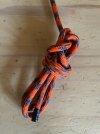
I think @Richard Mumford-yoyoman has video showing this. Also I’ve seen mid line knots pulled so damn tight they weren’t much bigger than the relaxed diameter for the line
Last edited:
evo
Been here much more than a while
- Location
- My Island, WA
Now for the bonus tip. Can anyone tell me why the used rope bridges broke about the same as the new ones?
Now I don’t knott block anything but my bridge rope. Not that I think it’s unsafe but unnecessary as there are simpler solutions. What is the benefit? To discuss I just see no point in it when simpler solutions exist and may even provide more options.
Now knotting the tail of yarders winch line is common practice, just a simple overhand is all that is needed (or possible to tie) in wire rope like that. That is the simple solution in that case, just tie a loose overhand, stake the tail to a stump, and pull it tight with the winch. The alternative? Call in the service truck with a torch? The service truck to install a babbit? Splice it in the field?
Knot blocking adds no benefit and extra gear in most all applications for life support. A friction saver, and a carabiner. A backed up running bowline, backed up, is nothing. A choking alpine butterfly is the same.. Typically we don’t do many many redirects, nor top tie anchors. I’m sure some city arbs do in the pnw as well as everyone outside conifer dominate land….
Just imagine trying to isolate a climbing line in a 150’ Doug fir that limbs start at 20-50’ and keep going another 100’+. There is a level of redundancy in a based tied accent method and a super high TIP. In that case you might have evenly spaced limbs every three feet or so, and you might be over 40% of the live crown. To isolate you have to have both legs parallel over 2-3 limbs of the same whorl (or abouts) where 50-90’ line setting shots are not uncommon. One pencil sized stub can give you are really bad day!
Now I don’t knott block anything but my bridge rope. Not that I think it’s unsafe but unnecessary as there are simpler solutions. What is the benefit? To discuss I just see no point in it when simpler solutions exist and may even provide more options.
Now knotting the tail of yarders winch line is common practice, just a simple overhand is all that is needed (or possible to tie) in wire rope like that. That is the simple solution in that case, just tie a loose overhand, stake the tail to a stump, and pull it tight with the winch. The alternative? Call in the service truck with a torch? The service truck to install a babbit? Splice it in the field?
Knot blocking adds no benefit and extra gear in most all applications for life support. A friction saver, and a carabiner. A backed up running bowline, backed up, is nothing. A choking alpine butterfly is the same.. Typically we don’t do many many redirects, nor top tie anchors. I’m sure some city arbs do in the pnw as well as everyone outside conifer dominate land….
Just imagine trying to isolate a climbing line in a 150’ Doug fir that limbs start at 20-50’ and keep going another 100’+. There is a level of redundancy in a based tied accent method and a super high TIP. In that case you might have evenly spaced limbs every three feet or so, and you might be over 40% of the live crown. To isolate you have to have both legs parallel over 2-3 limbs of the same whorl (or abouts) where 50-90’ line setting shots are not uncommon. One pencil sized stub can give you are really bad day!












New threads New posts
-
test
-
 Free CEUs: February 05 & March 05 - 'Urban Forestry Today' Webcasts @ Noon (Eastern)
- Started by UFT
- Replies: 0
-

-

-
-
-








