Christrees
Been here a while
- Location
- New York
Idk why your wowing..thats what im thinking about everyone on here that gave him another option. I told him what i knew .and he appreciated it. so
Follow along with the video below to see how to install our site as a web app on your home screen.
Note: This feature may not be available in some browsers.
That im sorry about didnt see that..I read this as a solicitation for any and all solutions.
This is discussed about once per year. Lots of solutions in the Archives
Ok yeah i get that. Thats great you gave your advice. A long term friction saver inst practical. And thats what hes looking for. So i still stand behind. The wire core long term friction saver. He can buy a long term friction saver and leave it up there. Thats what he wants. But yeah he will still have to use throw line paracord or and old rope. To get his rope in and out of the tree."Any and all advice is much appreciated."
And the most practical advice was given in the first response. It's been discussed here several times and it always comes back to using throwline or cord stored in the desired union. Cheap, practical, versatile.

It says it designed to be left in a tree overnight...not that it can only be left in a tree over. Obviously wouldnt leave it out there in the winter time.Just a couple of thoughts on the steel line canopy anchor. The description on treestuff says its designed to be left in the tree overnight, it never says for a long period of time. It does say to inspect every 6-12 months, but from how I read it and how they probably mean from a CYA standpoint is that you should store it and inspect that often at minimum.
The literature that comes with it may actually condone leaving it long term.
One other note to consider, there have been steel core failures in the past in fliplines because you cannot inspect the terminations. In this particular setup, the terminations are designed to sit in a direction that funnels water into the termination, increasing the chance for corrosion and bursting with ice buildup.
Yeah maybe. But i know i haven't googled a thing since joining here. My only point was if your going to tell him your way you could atleast look into his question and answer it. And i apologized to tom last night i didnt see the part where he posted all answers helpful. Something like that. I just couldn't believe noone but me actually answered his question about a long term friction saver@Christrees let me just point out a couple things. 1- a simple Google search would have shown the OP tons of choices for long term friction savers. If he just wanted that, he wouldn't have asked the question on a forum like this. He was asking for a more nuanced answer. People who have one idea about something often modify their plan when they become aware of new information or options so this is a healthy process. 2- the OP is free to tell us what he really does or doesn't want to do. Nobody here is giving advice with malice or judgment. 3- You are creating friction between yourself and other forum members for no reason, please consider saving some of that friction for subjects that warrant it. And yes, that was a friction saver joke.
Thanks for giving him a soultion. Thats all i was saying.

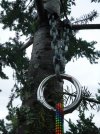
Here is my permanent Friction Saver. We now have two each of which have a throwline waiting for our climbing rope. There is a very rugged rubber hose that we put the chain through so that the tree is more protected. All hardware is rated for purposes way beyond what we are using it for.I read this as a solicitation for any and all solutions.
This is discussed about once per year. Lots of solutions in the Archives

Ha! I just asked @moss this same question. I do keep throw lines in all my trees but have a few crotches with webbing in them and was afraid of UV degradation. I never thought about the squirrels eating the webbing, haha.This has been addressed a number of times here and I think the consensus is that just leaving a throwline in the tree at all times is the way to go, and never leave a climbing line in the tree. Critters and all manner of other natural forces will quickly compromise it.

Arboreal rodents chew on gear that has salts from sweat embedded in it. If you wear gloves when installing long-term setups cordage and webbing won't be chewed.Ha! I just asked @moss this same question. I do keep throw lines in all my trees but have a few crotches with webbing in them and was afraid of UV degradation. I never thought about the squirrels eating the webbing, haha.

There has NEVER been a failure of a steel core flipline using our swaging process. RopeLogic wirecore swaging captures the full load bearing rope sheath and the load bearing cable cable. Redundancy is not an accident.Just a couple of thoughts on the steel line canopy anchor. The description on treestuff says its designed to be left in the tree overnight, it never says for a long period of time. It does say to inspect every 6-12 months, but from how I read it and how they probably mean from a CYA standpoint is that you should store it and inspect that often at minimum.
The literature that comes with it may actually condone leaving it long term.
One other note to consider, there have been steel core failures in the past in fliplines because you cannot inspect the terminations. In this particular setup, the terminations are designed to sit in a direction that funnels water into the termination, increasing the chance for corrosion and bursting with ice buildup.
The Wire Strop is a great choice for semi-permanent installation as rodents/wildlife cannot chew the anchor.
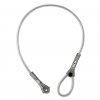
Yeah I was thinking the same thing last month or the month before when I first seen it on wesspurs site.This thread has gone all over the place.... but here is one more commercial option. Yes, it also has pros and cons like every piece of kit. https://www.wesspur.com/items/cli255.html
View attachment 78102