Work Photos

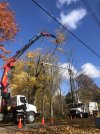
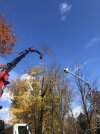
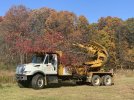
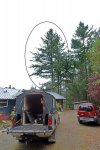
Long day today, removing two good sized firs next to/over a house, fence and AC unit. A combo of cut-and-toss, lowering and speed-lining. I work "in the woods " so much having a good rigging job was a welcome change of pace. I got some nice pictures as did the customer, so I thought it was a good one to share.

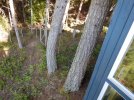
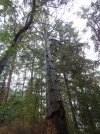
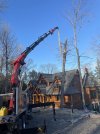
The two trees. The larger one was about two feet from the house and had 25-foot limbs over the roof.

0 RSL 01.jpg

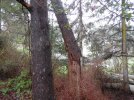
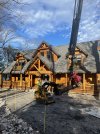
A closer look at the base of the trees and the proximity to the house. Note the wire fence, and behind the righthand tree is the AC unit. Lots of targets around.

0 RSL 02.jpg

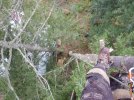
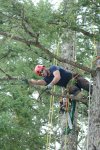
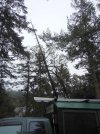
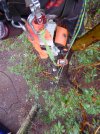
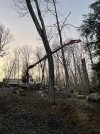
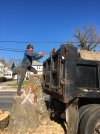
I climbed the tree farther from the house first, tossing the smaller limbs on the way up, taking the top and then setting lines for lowering and speed-lining both it's larger limbs and the material on the other tree. In this photo you can see how close and one-sided the other tree is over the house.

0 RSL 03.jpg

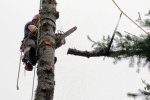
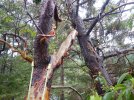
Taking the top on tree number 1.

0 RSL 04.jpg

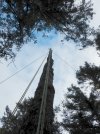
That tree then became a spar pole, with speed-lines going both up and downhill depending on what side of the tree was best for getting material off, a lowering line and my climb-line above all that. It worked well for the bottom half of the tree over the house, for the top half I moved the speed-lines and my climb-line into the tree over the house but kept the lowering line on the spar for removing the wood on the closer tree.

0 RSL 05.jpg

A little cut-and-toss.

0 RSL 06.jpg

Speed-lining.

0 RSL 07.jpg

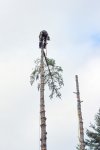
Due to wind and the fact I was basically over the roof at this point thanks to the trees lean, I went way up and took a very small top. I considered lowering or speed-lining it, but going small and just sending it ended up being the safest choice.

0 RSL 08.jpg

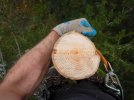
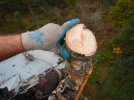
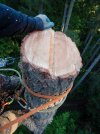
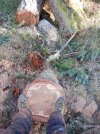
Kind of neat seeing the comparison in the wood/fibers between the chainsaw cut on the face (right) and the Silky handsaw on the back-cut (left), not to mention the effect the curved blade has on cuts. I've seen Reg Coats uses a straight blade Silky and while a small detail, is at least theoretically better.

0 RSL 09.jpg

Job done. The customer is a photographer and wanted to leave wildlife snags to hopefully attract birds which I'm all for. Given the left tree here is right outside that window, other than increased light it won't look much different than before from that perspective, plus the deeply furrowed bark covered in lichen is just a beautiful sight to see.

0 RSL 10.jpg
 
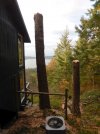
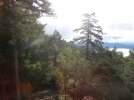
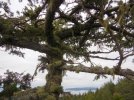
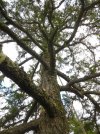
I got to prune an especially beautiful doug fir yesterday.

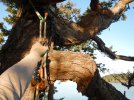
This was one on a rocky hilltop that experiences a lot of wind, the tree was maybe 90' tall and if I had to guess... 150+ years old. Most dougs grow straight trunks and straight limbs 90-degrees from the trunk, but decades or centuries of wind breakage mold the limbs on trees like this into wavy and twisted shapes, and the tops become flat and bonsai-like. It also provides excellent structure for the lichen that thrives on trees in this foggy environment.

The goal here was to just do an inspection and very light prune of the tree. Take out any big deadwood, reduce end-weight on limbs, and provide some aesthetic pruning to enhance the structure and silhouette of the tree by providing a bit more separation between the limbs. Hit my throwline on the first shot, spent about 2 hours on the tree and happy to report the structure and health of the tree seem to be excellent.

000 d fir prune 01.jpg

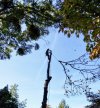
The very top of the tree. These were all mature limbs with a strong shape, so all I did up here was take out a tiny bit of deadwood.

000 d fir prune 02.jpg

Looking up from halfway through the canopy.

000 d fir prune 03.jpg

And a before and after photo of the work.

000 old fir BEFORE AFTER.jpg
 
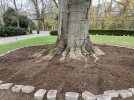
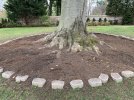
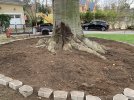
Yet another large old beech received a root invigoration today. For some reason that’s been the species that’s made up the majority of those projects this year. No before pic but it was pretty compacted and rocky. The tree didn’t have any girdling roots of any significance which not only streamlined the job but also glad to see a large tree with a good root system from what I found. Love doing this kind of work with the airspade. DC373AED-FBE9-43CF-BBB1-2EBD83B55109.jpeg870E766D-6CBB-4E33-9D17-295C0D8EB49E.jpeg206D421F-4A88-4BBA-B29F-37539ADD0ED1.jpegC6942E86-88AB-43BD-B64E-CDE46B1DAABE.jpeg
 
Work day for today, solo project:

- Fell skinny 70' dead grand fir through very tight shot in the woods.
- Fell 100'+ dead doug fir through very tight shot in the woods.
- Climb and reduce to habitat snag 100' dead doug fir.
- Climb and remove heart-rot 50' declining doug fir.
- Climb and reduce 70' declining doug fir to habitat snag.
- Climb and reduce weak regrown top on a 70' 'quasi-old-growth' doug fir for building safety.

Overall an awesome day of felling, removal climbing and then finishing the day with an absolutely beautiful minor prune on a postcard perfect day.

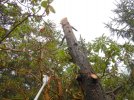
Here is after taking probably a 40' top on the tallest climbing removal. Deep conventional face with a snipe, moved so smooth and landed so perfectly I regret not having my Gopro on for this tree, but whatever ;)

0 decday 01.jpg

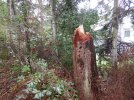
Squeezing the dead 100-footer through the tight woods.

0 decday 02.jpg

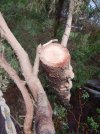
Like ricos post the other day, we have a lot of heart-rot issues with our firs here as well. This was a one I climbed, but it was plenty safe to be up. Just very dry and brittle wood.

0 decday 03.jpg

A bunch of stubs and a few limbs on the way up, decent size top, long log, carve up the trunk into a natural looking break for a habitat snag and come to the ground.

0 decday 04.jpg

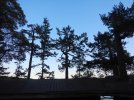
I'd say this was an 'evening climb', but this was the setting sun at like 3pm.... Old, twisted doug fir in the narrow strip of land between the saltwater and the house. It's a high wind environment here and shore firs lose their tops regularly, which gives them their wonderful shapes. That said, the weak regrown tops aren't ideal when there is a house in the path, so this was just reducing that regrown top to eliminate the failure potential while attempting to maintain a natural 'shore fir' look. SRT up, DRT to move around and come down on.

0 decday 05.jpg

Postcard perfect views:

0 decday 06.jpg

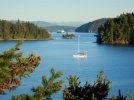
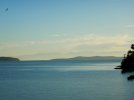
Calm waters and mountains in the distance:

0 decday 07.jpg

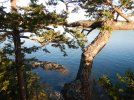
The shoreline below:

0 decday 08.jpg

And the final result (middle tree), again trying to eliminate the chance of failure while mimicking the look of the other firs that had their tops break out naturally. I only had to take about 12' out of the tree and a 5" cut. Given it's growth rate, I think it should make it generally safe for 5-10 years.

0 decday 09.jpg
 
Last edited:
Had a fun little project the other day, so time to bump this thread up again.

This was a long-dead, mid-sized doug fir that had broken at the base, was hanging onto the stump by just a few inches worth of fibrous wood in the still solid center, and leaning into a goofy shaped madrone. For the job I borrowed the new Stihl battery extendable pole-saw, which was great and now I want one...

Overview of the situation. While not as high as I'd have liked, I was able to set a line from the ground into that fir on the right side, which gave me a perfect rope angle.

00 leaning fir 01.jpg

It's a decent sized tree with a lot of weight leaning into the madrone. A rather precarious situation.

00 leaning fir 02.jpg

A closer look at the base and angles. This one was kind of interesting to me because usually doug firs here are very good at standing dead and usually just crumble from the top down while staying upright.

00 leaning fir 03.jpg

Freshly rebuilt 200T and HTA 85 polesaw hanging on the belt. Awkward especially with two climbing lines and a flipline on top of that, but was what was needed for the work.

00 leaning fir 04.jpg

With an SRT line in the fir behind me, I climbed up the madrone with my flipline and DRT rope-sleeve so I could stay supported at opposing angles and away from the underside of the fir in case it let loose on it's own. Limbed the fir with the battery polesaw as I went up. Oh, and yah, wet madrones are SLIPPERY.

00 leaning fir 05.jpg

Taking the top using the HTA 85. With no higher to climb in the madrone, the goal was to cut the top out and get it to fall past and over the limbs I was standing on and the tree was resting on. This would have been an almost impossibly large cut to make with a manual polesaw, and very hard with my much heavier gas polesaw.


Always a nice feeling to get that top weight out.

00 leaning fir 06.jpg

With the top gone, I could then cut the trunk with the 200T and get it to the last bit of support. A single 2.5" limb was all this entire log was resting on. (that fir limb on the back side is cut free)

00 leaning fir 07.jpg

Here is the final cut. I just lightly tickled the limb until I could see movement and get my saw away. Fell underneath the madrone perfectly.


Everything on the ground, no cleanup, walk away happy.

00 leaning fir 08.jpg
 

New threads New posts

Kask Stihl NORTHEASTERN Arborists Wesspur TreeStuff.com Teufelberger Westminster X-Rigging Teufelberger
Back
Top Bottom