












You were pulling a 20ft stub with a mini. I don't think your little taper did shit.You simply don't understand what you're looking at.
You keep saying you do but you don't
And here's the proof that unquestionable this hinge held perfectly, as it was intended to do, given a look at the broken fibers here, and as per the video the tree made the lay dead center of the padding log. View attachment 69633
Navigation
Install the app
How to install the app on iOS
Follow along with the video below to see how to install our site as a web app on your home screen.
Note: This feature may not be available in some browsers.
More options
You are using an out of date browser. It may not display this or other websites correctly.
You should upgrade or use an alternative browser.
You should upgrade or use an alternative browser.
swing dutchman
- Thread starter Daniel
- Start date

Daniel
Carpal tunnel level member
- Location
- Suburban Philadelphia (Wayne)
pg 8...You didn't explain why having a tapered hinge would cause the wood to steer or hold in one direction. You explained why you tapered the hinge but not its function.
Even in trees that have little or no lean, the faller may choose to protect a house, fence, or other property by using a slightly tapered hinge, which leaves more holding wood on the side of the hinge away from the property. This technique affords extra confidence in falling, especially when working with a tight landing zone or brittle wood that has relatively little holding strength.
Last edited:
Daniel
Carpal tunnel level member
- Location
- Suburban Philadelphia (Wayne)
the tree went right to the lay as set by the notch, so the taper didn't make a difference.You were pulling a 20ft stub with a mini. I don't think your little taper did shit.
Here we go again. You post up some shoddy cutting, and when called on it you claim that we just dont understand what we are looking at...
Both the picture of the undercut and the picture of the butt prove beyond a doubt that you did in fact leave a strip of bypass, which went across almost your entire undercut...You could have taken the 10 second needed to clean it up, but once again chose not to... Lazy hackery
Both the picture of the undercut and the picture of the butt prove beyond a doubt that you did in fact leave a strip of bypass, which went across almost your entire undercut...You could have taken the 10 second needed to clean it up, but once again chose not to... Lazy hackery
Daniel
Carpal tunnel level member
- Location
- Suburban Philadelphia (Wayne)
That was a plate cut, so there was some height to fibers at the back of the notch/front of the face. In which case the apex does not need to be cleaned out as it would on a standard face, where to cuts intersect perfectly. Even in a standard face cut, a tiny bit of bypass isn't going to make a difference. there is enough stretch and compression in the wood to allow the face to close normally. SO while you insist that a notch has to look perfect, I'll keep my own advice when it comes to knowing when it needs to be perfectly cleaned out and when it doesn't. You keep falling tres according to your rules if you need to. I do what works, and don't care about how it looks to simple-minded people like you.
JaredDTS
New member
- Location
- Kill Devil Hills
You are comparing the reaction of a 20ft nub being pulled by a skidsteer (as mentioned above) versus falling entire trees where even a full size skidsteer can't provide as much persuasion.
Daniel
Carpal tunnel level member
- Location
- Suburban Philadelphia (Wayne)
what are you trying to say?

TheTreeSpyder
Branched out member
- Location
- Florida>>> USA
For me, a Swing Dutchman, uses both
>>hard early close on hard sideLean side w/Step Dutchman
>>strong Tapered Hinge to the 'Off Side' (Dent)
The thin side of Tapered Hinge is missing or sheared by the early side close, tho, perhaps to center or so.
.
Usually save that patch tho as anti-swing, to Tapered pull. Even if center punch Tapered, to reapportion those fibers to off side, generally purposefully maintain some hinge on lean side, at this most leveraged position.
But, in swing strategy, leave out that safety, and invoke high torque twist/throw.
.
The harder the side lean , the greater return from Step Dutchman or Tapered Hinge leveraged responses from increased inputs. Employing the Dutchman is not really meant to be a dainty thing. If got cohonos to slap step hard with speed, get advantage of speed squared helping. A Tapered Hinge changes common 'strip' hinge to offset side pulls with tension offset ballast , Step Dutchman is same strategy with compression.
In hard sideLean w/hard Step Dutchman and Tapered Hinge in concert, torquing to off side, w/o anti-swing stabilizer patch, can give hard swing, even wild. Kinda like 2 opposing twists on a bar/T-handle around a center (vs. 1 short pull) much harder torquing to point of more chance of over correction.
.
As long as correct mechanix at highest leveraged force points that define the movement, and no binds, can fairly triage what can be allowed in solid wood/up to the constitution of the tree as a container of forces.
.
After seeing what can plot and do, just increases arguments on to scrutinize for no accidental , especially full face , Dutchman's. To me Tapered Hinge is mainstay, even just to practice, has self adjusting ranges per side load, and few things perfectly centered etc. Even if so, use to make softer hit, not into lean etc. But always anti-swing tuft preserved, unless specifically unlocking that safety.
>>hard early close on hard sideLean side w/Step Dutchman
>>strong Tapered Hinge to the 'Off Side' (Dent)
The thin side of Tapered Hinge is missing or sheared by the early side close, tho, perhaps to center or so.
.
Usually save that patch tho as anti-swing, to Tapered pull. Even if center punch Tapered, to reapportion those fibers to off side, generally purposefully maintain some hinge on lean side, at this most leveraged position.
But, in swing strategy, leave out that safety, and invoke high torque twist/throw.
.
The harder the side lean , the greater return from Step Dutchman or Tapered Hinge leveraged responses from increased inputs. Employing the Dutchman is not really meant to be a dainty thing. If got cohonos to slap step hard with speed, get advantage of speed squared helping. A Tapered Hinge changes common 'strip' hinge to offset side pulls with tension offset ballast , Step Dutchman is same strategy with compression.
In hard sideLean w/hard Step Dutchman and Tapered Hinge in concert, torquing to off side, w/o anti-swing stabilizer patch, can give hard swing, even wild. Kinda like 2 opposing twists on a bar/T-handle around a center (vs. 1 short pull) much harder torquing to point of more chance of over correction.
.
As long as correct mechanix at highest leveraged force points that define the movement, and no binds, can fairly triage what can be allowed in solid wood/up to the constitution of the tree as a container of forces.
.
After seeing what can plot and do, just increases arguments on to scrutinize for no accidental , especially full face , Dutchman's. To me Tapered Hinge is mainstay, even just to practice, has self adjusting ranges per side load, and few things perfectly centered etc. Even if so, use to make softer hit, not into lean etc. But always anti-swing tuft preserved, unless specifically unlocking that safety.
A plate cut? Pure fucking rubbish. That was a bypassed undercut and none of your snake oil salesman bullshit can change that fact.That was a plate cut, so there was some height to fibers at the back of the notch/front of the face. In which case the apex does not need to be cleaned out as it would on a standard face, where to cuts intersect perfectly. Even in a standard face cut, a tiny bit of bypass isn't going to make a difference. there is enough stretch and compression in the wood to allow the face to close normally. SO while you insist that a notch has to look perfect, I'll keep my own advice when it comes to knowing when it needs to be perfectly cleaned out and when it doesn't. You keep falling tres according to your rules if you need to. I do what works, and don't care about how it looks to simple-minded people like you.
If by "simple-minded" you mean that I strive for perfection on every cut I make, then color me simple minded...
Last edited:
Daniel
Carpal tunnel level member
- Location
- Suburban Philadelphia (Wayne)
the hinge functioned perfectly and the tree made the lay perfectly. That is shown without a doubt...
Your claim that there was a bypass in the face cuts is not supported by the fact that there were two lines of shadow running parallel to each other in the apex of the notch. You can say there was a bypass in the face, doesn't make it so. But even if it were, that did not affect the ability of the hinge to get the tree to the lay.
Your claim that there was a bypass in the face cuts is not supported by the fact that there were two lines of shadow running parallel to each other in the apex of the notch. You can say there was a bypass in the face, doesn't make it so. But even if it were, that did not affect the ability of the hinge to get the tree to the lay.
As I said both pictures fully support THE FACT that you clearly left a strip of bypass on your under cut....I have been at this game a very long time Daniel and your nonsense won't work here. Shadows, plate cuts, and parallel line? Have you no fucking shame?
Daniel
Carpal tunnel level member
- Location
- Suburban Philadelphia (Wayne)
You're stuck in an orthodoxy that I have long ago transcended.

evo
Been here much more than a while
- Location
- My Island, WA
That is my new favorite quote. Context meh, but a bad ass quoteDaniel and rico...may as well tie two cat's tails together and throw them over a clothesline. It's a good thing they are on opposite coasts.
Daniel
Carpal tunnel level member
- Location
- Suburban Philadelphia (Wayne)
me too!To me Tapered Hinge is mainstay, even just to practice, has self adjusting ranges per side load, and few things perfectly centered etc. Even if so, use to make softer hit, not into lean etc. But always anti-swing tuft preserved, unless specifically unlocking that safety.
My swing Dutchman doesn't necessarily use an early close as sometimes I will open the face.
While I haven't unlocked all the secrets of why it works sometimes and doesn't others. It's obvious (to me at least) that it shouldn't be used on trees with enough leveraged mass to sit down and close the kerf of the lean side. SO that will generally rule out very large side leaners. Small and medium trees are better suited for experimentation.
I didn't have much luck the first ties I tried playing with a step dutchman, so I haven't tried it since. that was over 10 years ago
Daniel
Carpal tunnel level member
- Location
- Suburban Philadelphia (Wayne)
And for those of you not familiar with the plate cut. this video published in April 2011 is the first time it has ever been published in any form. I made the cut up and use it regularly. It is a quick method for adding height to the fibers at the front of the hinge, which has several advantages. MOstly it allows a little flexibility for the hinge fibers at the front of the hinge to deflect or bow slightly which allows the tearing force to be applied more evenly across the entire width of the hinge. This can add significant strength to the hinges holding ability, as it's much easier to tear something in half by concentrating the force on a small area (the back of the hinge) and as those fibers breal, the force gets concentrated on the fibers just in front of them. This is the same principle that makes bend ratio cause significant loss of strength in ropes. It also gives the block cut and sizwheel added strength. It's just a lot easier to cut then they are. It generally takes about an extra 20 seconds to add the plate cut and for many it can actually save time in that it precludes the need to beat out a notch or walk to the other side of the tree to match cuts ect.
Rico can talk crap all he wants but it should be obvious that the plate cut doesn't need to be cleaned out in the same way that the apex of a standard notch would as there is no possibility of the tree stalling or resisting, the way it would when the kerf of an unintentional dutchman in a standard notch closes.
Rico can talk crap all he wants but it should be obvious that the plate cut doesn't need to be cleaned out in the same way that the apex of a standard notch would as there is no possibility of the tree stalling or resisting, the way it would when the kerf of an unintentional dutchman in a standard notch closes.
And for those of you not familiar with the plate cut. this video published in April 2011 is the first time it has ever been published in any form. I made the cut up and use it regularly. It is a quick method for adding height to the fibers at the front of the hinge, which has several advantages. MOstly it allows a little flexibility for the hinge fibers at the front of the hinge to deflect or bow slightly which allows the tearing force to be applied more evenly across the entire width of the hinge. This can add significant strength to the hinges holding ability, as it's much easier to tear something in half by concentrating the force on a small area (the back of the hinge) and as those fibers breal, the force gets concentrated on the fibers just in front of them. This is the same principle that makes bend ratio cause significant loss of strength in ropes. It also gives the block cut and sizwheel added strength. It's just a lot easier to cut then they are. It generally takes about an extra 20 seconds to add the plate cut and for many it can actually save time in that it precludes the need to beat out a notch or walk to the other side of the tree to match cuts ect.
Rico can talk crap all he wants but it should be obvious that the plate cut doesn't need to be cleaned out in the same way that the apex of a standard notch would as there is no possibility of the tree stalling or resisting, the way it would when the kerf of an unintentional dutchman in a standard notch closes.
BYPASS (Dutchman): Situation created when the two cuts of the undercut (free cut) do not meet exactly, i.e. one bypasses the other. Creates undesirable results such as barber chairing, cracked tree butts, excessive fiber pull and misdirected fall of the tree
Please notice that the 2 cuts DO NOT LINE UP EXACTLY. A textbook case of bypass, and the literal definition of bypass..
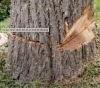
Nuff said.

Phil
Carpal tunnel level member
- Location
- Oak Lawn, IL
Daniel
Carpal tunnel level member
- Location
- Suburban Philadelphia (Wayne)
Please notice that the 2 cuts DO NOT LINE UP EXACTLY.
IT'S NOT 2 CUTS ... can you count to three yet?
Swing-dutchmans, tapered hinges, plate cuts and all other forms of arboricultural quackery generally don't work as intended and are more of a result of confirmation bias by those that utilize them.
Every example I've seen of someone trying out these techniques always notched it in the intended direction... and yet somehow claimed it was the tapered hinge or whatever that helped.
If you've got a lean or sweep in the tree just account for the lean and offset your notch from the intended lay and do an open face + bore with a normal hinge. Why do something that has the potential to produce potentially catastrophic or unexpected results?
Every example I've seen of someone trying out these techniques always notched it in the intended direction... and yet somehow claimed it was the tapered hinge or whatever that helped.
If you've got a lean or sweep in the tree just account for the lean and offset your notch from the intended lay and do an open face + bore with a normal hinge. Why do something that has the potential to produce potentially catastrophic or unexpected results?

Idk about the other stuff, but tapered hinge is legit and you probably use it and see it often. It’s just so basic that you probably didn’t realize it warranted a special title and articles and hours of conversation. I didn’t know it had a name before.
A tree is leaning east. You gotta make it fall north. Face cut facing to the north, back cut from south to north. Your hinge will be thicker on the west (tension fibers), and thinner on the east (compression). Simple enough, yeah? If your hinge gets skinny on the tension side, it’s in god’s or gravity’s hands.
It absolutely follows the face unless someone fucks up.
A tree is leaning east. You gotta make it fall north. Face cut facing to the north, back cut from south to north. Your hinge will be thicker on the west (tension fibers), and thinner on the east (compression). Simple enough, yeah? If your hinge gets skinny on the tension side, it’s in god’s or gravity’s hands.
It absolutely follows the face unless someone fucks up.












New threads New posts
-
test
-
-

-
-
 Free CEUs: February 05 & March 05 - 'Urban Forestry Today' Webcasts @ Noon (Eastern)
- Started by UFT
- Replies: 0
-

-








