Throwline or hook?

What advantage does the hook have over a carabiner? I see none...

It doesn't. I was using the Hook as an overhand/wrap long lanyard tie-off to progress from the outside of of a leaner, towards a cat I was attempting to rescue. After I had the cat I was letting my self back to the edge of the crown my rope was hooked by the hook. Perfect! I took pause and switched the hook out for my regular lanyard in DdRT configuration and continued to the left back to a "plumb line" under my primay rope setting. It was a happy accident that I found intriguing, some possibilities there, one being some kind of retrievable.
-AJ
 
What's the purpose of the short piece of rope attached to the hook as opposed to clipping in at the hook?
I'm not sure there is one. In theory, it keeps the biner out of the crotch I am going for. In practice, it sometimes makes it hard to get the biner past the crotch, but not always. I don't want to take it off because they supplied 1 extra "single use" super special lock nut and I used it to put the short rope on. I never tried it without the short rope.
 
My hook setup. Get out to where you have the hook set, unclip the hook and ddrt with the rope to get back if need be. 50 feet of rope in the bag, ready to deploy. Lots of uses for this. I would never bring throw line into a tree with me. Not because its an all around bad idea, just because it would not work well for me I think.
View attachment 62967

That's pretty cool, makes for a more versatile long lanyard. The small oval carabiner might cause trouble for me sooner or later, I'd try a compact oval shaped screwlink to see how that is. Excellent thinking!
-AJ
 
That's pretty cool, makes for a more versatile long lanyard. The small oval carabiner might cause trouble for me sooner or later, I'd try a compact oval shaped screwlink to see how that is. Excellent thinking!
-AJ
I might try the screw link! The oval does sometimes cause slight discomfort, but makes for quick change over.
 
I might try the screw link! The oval does sometimes cause slight discomfort, but makes for quick change over.
I use a small SS oval screw link on my hook and it is fairly quick to swap it on or off any of my lanyards. That way I don't have to disturb the original hook shackle, and the oval screw link is about the same profile so it is not introducing any added difficulty in manipulating the hook.
 
If one had a hook already in place on the end of a long lanyard, this might be very quick to implement. Is it retrievable by pulling the hook line?

Yep to the first. No to the second but it could be set as a retrievable, i’ll see what I can come up with. Could be excellent coming back from a traverse or redirect when there’s something about the angles to make normal Hook retrieval difficult or there is nothing to hook into.
-AJ
 
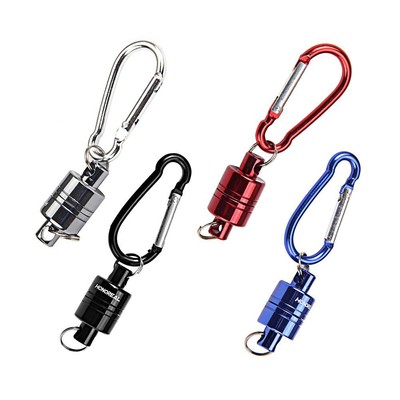
Anyone have a source for good magnets now that yoyo's currently occupied with other concerns?

I bought this, and it's made surprisingly well. Don't know about long term durability, but I think it would work well with a few minor upgrades.

 
My hook setup. Get out to where you have the hook set, unclip the hook and ddrt with the rope to get back if need be. 50 feet of rope in the bag, ready to deploy. Lots of uses for this. I would never bring throw line into a tree with me. Not because its an all around bad idea, just because it would not work well for me I think.
View attachment 62967
Rjb.. i like your setup. I've also seen some interesting techniques made available by using a short tether..
That aside, did you consider the straight pull strengths of the cordage you are using? I'm unaware of any info regarding that petzl e2e. I'd want to assume if it's good to go for a bridge that gets hammered with different pull angles, it would be ok for straight pull.. My thinking on this stems from some of those advisories you see when buying sewn hitch cord whereas the acceptable strengths are what they are because they are in a closed stem or using two legs. I'm more so curious if you came up with any general numbers you could share as i have some of the same petzl stuff.
 
Rjb.. i like your setup. I've also seen some interesting techniques made available by using a short tether..
That aside, did you consider the straight pull strengths of the cordage you are using? I'm unaware of any info regarding that petzl e2e. I'd want to assume if it's good to go for a bridge that gets hammered with different pull angles, it would be ok for straight pull.. My thinking on this stems from some of those advisories you see when buying sewn hitch cord whereas the acceptable strengths are what they are because they are in a closed stem or using two legs. I'm more so curious if you came up with any general numbers you could share as i have some of the same petzl stuff.
I actually never concidered that the petzel e2e might be on the weak side in that config. The stitching looks like shit, always has. The hook is supposed to be non life support, and I might exceed ideal angles for non life support at times, but it will never be shock loaded. 1,000 lbs tensile would probably never break. None the less, now you have me thinking and I might have to replace that cordage.
 
I criticized the loose stitches before, but now think that the single pass method Petzl uses doesn’t require the two pieces of rope to be compressed together. Compressing might increase the break strength, but maybe it isn’t needed. In both methods it’s ultimately the stitches that holds it together, and as long as they are consistently tensioned to work in unison, the looser method obviously tests high enough for Petzl.
 
I criticized the loose stitches before, but now think that the single pass method Petzl uses doesn’t require the two pieces of rope to be compressed together. Compressing might increase the break strength, but maybe it isn’t needed. In both methods it’s ultimately the stitches that holds it together, and as long as they are consistently tensioned to work in unison, the looser method obviously tests high enough for Petzl.
Exactly. They test things and can be held liable if they fail. I can't see them putting out a product that is not reliable (ahem, early model zig zag). I used the sequoia bridge because I had it on hand. Maybe someday I will make a double braid hand spliced e2e that will be stronger and a little longer might actually be better for getting the hook set.
 
I can't see them putting out a product that is not reliable (ahem, early model zig zag).

I can't see that either, however when we use said product in a manner it wasn't tested/rated at, were getting into that gray area. On top of that, we don't even know the original numbers for it in the rated configuration.

My thing with the hook is, even though it's not supposed to be life support, i still want it all legit or at least as strong as the hook itself.. I wish petzl would put out actual breaking strengths on some of their textile/replacement stuff as opposed to the certs/standards they are confirming to as i end up all over the place trying to look them up.
 
Now I am really curious. Maybe I'll get something spliced up to replace the seqoia bridge, then see what it takes to break it in a straight pull!
 
Now I am really curious. Maybe I'll get something spliced up to replace the seqoia bridge, then see what it takes to break it in a straight pull!

Does Petzl have the specs on their site for it's strength in a normal bridge use/basket pull scenario? I suspect that for a straight pull it's all about the strength of the stitched eyes not the cordage.

For reference on the overall strength of a stock Captain Hook system, the 10mm Reep Schnur hook line has a surprisingly low break point. I had a new length that broke as I recall at 2900 when one of my sewn eyes was load tested.
-AJ
 
Does Petzl have the specs on their site for it's strength in a normal bridge use/basket pull scenario? I suspect that for a straight pull it's all about the strength of the stitched eyes not the cordage.

For reference on the overall strength of a stock Captain Hook system, the 10mm Reep Schnur hook line has a surprisingly low break point. I had a new length that broke as I recall at 2900 when one of my sewn eyes was load tested.
-AJ

Was that your hand sewing? Did the sewing break or the cordage?
 
Was that your hand sewing? Did the sewing break or the cordage?

Cordage broke well away from the sewing. Not to brag but no one's been able to break my sewn eyes no matter what cordage is used, it never breaks near the sewn eye. It's amazing how strong a sewn eye can be. The low strength of the new 10mm Reep Schnur was surprising, maybe a bad batch, don't know.
-AJ

Edit: Wesspur was able to break my first generation eyes at 4500-4800 lbs on a straight pull but I've improved my technique based on their advice and it made a huge difference.
 
Last edited:
Isn't that 10 mm reep shnur the same cord they use for their multisling?

Don't know. I've guessed that DMM intentionally used the 10mm Schnur with the Hook to emphasize that it is not to be used for primary life support, it is most definitely the weakest component in the Captain Hook kit. They could've used a Dyneema core 10mm that would have ridiculous strength. That would raise the kit price of course. Reep Schnur is exceptionally light and handles very well, I'm fine using it with my Hook for traversing and positioning.
-AJ
 

New threads New posts

Kask Stihl NORTHEASTERN Arborists Wesspur TreeStuff.com Teufelberger Westminster X-Rigging Teufelberger
Back
Top Bottom