Need help supporting tall shrubs after a storm

Hi, I'm a homeowner in NJ and hoped someone could help me figure out how best to support some trees (shrubs, really) that were damaged during our recent ice storm. We received some very heavy snow back in March which resulted in these trees bending over and not returning to the full upright position after the snow melted.

I thought driving some heavy stakes into the ground then using some nylon rope and a piece of garden hose around the tree would help, but they're bent over enough, and large enough that I can't pull them to upright myself.

Is this something I can do as a homeowner, or do I really need a professional? Would a professional use some kind of ratchet system where they're pulled to upright, or will that damage the roots? Perhaps it has to be done progressively, over time?

Here's a picture of what I'm dealing with. I'd really rather not have to pay someone to do this. 33853793_10156224878647976_768312161117143040_n.webp
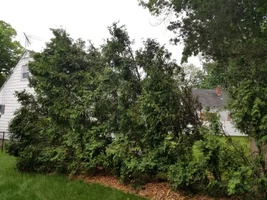
 
I think nurseries have a strap like material that would hold them up. Do you have a large tree or something suitable to hold the weight of all of them directly behind them? You will need good rope and some knot skills. After you get them back up they will have to leave them for at least a year. I just did something like that not to long ago with much taller shrubs. That dose not look like it would be too hard.
 
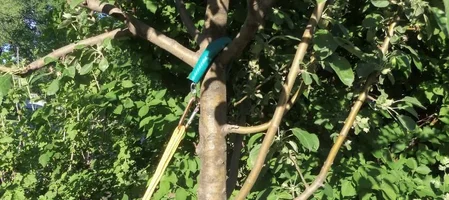
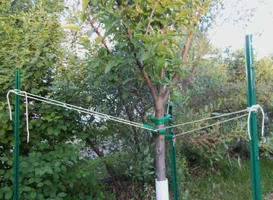
I drive ordinary, 6' T-posts into the ground on the opposite side of the lean and use 1/4" polyester rope (with the pieces of old garden hose for a cambium protector) and pull them back up plumb. As you guessed, you'll need to leave them staked up this way for a full season or two. You may want to use two posts per tree/shrub, both on opposite side of lean and spaced a couple feet apart, for better stability against the wind. I've successfully staked up fruit trees this way that were almost pulled out of the ground. The worst one at my house, an apple tree that the storms nearly tore out of the ground, we staked last year in March, is full up with new apples and there is almost no tension on the ropes unless it's very windy. I'll leave it staked, anyway, until sometime next summer. I could probably remove the stakes now, but I think it's better to give them another full growing season, in case there are fall/winter/spring storms, again.

You'll want a T-stake post driver (you can get them at any farm store and most home improvement centers) because they'll drive the stakes in deep with little effort. You want to drive them in about 2 feet. The best way to get the stakes back out of the ground is to use a Hi-Lift jack (sometimes called a farm jack) and those are also easy to come by from any farm store (TSC, Orscheln, etc.) or just borrow one for the job.You probably won't need any mechanical advantage device to pull them back up... tie the rope around a stake, go through the hose and around the tree at a slightly upward angle (you may have to go above a crotch so it can't slide down the trunk) and pull it up by pulling the rope back toward the stake. When it's in position, mark where the rope is at the stake, release tension and tie a loop that has the mark you made at the END of the loop. Pull it back up and loop this over the stake. Repeat for each stake, and for each tree/shrub. You can drive the stakes into the ground so they are at a slight angle AWAY from the direction of lean, which helps a little with the ropes staying where you want them, and with keeping the tension of the tree from moving the stakes inward.

If you can, get a helper to PUSH on opposite side of tree you're pulling from to make it easier to get this done. My wife and I can do this with 20' fruit trees by ourselves. On one pear tree, we did use a big, racheting tie-down strap to help generate enough force to pull it back plumb. I just hooked it to the front of my truck and hooked the other end onto a nylon loop sling wrapped around the tree about six feet up.

Polyester Rope
Farm Jack
Post Driver

Use polyester rope.. it has good UV resistance. Other types do not.
 
Last edited:
staked-apple-tree.webp
Like this...

staked-apple-tree2.webp

This one I angled the ropes up the other way and went below the first union... and used 3 of the T-posts because it was getting whipped around a lot by the wind from multiple directions. Really, this is the best way... keep the trunk stable so it's not moving around from the wind load. The upper stems can handle the flex, but if the root ball has been disturbed, the main stem will need one or two growing seasons to stabilize, again.
 
I love to learn!

My father was a college professor, and he used to tell me that when you announce to the world that you already know everything (I was about 13 and therefore knew it all) that all you're really doing is proving to the world that you're an idiot.
The guy had a masters in both engineering and architecture. I figured he might actually know what he's talking about, and took his advice to heart. I still like to research stuff, and the internet makes that much easier than it was back then, when I'd spend hours in university libraries looking for information on something that interested me.
I'm still an idiot, but I've gotten very good at it! :D
 
I had a long stand of hollies i had to pull straight again. They are too tall to use that method. Also the roots were fine. We had to use a 2 to 1 system to set the big ones. All of them looked like those little evergreens do.

Sent from my Z965 using Tapatalk
 
Hi, thanks everyone for your help. To the right of the picture is a huge ceder tree. What do you think about using ratchet straps like this from Home Depot to strap the first one to the tree, then the second one to the first one, and so on?

https://www.homedepot.com/p/Husky-1-in-x-12-ft-Ratchet-Tie-Down-4-Pack-FH0829/300319116

Can I use one tree to support another, which is supported by the tree in other words?

Or really is the only proper way to do this with 6' stakes? If so, can I still use those straps?
 
The ratchet straps are good for pulling the tree into position, but you run the risk of people stealing the ratchet straps, and they're overkill. They're also quite heavy and you're likely to end up using way more tension than is needed, just to keep them tight enough not to sag. Really not so good for smaller trees and shrubs. I've tried the lighter duty 1" ratchet straps, but ended up swapping them out for the rope within a month.

You can use a larger tree for support, if you do it down low on the trunk, but that only gives you support in one direction. Even if it's in the right direction (opposite the lean of the affected trees) things are going to whip around in the wind a lot. Remember to ensure nothing is cutting into the bark of the support tree. If it cuts down to the cambium, you'll end up with that one getting mostly "ringed" and parts of it will start dying.

You can try it, of course, but I think you'll find that the more work you try to save yourself, the more you'll end up doing. I've tried a lot of different things over the years, and always end up right back where I started. T-posts and 1/4" dacron polyester rope and pieces of garden hose. Screw-in-the ground 5/8" x 3' steel anchors for bigger trees. Nothing else I've tried works any better or cost me any less.

Of course, your mileage may vary. :)
 
Rope and sleeve like Jeff suggests is a good idea. Monitor to make sure that there isn't bark
Damage

When I can my preference is to use flat webbing to make slings. Anywhere from 1" flat webbing like on backpacks up to 2" rigging and ratchet straps. You can tie loops using an overhand or figure eight follow through. More knot research. :). Webbing spreads the load and reduces the girdling potential. Most times it's overkill though. Not needed when simpler solutions are good enough

A few times that I've guyed tip overs a bit of pruning helped. Structural first, taking out or reducing double leaders. If there are 'blobs' of heavy, thick growth out at the ends it can create leverage that's working against you. Don't think that pruning is mandatory, just an option

Whatever you come up with would be interesting to
See. As you know...if you don't post pics it didn't happen haha

Oh...welcome to Treebuzz

Where is home?
 
If you are somewhat proficient with knots, you can use 1 rope with a series of alpine butterfly's tied along its length. You will need to anchor the pull end to either a stout tree or a dug in dead mans anchor. Attach to each bush/ tree its own padded tether with a random length of cordage. Near the bush on that cordage tie a loop that you can hook a ratchet strap to. The loop will be abandoned or can be used to cinch. Starting with the bush closest to the anchor, attach ratchet strap to loop and the other end to anchor... ratchet until straight or tree is broken! Once the tree is upright take the tail of the random length tether and secure it to the nearest loop. Remove ratchet strap and repeat process until all are upright.
Be advised additional lateral supports may be required. In addition, the comment about damaging the roots- they may already be damaged and by pulling on them you may exacerbate the issue. It's a risk you must be willing to take. Depending on the composition of your soil, moistening before the procedure may be beneficial. Good luck
 
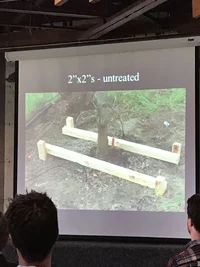
If it’s tight I’ve heard this can work if you can’t get the space to guy things.
 

Attachments

  • 32D1682C-CA2D-4AA0-9381-A5505B423F0C.webp
    32D1682C-CA2D-4AA0-9381-A5505B423F0C.webp
    177.4 KB · Views: 11
Good alternative for at planting too.
Got that from an Ed Gilman talk that was a planting talk. But I figured it’d work pretty much the same. If I recall it’d be minimum 2’ stakes with long sharp drawn out angles not just the tips. So they can be pounded in and untreated spruce so they can rot and not be a problem later on. Just make sure you clean up the screws eventually so they don’t go through the lawn mower.
 
wooden dowels instead of screws to avoid leftover screws.


Water the trees extra, due to some root damage.

Proper mulching, below the exposed Root Collar, will help with drought stress.
 
wooden dowels instead of screws to avoid leftover screws.


Water the trees extra, due to some root damage.

Proper mulching, below the exposed Root Collar, will help with drought stress.
Mulching ‘below’ the root collar, what do you mean by this?

I like the dowel idea then it can rot as it likes.

As far as watering goes, do water due to root damage as needed but our last storm brought down a lot of conifers do to over saturated ground so keep the factors in mind when you water

I agree pull the mulch back cause the outside ring of the root ball needs it and trunk doesn’t.

Also mulching at planting sure I hear you but do you guys mulch in these scenarios when you stand something back up or do you leave root plate area exposed for visual inspection?
 
Another question on the original picture if using ma ratchet, b&t, etc how much pressure/force would you leave on a stem for how long to try and correct it? At planting you’d never stake it to need significant pressure you’d straighten the tree but here you can’t adjust the root plate
 
If your trying to save penny's you'll never make dollars. Higher a professional. THe time your spending on discussion and buying materials you could of paid soneone couple hundred and not worried.
 

New threads New posts

Kask Stihl NORTHEASTERN Arborists Wesspur TreeStuff.com Teufelberger Westminster X-Rigging Teufelberger
Back
Top Bottom