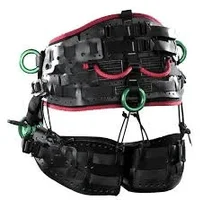
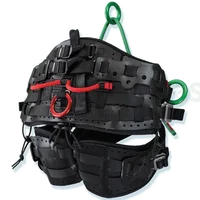
Tree motion rear connector "life support".

JoshR

New member
Location
Alabama
Ok guys, I thought I read somewhere that there is a connection point on the back of the harness. If true, is it the center point that was once referred to in product descriptions as a balanced saw attachment point?

If this is true, and wherever it actually is, does anyone here ever utilize that feature?
 
upload_2016-8-4_17-40-41.webp upload_2016-8-4_17-41-18.webp
So the idea is on the TM that if it is green then it is life support.
  • Standard version has rated ring in the back of the saddle - Super Light has smaller, non-rated ring in the back of saddle.
  • logical, color-coded distinction between PPE attachment points and gear loops
I have never used it for life support.
 
My 1st and 2nd TM's had the red connector and my new barely used one has the green...saying this it just does not have a damn use...but hey I am a minimalist....never owned a light version
 
For rescue maybe? Otherwise I can't imagine that getting used very often. I've got the old red ring personally. I consider it a badge of honor and I'm dreading having to replace my rig soon.
 
Dudes.... It is for a short lanyard to keep you from jumping out of a bucket that stays out of your way... Right? That's how my falcon explained how to use the rear point. Not fall arrest, fall prevention.
 
That doesn't sound legit to me. I think you have to have a fall arrest harness in a bucket.
I'd have to look it up, but I think a waist belt is legal under some circumstances so long as the lanyard doesn't allow you to physically escape the bucket or basket.

@Tom Dunlap I'm sure you know exactly the circumstances in which a TM rear attachment should be used for life support. Want to set us straight?
 
Tree workers have been tossed out of buckets as a result of dynamic loading events that created a catapult effect, in which case it won't matter how long your lanyard is you're leaving the bucket. Fall prevention makes sense for construction workers in some circumstances but can't be considered safe for use in an aerial lift in my opinion.
 
Tree workers have been tossed out of buckets as a result of dynamic loading events that created a catapult effect, in which case it won't matter how long your lanyard is you're leaving the bucket. Fall prevention makes sense for construction workers in some circumstances but can't be considered safe for use in an aerial lift in my opinion.
That would make sense... But then why does the treemotion need a point there? Do they sell a shoulder harness that is life support and hooks to it?
 
I have the older model with the red ring in the back as well. I didn't realize that about the color coding. Thanks for pointing that out. John kays.
Precursor, currently I have a protrusion in my L5 S1 disc. My chiropractor says that twisting under load is one of the main culprits for these kinds of injuries.

Example: I've got a high tie out in a tree and there is a lonnng limb that I have to work my way out to the end of it. Now, for whatever reason let's say that in this situation, in order to be out of the way of the rigging line "trajectory", and to be in a non compromising bodily position, you need your back to your TIP. Here I am in my TM, using a rope wrench setup, and I'm going to choose to put my main line around my left or right hip. If I need at any time to put my weight on that line it will twist my back one way or the other. my back will be under load as well.

So, that's why I'm thinking that if I could, say, throw a Prusik for example, around my rope above my RW. Then, I could run a short 8 or 9 mm line or some webbing and hook it to that center back ring and maybe that would eliminate or reduce negative twisting pressure.
 
I guess the main focus of what I'm getting at is, injury prevention and longevity of the body. Any of you guys that don't have back issues may not have any issue with this kind of stuff. But, unfortunately through experience I've learned that I've been too hard on my back. So I'm in protection mode. And I'm out from climbing for like 8 to 12 weeks
 
Last edited:
I guess the main focus of what I'm getting at is, injury prevention and longevity of the body. Any of you guys that don't have back issues may not have any issue with this kind of stuff. But, unfortunately through experience I've learned that I've been too hard on my back. So I'm in protection mode. And I'm out from climbing for like 8 to 12 weeks

I'm really sorry to hear that you're out from climbing for 8 to 12 weeks. I don't know that I entirely trust chiropractors when it comes to taking care of back injuries. They can't prescribe medications that might be needed, for example. It's probably expensive, but some kind of real doctor who specializes in problems of the spinal cord might be good to consult with.

When you think it might be time to go back, take it really slowly and see how things feel. I had a bad back muscle pull once; thought it was healed up fine, could walk around and bend at the waist no problem, no pain. It was only when I tried to return to work and start lifting stuff like I used to that the pain came back with a vengence.

So my point is that you should do successive approximations of the work you normally do while on your own time, before declaring yourself fit for duty, and then finding out you were completely wrong about it. Especially if you are on workman's comp right now.

I really hope you find a good solution; back problems are a scary thing, because if its not all working right, it can be tough to make a living.

Best wishes.

Tim

 
I'm really sorry to hear that you're out from climbing for 8 to 12 weeks. I don't know that I entirely trust chiropractors when it comes to taking care of back injuries. They can't prescribe medications that might be needed, for example. It's probably expensive, but some kind of real doctor who specializes in problems of the spinal cord might be good to consult with.

When you think it might be time to go back, take it really slowly and see how things feel. I had a bad back muscle pull once; thought it was healed up fine, could walk around and bend at the waist no problem, no pain. It was only when I tried to return to work and start lifting stuff like I used to that the pain came back with a vengence.

So my point is that you should do successive approximations of the work you normally do while on your own time, before declaring yourself fit for duty, and then finding out you were completely wrong about it. Especially if you are on workman's comp right now.

I really hope you find a good solution; back problems are a scary thing, because if its not all working right, it can be tough to make a living.

Best wishes.

Tim

Thanks for actually reading my wordy post haha. We differ in our trust in chiropractors. Mine is older, experienced, and he went to school for around 8 years. Very knowledgable about the human anatomy and physiology. I'm reffering with my primary doc As well but, the way I see it, even the medical doctors can be wrong so, Im gonna take a little from both.

Anyways, after my disc heals up, I'm going to have to seriously work at sacrificing speed and "gettin it done" for proper or better positioning with the "maximum" effect on bodily health. I have a feeling that it's gonna be like learning how to climb all over again.
 
[snip]
So the idea is on the TM that if it is green then it is life support.
  • Standard version has rated ring in the back of the saddle - Super Light has smaller, non-rated ring in the back of saddle.
  • logical, color-coded distinction between PPE attachment points and gear loops
I have never used it for life support.

Your post reminded me of reading an explanation of this
http://www.treemagineers.com/blog/making-it-intuitive/

This is a great blog for those who haven't stumbled upon it. Mark is a really interesting guy who I hope to meet one day.
 

New threads New posts

Kask Stihl NORTHEASTERN Arborists Wesspur TreeStuff.com Teufelberger Westminster X-Rigging Teufelberger
Back
Top Bottom