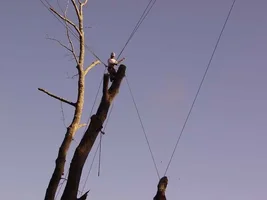
work position on hazard tree

Same pic as the last.

I'm just playing with the image size to see what best fits the screen. This is a little smaller still.

Anybody have a preference?
 

Attachments

  • 14960-resize1646piece_in_air.webp
    14960-resize1646piece_in_air.webp
    19.6 KB · Views: 114
Thanks for the good pics. It seems that too often the background is terrible for pics.

The exploding knots would have some merit. It would be easy to come up with a trigger weight. Keep the ideas coming!

Tom
 
BC,

Graeme is using a slip hitch for sure. I have the real footage of that. I was very lucky to get to know Graeme a bit and he offered some footage to me that was a treat to watch. He has a unique enviroment to work in and deals with situations in a complex way. Quick as a whip. I hope to work with him on something someday. Great stuff.

Have you ever seen anyone use explosives on a tree removal before? /forum/images/graemlins/shocked.gif
 
that was one heck of a top to drop off and have a rope catch it! It doesn't look like it ran at all, did it? Amazing something didn't snap.

many questions about that video.

Looked like the time it took to yank out that knott you could have unsnapped it much faster, maybe have a slip hitch and a snap so if you didn't have time to unsnap, the slip would give way under heavy shake or failing trunk.

don't get me wrong, I'm sure those guys know what they are doing. just stating what things looked like in the video. Looked a little tense.

The video took so long on my junk computer I didn't want to wait on the others, but the still pics on the site are amazing too. Whole nother scale that's for sure.
 
Mark,
In my field, natural resource management in the PNW, it is fairly common to use explosives to top trees for snag creation. That is a takedown of a fashion, just taking the top 1/3 to 1/2 of the tree and leaving the rest for the critters. It is pretty wild to watch...not something I do myself as I'm not a blaster. I do know that there are two things you don't want to happen...either under-charge the tree and then be left with a top that doesn't blow free, or have a failed charge with no real assurance of why. You really don't want to climb up to correct either situation /forum/images/graemlins/shocked.gif.
 
I remember reading that Jerry Beranek used to clip in to his belt buckle loops on his pants in a tree that he was not confortable with. This is not a bad idea because you can still use your regular lanyard.
 
Thinking about it later, I decided that it did probably ran a lot more than it looked.

I viewed a short video clip of a large limb I recently roped down and my groundman let it run a lot at first. On video it doesn't look like that much and even looked like he stopped it all of a sudden, which was not the case, it was supper smooth.

Also I think that video we are talking about, the camera panned down and missed the run part.

I think he bailed cause being that high up and taking that heavy of a load he didn't want to risk being tossed around on that trunk, or maybe even the possibility of the trunk snapping off if the material didn't run?

I think picures and videos can be misleading, so I'm sure they knew what they were doing.

I like Jerry's belt loop idea!
 
Any body ever use a rock climbing set up in a tree where there was a chance of failure below where you needed to work? I never have but have considered it as an alternative to taking a grounder. Of course you would have have to use dynamic rope then there would be the issue of a belayer and if'n you were to fall with a chunk of tree tied to you. And this would for sure be a last resort if there were no other trees to tie into or crane access. These preceeding post have some excellent ideas and solutions to a tricky situation.
 
[ QUOTE ]
These preceeding post have some excellent ideas and solutions to a tricky situation.

[/ QUOTE ]

You're right here. I agree that there are some situations that arise that would require a technique like the ones discussed, but also stress (especially for newer climbers) that this situation should cause you to really, really comtemplate the scenario. It is also possible that it may be above your head, or even above all of our heads. The option to pass on the job is also a smart possibility!
 
Skew, what you have described is basically the system USFS climbers deploy when working in the uppermost portion of the crown of conifers. Picking cones or collecting grafting scion requires the climber to work above the point in the tree where one can be assured that one's weight will not cause failure of the lead or limbs. We tie in with a self-belay system at a bole diameter of not less than 4 inches and place protection, which consists of a basket hitched sling and carabiner, every 3 feet up the bole from there. We use a dynamic line for this, as the climber is often above the last anchor point. Attachment of climber's harness to the belay line is by prusik hitch or mechanical rope grab. This self-belay line is a separate unit to the tree access system, which is left behind below the "danger of breakout zone". We actually do sometimes use a ground-based belayer system to accomplish this, but complications with deployment and good visibility between climber and belayer usually relegate it to infrequent applicability.
 
I did exactly that with a Ddrt system once in a dead White Pine removal. I shudder when I think of it. Footlocker was on that job. I went to remove 3 baby squirels from their nest before I poped the top out. The pine was so dead that there wasn't any bark on the stem above 40'. Scared the shyte out of me.
 

New threads New posts

Back
Top Bottom