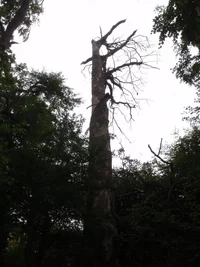
Wildlife cuts

I was at the TCIA expo and walked up near the end of a presentation on using cuts to promote wild life on dead or dying trees that don't pose a danger buildings or targets. I was curious if people could share what they know about this or any good books or websites that would have information I could use.
 
there was a thread here awhile back about that. They had a name for it that would probably make for a quick search, but I don't remember what it was. Someone will probably help out soon, but if you work hard enough, you might search it out (it's from at least a few weeks ago).
 
odd, I was just talking to a guy about this yesterday. he said he saw a presentation where they showed 18 different cuts to perform that each benefits a different type of critter. He said he had some paper from the presentation, next time I see him I'll ask him about it.
 
if the target is 30 feet away make the trunk 29' long.

the type of cut you make depends on the type of critter you invite.

a more specific question will elicit a more specific answer.
 
I believe the thread referenced is 'Dead Wood' which is pinned second from the top in General Discussion. One of the cuts I have heard mentioned is called the 'Corona Cut.' I can't remember the specific method or purpose, but I thought it was to promote wildlife habitat. Guy? Help?

-Tom
 
I like the post. A fella that owns a company up here explained this concept to me back in 99. He called it habitating. The theory was that various and diverse types of breaks, splits etc promote critters and wildlife. I know nothing of which specific cuts, after seeing a seminar by Ted Green a couple years ago i connected the dots a bit. I have "hacked" up the top of about 15 trees in the last 10yrs. Various shapes and trees have been tried. I think it works great where you use it. Personal opinion.
 
I don't know about any "cuts" that you can make to encourage more wildlife to inhabit a standing spar or section of a tree. Would be interesting if certain notches attract certain insects which in turn attract certain bird species.

The coronet cut is a funny one, and I think has no real benefit to wildlife, but does make a cut look more like storm damage.

Where possible, I try to counsel my clients about the benefits to leaving standing deadwood in terms of wildlife, mostly birds. I wonder if you could hollow out a trunk for say, an owl. You could fill it with dead rodents to entice the wise raptor.


SZ
 
Topping trees at an appropriate height, above a few live branches can be great.

Spike the tree a bunch to induce wounds.

Flush cut some branches to start cavities.

I use the tip of the bar to start hollows.

Specific cuts to specific animals. Bird and bat boxes can be installed in addition to the natural processes. An example are wood duck boxes that have an appropriate sized box/entrance hole/ height/ orientation to the water.

A wildlife biologist suggested a low power rifle to blow the tree apart.

Partial top-cuts through low branches that will droop to the ground and stay alive for a while. I've done this at my house, not on this tree.

Loose bark plates can be bat-itat.

Perch branches are good, with an opening through the branches for birds to be able to land and take off without too much impediment.

Dead Noble Fir one year after cutting. Normally I woundn't do this in the front yard, but that what the client wanted. It has a clear groundfalling dropzone for the future removal if it becomes a hazard.

P1020726.jpg


P1020727.jpg


P1020728.jpg


P1020728.jpg


I notched out triangular shaped pieces to simulate the broken effect.

In the part missing bark, there is a cavity start. Don't know if this will become used or not.

If you top the live tree, it will grow solid wood around the outside, with the heart more prone to decay, which is good, both for stability/ longevity (the tree can be girdled in a few years if you don't want the new tops to become too big).

Brush piles around the base and in the vicinity are good habitat, as well as large "coarse woody debris" like thick log sections.

 
i have been working on the veteran pollards in burnham beech's in the uk for a few yrs on & off. a tec that the corperation like to adopt for pruning in the higher canopy near the pollard's is called 'veteranising' this envolves leaving max deadwood, back cutting branches to promote rips, leaving loose bark, useing spikes on live trees, boaring saw at 30-45% angles into the branches & trunk, part cutting the tops of trees & winching the rest off & alot of other methods of generaly mutilating trees. This as far as i can make out will age a tree premituarly & introduce fungi, invertarates, lichen & wild life that prefer trees with wounding for shelter, along with visitors that feed on all of these. i think in short take all the things you have learnt about tree care forget! the correnet cut seems to have the lable of being mainly a cut to make a tree look as if it has lost its top naturaly without much habitat significance. i have heard that the more chainsaw cuts made to reproduce wounding can be detrementle as the action & friction/heat of a chainsaw as opposed to a handsaw or just breaks quaterize the wound thus making them sterile & less atrective to fungi ect. ted green as mentioned in the post brought a guy from europe to the beeches to virgin pollard trees with an axe, not sure of the results it will prod. he knows alot about this subject.
post is of tree i cut for habitat
 

Attachments

  • 202312-P6180079.webp
    202312-P6180079.webp
    125.6 KB · Views: 83
[ QUOTE ]
the more chainsaw cuts made to reproduce wounding can be detrementle as the action & friction/heat of a chainsaw as opposed to a handsaw or just breaks quaterize the wound thus making them sterile & less atrective to fungi ect.

[/ QUOTE ]good point thanks for posting.

there are tree-friendly ways to create habitat too; veteranizing is an unfortunate term because it's done for bugs and crud not trees imo.
 
Thanks for the great post southsound, and others. I gave a general question for general answers and I appreciate them. I know little about the subject so I thought asking a general question would be better to ask before specific.
 
"Brush piles around the base and in the vicinity are good habitat, as well as large "coarse woody debris" like thick log sections".

It's also a good way to attract undesirable wildlife like Peromyscus and Neotoma rodents, known carriers of the Hanta virus.
 
[ QUOTE ]
"Brush piles around the base and in the vicinity are good habitat, as well as large "coarse woody debris" like thick log sections".

It's also a good way to attract undesirable wildlife like Peromyscus and Neotoma rodents, known carriers of the Hanta virus.

[/ QUOTE ]
Yes. I suppose there is the good and the bad. Each area, each land/homeowner, each situation specific. Not really good in New York City I suppose.
 
there are tree-friendly ways to create habitat too; veteranizing is an unfortunate term because it's done for bugs and crud not trees imo.

[/ QUOTE ]

Hmmm...(yes I know....the sound of Sean climbing into the saddle of his hobby horse....)Guy "bugs and crud" are just a little connected to the very trees that many of us value as much as you, disassociating them in the minds of other tree people and our clients is not really a great idea imo.

I promise not to derail...

I am interested in whether the intention is to provide specific habitat for specific species, or whether it is reflecting a more general desire to reduce the loss of deadwood habitat that is a smuch an issue for the urban forest over there as it is over here.

It would certainly have been difficult to sell leaving the standing dead tree in southsoundtree's post with an intact dead crown given its proximity to the house.

My understanding talking to some of those who "pioneered" the coronet cuts in the UK was that such cuts were principally aimed at creating a visual effect similar to storm damage not that they thought it was preferred habitat to fungi or insects, tearing cuts are going to produce some of the habitat niches in that regard.

It is true that if we wish to provide habitat for specific species that we value then we are only limited by oiur imagination, and as Guy has said there are ways and means of providing that habitat without significantly compromising the structural integrity of the host tree.
 
[ QUOTE ]
Guy, What are some tree friendly ways to promote wildlife?

[/ QUOTE ]

1. Jam sticks into forks as foundations for nests

2. Excavate decayed hollow to increase den size.

3. Use logs as erosion bars, and pack low spots in natural areas with brush

4. fasten bark plates on big trunks for bats.

etc. etc. I got a ppt on this; wish i could attach it here:

Ornitho-Arboriculture: Advanced Tree Care Strategies Increase Wildlife Habitat

When arborists remove dead branches and dead trees, they remove valuable habitat. But there are many ways that urban trees can be managed to increase habitat, from crisscrossing branches in treetops for raptors to installing bathouses and birdhouses to laying logs against the earth to control erosion, build the soil, and give a home to small but ecologically important critters.
 

New threads New posts

Back
Top Bottom