Why professionals dislike RADS?

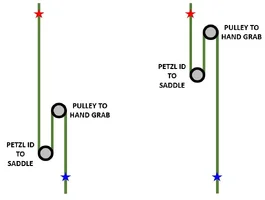
It is 1:1 as illustrated in this sketch I've attached. The red and blue stars in the sketch do not move as you ascend from the left position to the right position. While it may feel like you're tending more rope than you are actually moving upwards, the rope never moves vertically. If it were anything other than 1:1, the distance between the red and blue stars would change.
 

Attachments

  • RADS 1-to-1.webp
    RADS 1-to-1.webp
    14.8 KB · Views: 22
The distance between the two stars does indeed change, every time you pull on the rope and the lower pulley moves up with the load. The rope moves twice the distance that the two pulleys close up. But the stars return to the same spacing when you take another bite basically because the overall rope stays the same length and you are adding no rope to the system. Your premise only holds true if the two pulleys are stationary the same distance apart and never move closer, or you only measure when the pulleys are returned to the same distance apart. In any mechanical advantage the overall length of the rope stays the same no matter how many pulleys it moves through and if you always return the pulleys to the same spot each time, as your drawing implies. Then the stars will stay the same distance apart, whether 1:1, 2:1. 3:1 or whatever. The degree of mechanical advantage has nothing to do with rope length, but is directly related to how much the rope moves in relation to the lower pulley moving up (the movement of load vs. rope movement to move that load is all that counts). The test here for MA is to forget the upper pulley which merely changes direction, and focus on what the lower pulley does by itself if the rope merely leads back upward. Watch the load upward movement vs. the rope upward pull amount needed to raise the load.
 
That is precisely my point. Yes, there is some MA "within a portion" of the system, but as a whole, it's 1:1.
Nope, sorry. Think through it again. MA ratio does not apply to the whole climbing system in this example. That portion of the system you isolate above is the ONLY place any MA happens. The MA happens with the distance the load moves up vs. the length of the rope needed to do that EACH TIME THE ROPE IS PULLED. And the MA governs roughly the same ratio of force needed. The load will move up half the distance the rope is moved through on the pull side and, aside from friction, the pull will require about half the weight of the load. Notice the two stars in your drawing will move part TWICE the distance the load moves up, or 2:1 MA. There is no MA happening anywhere else in the rest of the climbing system above the load or below the pull. The 1:1 you discuss is a non entity, has nothing to do with MA or what is involved in lifting the climber each time the rope is pulled. It is merely the obvious ratio of relative position of the ends of the rope each time the pulleys return to the starting point once the MA has finished and the upper pulley is shifted back up the SAME distance each time. None of that last stuff is MA. And your 1:1 does not even happen if the upper pulley happens to be shifted a slightly different distance up the rope before the next pull of MA. Your stars will not line up then. I think it is time for a beer.
 
It is 1:1 as illustrated in this sketch I've attached. The red and blue stars in the sketch do not move as you ascend from the left position to the right position. While it may feel like you're tending more rope than you are actually moving upwards, the rope never moves vertically. If it were anything other than 1:1, the distance between the red and blue stars would change.
Not to jump on anyone.. This is far from whats going on in a rads... It's a compound system on a complex.
The system when tended from a groundie is 3:1.. When the climber is doing the work you get to add 1 ma. This proven theory is exactly how a double rope system is a 2:1 and not just a 1:1 redirect.

So starting at the anchor/tie in/PSP

rope goes to climber then back up from the hitch pulley. Both legs are supporting the climber holding 50% of climbers weight. now if the climber could pull theirselves up this way that would be a 2:1, BUT this sucks and is not a efficient use of ones bodies muscle groups.

Sooo, you hang a extra pulley off the PSP side to redirect that line, creating the same mechanics as a double rope system pulling on a 2:1 system.

This creates 4:1

Hard to wrap ones brain around this, but when the load is doing the work things change. Now if one was to use this as a pick off, or say a groundie yarding up a climber the system is a 3:1..

Smoke a fatty on that one...

your stars do change, every pull on the rope.
It pulls the tail downwards
but then one must move the top pulley up
then the tail goes up as the distance between the pulleys gets further apart
 
You have a 150' rope, anchored to a branch 50' above you, and your upper pulley is all the way up at the branch. 50' of line runs down to you, 50' back up to the pulley, and the last 50' of the tail runs back down to you.

You pull yourself all the way up to the branch: 100' of rope will be lying on the ground. You've pulled 100' of rope past the starting point, but 150' past yourself. That's why it's a 3:1 - you had to pull 150' to go 50'.
 
Close, Tuebor, but the mechanical advantage in your setup above is only 2:1. This is admittedly a gray area and hard to visualize. The last 50 feet of rope down to you after the upper pulley is indeed another third extra length but it is only there because of the upper pulley changing the direction back down. The advantage in force is the same as if you had someone at the TIP pulling up on the tail without the upper pulley. It is only the movable lower pulley that is doing work and giving advantage. The rope pulled through the pulleys only really counts before that last fixed shiv which is just a redirect shiv. Think about the situation that when you pull on the tail on the ground, you might back off a ways first, adding say another fourth 50 foot length you have to pull to you. Is this suddenly 4:1 because of 4 times the rope pulled to you? Or lets say you were standing on a ladder right under the upper pulley and thus did not need the last 50 feet of rope? Have you added or lost any mechanical advantage with changing tail length? What I mean is the length of rope after the last fixed shiv is not counted in MA. It is not adding anything to the reduction of force. The thing that is even harder to grasp about this is you could add even more stationary pulleys to redirect the line, lets say another several scattered about to lead the rope up to another tree and then down to you again. Confusing! But MA is still the original 2:1 since this added rope length is just through redirect pulleys and really is no actual help (the added friction of more shivs in fact will hurt). A fixed upper shiv is just redirect, not contributing to MA ratio.
 
You have a 150' rope, anchored to a branch 50' above you, and your upper pulley is all the way up at the branch. 50' of line runs down to you, 50' back up to the pulley, and the last 50' of the tail runs back down to you.

You pull yourself all the way up to the branch: 100' of rope will be lying on the ground. You've pulled 100' of rope past the starting point, but 150' past yourself. That's why it's a 3:1 - you had to pull 150' to go 50'.
That has always been my perspective, but now evo has me doubting myself, so I am still working on that fatty and plotting a response. It could be a while.
 
Here is one thing that can help make this all more confusing: Consider the case of a single fixed upper shiv like a classic DRT setup with shiv at the TIP. To raise yourself, the pull needs to roughly equal your own weight. This shiv is simply getting the rope back down to you to pull on, just a redirect. If a groundie is lifting you, he will pull a foot of rope for every foot you rise and if you weigh 200 pounds, he needs to pull 200 pounds. BUT, the amount of rope moving past YOU is actually twice the amount he is pulling from his fixed position on the ground. The rope is sliding down past you a foot as you rise a foot, making a total of two feet, and this would be your experience if you were pulling on the rope yourself, two feet pulled past you to rise one foot, yet with only 1:1 MA ratio (that is to say, no MA basically). So add a lower shiv for 2:1, but pull three times the rope if the pull is coming from the load, etc., and this is where it begins to get fuzzy!
 
Last edited:
Close, Tuebor, but the mechanical advantage in your setup above is only 2:1. This is admittedly a gray area and hard to visualize. The last 50 feet of rope down to you after the upper pulley is indeed another third extra length but it is only there because of the upper pulley changing the direction back down. The advantage in force is the same as if you had someone at the TIP pulling up on the tail without the upper pulley. It is only the movable lower pulley that is doing work and giving advantage. The rope pulled through the pulleys only really counts before that last fixed shiv which is just a redirect shiv. Think about the situation that when you pull on the tail on the ground, you might back off a ways first, adding say another fourth 50 foot length you have to pull to you. Is this suddenly 4:1 because of 4 times the rope pulled to you? Or lets say you were standing on a ladder right under the upper pulley and thus did not need the last 50 feet of rope? Have you added or lost any mechanical advantage with changing tail length? What I mean is the length of rope after the last fixed shiv is not counted in MA. It is not adding anything to the reduction of force. The thing that is even harder to grasp about this is you could add even more stationary pulleys to redirect the line, lets say another several scattered about to lead the rope up to another tree and then down to you again. Confusing! But MA is still the original 2:1 since this added rope length is just through redirect pulleys and really is no actual help (the added friction of more shivs in fact will hurt). A fixed upper shiv is just redirect, not contributing to MA ratio.
Right. Arbs seem to look at how much rope is moving. That's why I said in my earlier post:

If you're talking about the amount of rope to pull to move one foot, it's a 3:1.

If you're talking about mechanical advantage, it's a 2:1.
 
I should clarify what I said above, in that there is a difference where the pull comes from, whether from load itself (the climber) or from, say, the groundie, with my statement that the pull to raise your weight must equal your weight with a fixed upper pulley. This is not completely true If you yourself are the load, pulling on the tail of a DRT system or single upper pulley. It is more accurate to say that the pull must equal your weight only at the instant you are pulling. And by being the load yourself, you instantly reduce this by slightly more than half as soon as you lean hard into the pull. You transfer slightly more than half your weight off the load and onto the pull and so you rise. This feels like MA and indeed works to your advantage as such, but the actual ratio is in fact still technically 1:1, loaded weight at that instant vs. pull required at the same instant. You pull down with some weight which you automatically have instantly removed from the load side. On a practical level, I would have to agree this is a bastard form of mechanical advantage which feels to the climber as roughly 2:1 and this is what counts at that moment. So I admit I am not sure how useful all this technical discussion actually is to most of us. But I used to teach this stuff to shipyard riggers once upon a time, so it is easy to lapse into that mode.

 
I should clarify what I said above, in that there is a difference where the pull comes from, whether from load itself (the climber) or from, say, the groundie, with my statement that the pull to raise your weight must equal your weight with a fixed upper pulley. This is not completely true If you yourself are the load, pulling on the tail of a DRT system or single upper pulley. It is more accurate to say that the pull must equal your weight only at the instant you are pulling. And by being the load yourself, you instantly reduce this by slightly more than half as soon as you lean hard into the pull. You transfer slightly more than half your weight off the load and onto the pull and so you rise. This feels like MA and indeed works to your advantage as such, but the actual ratio is in fact still technically 1:1, loaded weight at that instant vs. pull required at the same instant. You pull down with some weight which you automatically have instantly removed from the load side. On a practical level, I would have to agree this is a bastard form of mechanical advantage which feels to the climber as roughly 2:1 and this is what counts at that moment. So I admit I am not sure how useful all this technical discussion actually is to most of us. But I used to teach this stuff to shipyard riggers once upon a time, so it is easy to lapse into that mode.
Ok, I changed my mind.

If we are strictly talking of mechanical advantage, then by definition, that is the ratio of force output to force input. For the combination of a fixed pulley and a moving pulley, that's a 2:1 mechanical advantage, IF the pulling force is being applied separately from the moving pulley, such as a groundie pulling your tail and hoisting you up on your RADS system. (And he only has to pull 2 feet of rope to move you up 1 foot.)

But in the case where the pulling force is being applied at, or by the load, it's a 3:1 advantage, and the climber has to pull 3 feet of rope to move up 1 foot.

So RADS is a 3:1 mechanical advantage as well as being a system that requires 3 feet of rope to pull to move up 1 foot.
 
Ok, I changed my mind.

If we are strictly talking of mechanical advantage, then by definition, that is the ratio of force output to force input. For the combination of a fixed pulley and a moving pulley, that's a 2:1 mechanical advantage, IF the pulling force is being applied separately from the moving pulley, such as a groundie pulling your tail and hoisting you up on your RADS system. (And he only has to pull 2 feet of rope to move you up 1 foot.)

But in the case where the pulling force is being applied at, or by the load, it's a 3:1 advantage, and the climber has to pull 3 feet of rope to move up 1 foot.

So RADS is a 3:1 mechanical advantage as well as being a system that requires 3 feet of rope to pull to move up 1 foot.
Yes, on a practical level, that's it in a nutshell The pros and cons of RADS - great MA if you need it but lots of moving rope and s-l-o-w progress up. But as others have said, works fine for a short traverse, positioning, stuff like that, even if not the main system. I have been using an old foot ascender with RollclipZ hanging off it for the shifting upper pulley and was intrigued by the gadget in Dave's video towards the beginning of this thread. But OMG the bloody thing is over a hundred bucks. Time for some DIY?
 

New threads New posts

Kask Stihl NORTHEASTERN Arborists Wesspur TreeStuff.com Teufelberger Westminster X-Rigging Teufelberger
Back
Top Bottom