Why 1/3 notch depth?

I want a refund on my ticket. Back on April 16, post #56:

"How does a shallow facecut increase barberchair potential? Here's your chance. I'll write it up and post it in another day or two and we'll see who knows what they're talking about."

Here we are two weeks overdue and nothing. Now I'm having second thoughts about listening to someone who can't tell 2 days from 2 weeks.
You know he’s going to post a link to his new book and tell us all to go buy it if we want his answer…
 
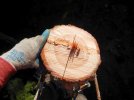
I'd like to know what's up with those high back cuts... I'm thinking there is no need for a hinge, since they are front leaners there is no need for directional control. So they are more of a score cut, basically, just some distance between snap cuts so there isn't much of a hinge. Then finished with the back release. Can you post up some close-ups of the stumps??? Thanks Graeme
 
Last edited:
Graeme, I think the Ferris Bueller class role call guy said fibers snap at 1% strain and the growth stress was in the range of .1 to .3% strain making it relatively 10 to 30% of what's going on.

Any further insight on consideration to be given to the effects of growth stress on felling cuts?

clippety clop clippety clop whinney. refreshing horse ride cleared my head, so now different movie reference " More input Stephanie" :)
 
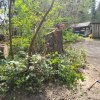
Much respect Graeme and I have an honest question. How do you feel about working in clear cuts like the one pictured above? I spent a decade working in similar looking sites in Sountheast Alaska and eventually realized I could no longer participate in such devastation so I became more involved in the sustainable selective logging practices that were beginning to take hold in the redwoods of NorCal. Logging in Alaska was an amazing time in my life but even after a few decades I still carry some regrets.
Thats a great question.

The logging practices for mountain and alpine ash (E. regnans and delegatetensis) mirror the natural cycles of those forests. Wildfires raise these forests to the ground for extensive areas and have done so for millennia. The forest regenerates using the seed bed of ash (hence the name) to germinate in. The seed bed of all the other plants is present as well in a ready state waiting for a devastating fire. Ash grow about 1m per year and the biodiversity is nurtured by this natural occurrence so we can be harvesting in 60 years.

We are still logging 1939 regeneration (39 regen) which was from a significant fire (look it up). Wind changes and rain events retard the burning and eventually put them out (sometimes months). There were many smaller fires between but the main ones and they were 39, 26, 08, ...
We are not allowed to log trees over 100 years old so 08 trees cannot be felled.

Under strict forest supervision we harvest the timber, the coupes are burnt and mostly contained within the coupe. The result is a burnt coupe that resembles the result of a natural bush fire on a smaller scale. It grows with the same biodiversity as of its ancestors.

Of all the forests in Victoria only 4 % is ever allowed to be harvested. the remaining 96% is never touched. I would have to look it up but I think only 1% of the 4% is programmed to be logged each year.

Clear fell is the only sound harvest practice for these species. Select felling causes regeneration difficulties and often downgrades the gene pool of ash in the area. I recall Sir David Attenborough say during the "Private Life of Plants", "The paradox of a mountain ash forest is that it must be raised to the ground by fire to become healthy again".

Regards
Graeme McMahon
 
Last edited:
Thats a great question.

The logging practices for mountain and alpine ash (E. regnans and delegatetensis) mirror the natural cycles of those forests. Wildfires raise these forests to the ground for extensive areas and have done so for millennia. The forest regenerates using the seed bed of ash (hence the name) to germinate in. The seed bed of all the other plants is present as well in a ready state waiting for a devastating fire. Ash grow about 1m per year and the biodiversity is nurtured by this natural occurrence so we can be harvesting in 60 years.

We are still logging 1939 regeneration (39 regen) which was from a significant fire (look it up). Wind changes and rain events retard the burning and eventually put them out (sometimes months). There were many smaller fires between but the main ones and they were 39, 26, 08, ...
We are not allowed to log trees over 100 years old so 08 trees cannot be felled.

Under strict forest supervision we harvest the timber, the coupes are burnt and mostly contained within the coupe. The result is a burnt coupe that resembles the result of a natural bush fire on a smaller scale. It grows with the same biodiversity as of its ancestors.

Of all the forests in Victoria only 4 % is ever allowed to be harvested. the remaining 96% is never touched. I would have to look it up but I think only 1% of the 4% is programmed to be logged each year.

Clear fell is the only sound harvest practice for these species. Select felling causes regeneration difficulties and often downgrades the gene pool of ash in the area. I recall Sir David Attenborough say during the "Private Life of Plants", "The paradox of a mountain ash forest is that it must be raised to the ground by fire to become healthy again".

Regards
Graeme McMahon
Thanks Graeme. I appreciate the detailed answer and it sounds like you folks do a good job of managing your ash forests..Very different than the high ball logging going on in Southeast AK in the 1980's. Forests that had never before seen the axe or saw. Ancient timber clear cut and yarder logged. Destroyed flora and fauna left in our wake with zero followup. Yea, I have regrets.
 
Thanks Graeme. I appreciate the detailed answer and it sounds like you folks do a good job of managing your ash forests..Very different than the high ball logging going on in Southeast AK in the 1980's. Forests that had never before seen the axe or saw. Ancient timber clear cut and yarder logged. Destroyed flora and fauna left in our wake with zero followup. Yea, I have regrets.
I can understand your regrets. I see clear cutting in a forest that is managed for timber is essentially the same as cutting down corn every fall. Sure, the trees grow longer, but they are grown for the purpose of being cut, and they’re cut with the expectation of growing more trees to cut again. That does not seem like a bad thing to me, it seems quite sustainable when trees are “farmed” to promote growth of more timber for later use.
 
I can understand your regrets. I see clear cutting in a forest that is managed for timber is essentially the same as cutting down corn every fall. Sure, the trees grow longer, but they are grown for the purpose of being cut, and they’re cut with the expectation of growing more trees to cut again. That does not seem like a bad thing to me, it seems quite sustainable when trees are “farmed” to promote growth of more timber for later use.
We can look at a well managed select cut redwood forest to see that there are other ways to skin a cat.. Methods that leave the flora, fauna, watershed, and soil health largely intact. And all of this is done while board footage yields, as well as the average DBH of the timber are both greatly increased during a 13 year cycle.
 
Last edited:
A tree every 2 - 5 minutes for 9 hours a day in steep country is steady work for my old legs.
That's efficient! And hard to think that many could keep up with that pace or come close. There is so much involved in that level of efficiency.... keeping the saw shard, knowing which tree to cut next, planning how to use the trees to save your energy, where to stage fuel...
 
Trees take all different widths at different percentages of depth.

80% width is a good guideline, but it isn't a rule. Think of gutted hinges and hollow trees. Regular stuff.

All things are very situationally dependent, including Very species dependent.


I don't go deep on tops personally. If you can't push it, you should be wedging it. $0.02.

Halfway depth for a very balanced top, no wind, yes.
Deeper, asking for trouble, at times.

Shifting the hinge a few inches is different that 12".

12" shift has a lot more eyeball-evaluation certainty. Generally, the initial facecut kerf may start to close a tiny bit or more with a rearward hinge on logs...confirmation that you are winning.

Be careful with very straight grained/ Barberchair prone wood if you're loading the hinge up a lot with a heavy log on a rear-placed hinge.

great answer
 
Deep-set hinges are great for spars.


I watched a company trying to tip a 1/3 depth doug-fir spar, dead upright.

Sawyer didn't gut the hinge, nor cut it up thin. Stacked wedges, sweat pouring off the sawyer, two guys on the rope puller, sweating.


Instead, hold the trigger longer on the face cut, get deep, humboldt it so the facecut falls out on its own, back cut it and let gravity pull it over. Don't over-thin the hinge, rather gut it from the rear. Don't dig the non- existent pull rope from under the log.
Boring, lazy tree work. One person involved in a one-person-job, everyone else doing something productive or taking a break.


20220428_120400.jpg
 
That's efficient! And hard to think that many could keep up with that pace or come close. There is so much involved in that level of efficiency.... keeping the saw shard, knowing which tree to cut next, planning how to use the trees to save your energy, where to stage fuel...
Thats the best of it Mark. The thickness of undergrowth, diameter of trunks, lay of the trees, steepness and bridged spars all slow down that rate of work. We always say the "bush" dictates productivity. Faller and planning help but have limits.
Regards
Graeme McMahon
 
This shallow face cut revelation seems like the TreeBuzz version of Trump's healthcare plan. Often promised, wildly promoted, never delivered.
My apologies for the delay in posting the info on how a shallow notch increases the chances of barber chair. I thought this would be a good subject for a formally written article. I started writing and have the intro pretty well finished... It's challenging to get the technical ideas on paper in a way that reaches an audience of varied knowledge and experience. I'm working on it and will keep you posted.

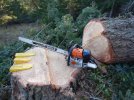
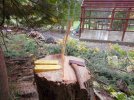
and the great photos above show many options outside the 1/3 rule..

Here's a video from a cedar removal last week that employed a deep notch used to cut ensure that the hinge fibers were well past the area of included bark.

 
My apologies for the delay in posting the info on how a shallow notch increases the chances of barber chair. I thought this would be a good subject for a formally written article. I started writing and have the intro pretty well finished... It's challenging to get the technical ideas on paper in a way that reaches an audience of varied knowledge and experience. I'm working on it and will keep you posted.

and the great photos above show many options outside the 1/3 rule..

Here's a video from a cedar removal last week that employed a deep notch used to cut ensure that the hinge fibers were well past the area of included bark.

While your at that article please include a letter to the ISA explaining why they forgot your honorary life long certificate?

CE0CB5FC-357E-4700-AFB2-D15AFA77B406.png
 

Attachments

  • 604C0DB8-C796-4320-A5B9-4B8C019179D5.png
    604C0DB8-C796-4320-A5B9-4B8C019179D5.png
    201 KB · Views: 22
Last edited:
There you go doing homework on me again... don't you have anything better to do?
I passed that exam twice.
last time I got a 94, only studying the morning of the test...
I was certified when I put that on the webiste.. I just haven't updated the website or botherred taking the test for the third time.

do you think I need to pass a test to be a better tree cutter?

I guess I could put "previously" ISA certified, but I doubt anyone cares.. except you fo course ;)

how about you? are you certified???

Do you think it has value..

do you think you need or become a better arborist by becoming certified?

I don't care much for the ISA these days... how about you?
 

New threads New posts

Kask Stihl NORTHEASTERN Arborists Wesspur TreeStuff.com Teufelberger Westminster X-Rigging Teufelberger
Back
Top Bottom