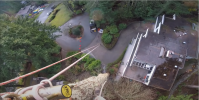
What's your upper weight limit for speedlining stuff?

Winchman

Carpal tunnel level member
I ask because I took quite a ride the other day when I speedlined an oak limb that probably weighed at least five hundred pounds from about fifty feet up. The outer part of the limb stopped abruptly in some shrubs, and the heavy end flipped over it and hung from the line. I was expecting it to drag some before it got to the shrubs, and then come to rest near the base of the anchor tree without a sudden jolt. The 3/4" rope with a 1090#wll was at an angle around 45 degrees, and I had two slings on the limb.

Was I way over the weight that should be speedlined?
 
Personally, I don’t speedline anything bigger than about half that. With a big rope like that, it’s probably safe enough if your anchors are quite strong, and your slings are too, but I prefer to go smaller myself.
 
Anything can be speed lined it all comes down to how strong your anchors and system as a whole is. I don’t know all the numbers but if you were at a 1000lbs for the chunk you were well above that at your anchors. 200lbs is my max for a true speed line catch. Heavy loads catch them first buy negative rigging and use a speedline to move the material.
 
I ask because I took quite a ride the other day when I speedlined an oak limb that probably weighed at least five hundred pounds from about fifty feet up. The outer part of the limb stopped abruptly in some shrubs, and the heavy end flipped over it and hung from the line. I was expecting it to drag some before it got to the shrubs, and then come to rest near the base of the anchor tree without a sudden jolt. The 3/4" rope with a 1090#wll was at an angle around 45 degrees, and I had two slings on the limb.

Was I way over the weight that should be speedlined?
Speedlining exerts quite a bit of dynamic force on your anchor (in this case the tree you were in). These are bending forces, which can have a very powerful effect on a spar. Much more than negative rigging which exerts force vertically and tests the compressive strength of the wood rather than the bending strength.

500# is excessive. Would have looked at other options (taking it in 2 or 3 pieces).

If it’s a controlled speed line, like flushcut mentions, you absorb the dynamic force in the lowering line, but you’ll still be testing that bending force once you let it out into the speed line.
 
Thanks. One more thing for the "Don't do this again!!" folder.
It’s very rare I break out speedlining for anything other than conifers, with their wee limbs. Or something else decurrent (similar branching structure) like tuliptree. Oak, haven’t yet.
 
Controlled speed line as mentioned! Nice and gentle, take a large piece. Situational of course. Can be frustrating to set up. If you only have 2 or 3 pieces to do just normal speed line it smaller. If there’s a long day ahead go bigger with controlled speed line.
 
Consider that your sliding carabiners under heavy load and high speed could heat up and glaze or damage the rope if abused badly enough. Pulleys, different story, don't get hot.
 
Always worth considering a back stay when speed lining. Another rope at the same place as the canopy anchor, but 180 degrees to the speed Line. helps to Stiffen the spar/ reduce bending.

We use spar stays somewhat regularly for heavy winching applications, where The spar would likely be ripped out of the thin soil without. Definitely More clutter but helpful trick. Probably 1000 lbs of logs being drifted between trees with stays, wouldn't dynamically catch that though

That said, 500lbs is probably too much

20201210_110518.jpg
 
Maybe this'll help. At about 6:50 (on the second day's video), Reg Coates starts handling sizeable trunk sections on a zipline. Really controlled and not over loaded - he doesn't bomb big wood right onto the zip line and he lowers in a slower, controlled manner down the zipline using a small porty up top. Climbing Arborist shows a nice zipline setup too using a DMM rigging hub as a "trolley" which provides good control as well (and they backstay the tree). Maybe some stuff to think about. Cheers.
 
It's beginning to sink in that this incident could have ended very badly.

I've been replaying what happened on this drop compared to the other drops that went so smoothly. I'm pretty sure I understand what went wrong and why. It wasn't just that this one was excessively overweight. The limb was almost directly over the speedline, and the outer branches rode the line down until they hit the bush. I could have used a better anchor point for the speedline, but those trees were surrounded by poison ivy and bushes covered with cow itch.

We all make mistakes. This one will bother me for a while, but it won't keep me from climbing.

Working in an oak is so much different that working in pines. Over the week, I set at least seven TIPs. Two looked pretty good from the ground, but I just couldn't get in a position to make a cut safely once in the tree. I spent way too much time around a limb I really wanted to remove, but finally gave up on.
 
Working in an oak is so much different that working in pines.
Thank goodness for that. Once you get some more time in them their logic will unfold for you. And they are way more fun, because you have to meet the tree’s growth as it is and work with it. Also, good on you for having some time to reflect.
 
I normally draw the line around 300lbs, much bigger than that and the forces on the anchors can get ridiculous quickly. That and anything that heavy is usually not going to have much brush on it to slow it down and momentum can turn the speedline into a battering ram when it gets to the end of the line.
 
A brush-built crash pad can help.

So much depends on the vertical- horizontal component.

Controlled versus uncontrolled.

Dropping things hard or easing them down... if my groundworker has the speedline in bare hands, i hang the piece by the wood fibers to vertical, then cut free.

I like to hang rope-rigged pieces similarly, as possible, often cutting and roping speedlines or reasonable-sized freehanging pieces.


Birch and cedar, for example, will frequently hold themselves when top-cut only, letting them swing down to vertical.
 
300lb has always been my limit for a well set up speedline. Seems a safe estimate. In the field though I would be very conservative with my weight estimate so I probably stay much lower.

When in doubt I will negative rig, then use the GRCS to raise the piece back up, then connect to the speedline.

Tony
 

New threads New posts

Back
Top Bottom