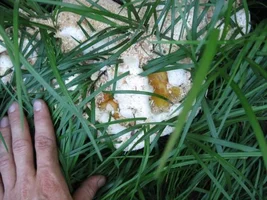
Whats this Fungus ?

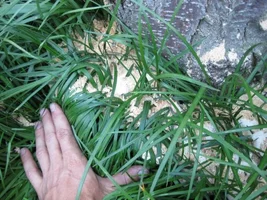
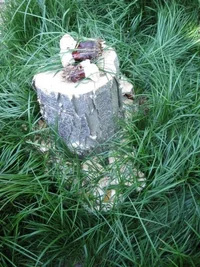
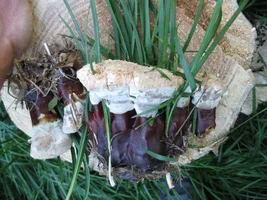
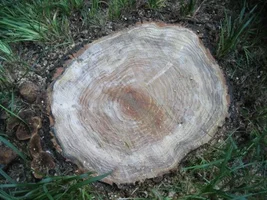
Removed a 24" Thornless Honey Locust (Gleditsia) today. The tree was located in a small tree well aprox. 6'x6' with an open bottom. This fungus was prevelant surrounding
(not touching) the trunk base. The Liriope grass had been encased by this fungus causing me to think that it must have been a foamy gel before it hardened into this fruiting body. Anyone have any input?
 

Attachments

  • 184669-IMG_0177.webp
    184669-IMG_0177.webp
    70.5 KB · Views: 190
[ QUOTE ]
Looks like Ganoderma, probably Ganoderma lucidum (varnish shelf, lin chi, the mushroom of 10,000 years)

I see it on honey-locust alot. Good thing you took the tree down.

[/ QUOTE ]also aka lacquer polypore. very common here. i manage trees that have it, with caution, attached.

where'd the 10,000 years come from?
 

Attachments

Guy is correct IMO Ganoderma sp is not what would commonly be thought of as an agressive wood decay fungi, it is always important to understand what the predisposing factors are in each case that have led to the situation you are observing, Ganoderma sp Ganoderma sp like so many other fungi require a host of other events and actors (fungal and other) to have preceeded its successful colonisation of a tree.

Ganoderma sp can certainly be found fruiting on portions of a tree that are dysfunctional, and we do of course often see it (since its fruiting bodies are so large) on trees that have had extensive wood decay extend through the root crown and buttress roots.
 
[ QUOTE ]
where'd the 10,000 years come from?

[/ QUOTE ]

Maybe it's in reference to its ability to extend life.

In Oriental Medicine this mushroom is used to increase blood circulation, liver function and to strengthen the immune system.

-Diane-
 
I've learned to be a bit careful about Ganoderma on urban and community trees, particularly in an international setting. Although in North America we're not too freaked to see G. lucidum or G. applanatum, G. adspersum in northern Europe causes more concern. I don't know if that is a cultural thing or whether it really reflects a difference in risk.

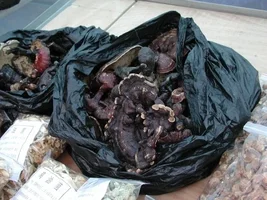
I attached a picture of Ganoderma from Tibet, being sold with other medicinal fungi in one of the high mountain passes to the east of Lhasa, just to the side of the road.
 
I suppose my post was intended to point to the fact that wood decay fungi are really flagging important issues of dysfunction that we need to assess.

I am not so sure that it really is all that different in Europe KTSmith, Ganoderma sp were accurately described back in 2000 in Fungal Strategies of wood decay in Trees (FW Schwarze. J Engels. C Mattheck) and more recent more detailed analysis supports the general view that it is a wood decay fungi very often associated with weakened or damaged street trees.

The simultaneous white rot and its selective delignification common to Ganoderma naturally envolves the appearance of defect symptoms, bulges or fibre buckling...it would be fairly rare for trees with a soft kind of decay like Ganoderma to fail without any warning signals in the tree's body language.
 
[ QUOTE ]
..it would be fairly rare for trees with a soft kind of decay like Ganoderma to fail without any warning signals in the tree's body language.

[/ QUOTE ]

What do you mean? I've seen several trees fail at the root collar with no other evidence than the Ganoderma lucidum fruiting body.
 
[ QUOTE ]
I've seen several trees fail at the root collar with no other evidence than the Ganoderma lucidum fruiting body.

[/ QUOTE ]

Sure its not impossible it is however not common, the loss of structural integrity within the tree stem be it at the root crown or above will over time produce visual indicators in the body language of the tree, if the tree is exposed to sufficient wind loading then of course it will fail.

The point being made is that fruiting bodies of wood decay fungi are flagging dysfunction...the extent of which should be assessed.

Ganoderma spp are not generally described nor considered to be an agressive decay fungi, it would be expected (based on its pathology) to follow on from a number of other wound fungi have successfully colonised the wood tissues breaching defence boundaries.

A great many variable elements to be taken into consideration when carrying out detailed assessments of trees with visible wood decay fruiting bodies, a great many trees can and do survive with what would appear to be significant sized fruiting bodies of Ganoderma spp.

It should be noted that Ganoderma spp can also manifest as a perennial canker.
 
[ QUOTE ]
In Oriental Medicine this mushroom is used to increase blood circulation, liver function and to strengthen the immune system.

-Diane-

[/ QUOTE ]weell dam gimme some of that--how is it prepared and ingested for these purposes?

KY I don't know how many ganoderma-infected failures you've seen; i haven't seen any where it was the primary pathogen.
 
I sort of stepped back from this thread a few days back because I must not have expressed myself too clearly. But fool that I am, I'll try again.
I agree with Guy and probaby Sean as well, I don't think of G. applanatum or G. lucidum as being strongly agressive, in the sense of being perthotrophic, that is being able to kill living, otherwise healthy tree tissue. My earlier point about caution with northern European species rests in folks showing me G. adspersum with the strong conviction that it *is* a primary pathogen and a dominant one of concern . True, in Francis' book, he doesn't mention (not much, anyway) G. adspersum. But that is what concerned folks took time to show me on street trees in Belgium and Germany. I don't know what the real story is.
In the northeast US, G. tsugae on eastern hemlock is the species I come across most often and that does seem to move in and spread pretty readily but does seem to come in after root and butt injury. If we cut all the hemlocks with the red varnish conks, we wouldn't have too many standing hemlocks at the edges of the human community!

As for the medicine, folks grind the dried fruiting bodies of G. lucidum in a mortar and pestle and make an infusion or decoction of the powder. I don't think the other species are used in this manner. No idea as to dose!

 
[ QUOTE ]
weell dam gimme some of that--how is it prepared and ingested for these purposes?

[/ QUOTE ]

Guy,

Talk with a qualified acupuncturist who has Chinese herbal medicine skills. I think it can come as a tincture or powder/capsule form (a little easier than hand-grinding
grin.gif
)


-Diane-
 
Ha, Ha, I thought Guy was a do-it-yourselfer. If I was really interested, I'd just grow the mycelium in liquid culture and freeze-dry it. The mycelium is pretty friable and then go into capsules or on top of cheerios or brown rice or ? If I were buying pre-packaged stuff, my acupuncturist does have it...I'd probably check the Paul Stamets products at Fungi Perfecti as well. He's heavily into the medicinals.
 
KT, I think many of us were writing the same thing in slightly different ways...
wink.gif


It is quite amazing to thik how important some Ganoderma spp are to Chinese medicine, having in years gone by cut many a tree throughly infected by Ganoderma spp, I can attest to the horrible taste of the digested wood tissues with mycelia...
crazy.gif
yuk I hope the powder or pills are a little more palatable!
 
Guy- I have seen several...however, I do admit a slight bias, in that I am starting with the failure (when the client calls) and then seeing Ganoderma lucidum (specifically. I haven't seen failures assoc. with G. applanatum). I thing there is a definite strong causal relationship. Until I see research that can inform me otherwise, I err on the side of caution. I assume risk of failure is fairly high, and I give my recommendations for removal based on the hazard level. If I see G. lucidum on a large tree near a house, I recommend removal.
 

New threads New posts

Back
Top Bottom