what knot to use

i just purchased 20ft of tubular webbing rated at 22kn and I'm planning on making some light duty ring and ring friction savers and was wondering what knot would be sufficient for light rigging. I have read that certain knots synch too tight and actually end up cutting into itself.

What knot would you guys recommend I use to attach the tubing to the rings. Would thimbles help keep the radius from severly weakening the tubeing?
 
I used a Beer knot, and girth hitched rings. A fair warning-with the webbing the friction saver dangles around to much IMO, especially when retrieving.

I had purchased 300 ft, I now use them just for rigging. I found a stiffer piece of line works better for a FC for life support.
 
thanks man. I didn't even think about using rope. I have a ton of extra short rigging lines. I'll try that as well along with the webbing. How much did you pay for 300 ft of webbing? What was the heaviest piece you've ever rigged using the webbing?
 
$75 maybe for the 300 ft (ebay,search the store "rescue direct"). I keep it small on the loops. Mainly for redirects, or a quick small peice thats not worth dragging up the loopie for, but satill needs to come down on rope.
 
man I just spent 10 bucks for 20 feet. Either way I'm going to go down the rope trail (nick you reading this) we are trying to go the retrieveable route as to avoid chaseing down other friction saving devices
 
There was a retrievable rigging thread a while aggo that had some pretty cool ideas in it.

Are you looking for something that can be set from the ground or just placed while in the tree and retrievable from the ground?
 
id rather set it from the ground but i have no problems setting it while climbing as long as i dont have to go get it afterwards, there was a nice little idea i read, its kinda like drt off of srt climbing but for rigging, just throw the line up, tie a knot around a block at the end of the line already in the tree (include another line in the block) then pull the block up into the crotch of the tree and lock off that line, then use the line hanging from the block, its pretty nice but you need to have some low stretch lines in place, otherwise you are doubling your stretch, and if your using two lines that like to stretch, then you are adding a lot of flex into that sytem,

its nice because you can float the crotch up or down depending on where you have to rig from

ill have to look up that thread again, thanks for the reminder zac
 
[ QUOTE ]
id rather set it from the ground but i have no problems setting it while climbing as long as i dont have to go get it afterwards, there was a nice little idea i read, its kinda like drt off of srt climbing but for rigging, just throw the line up, tie a knot around a block at the end of the line already in the tree (include another line in the block) then pull the block up into the crotch of the tree and lock off that line, then use the line hanging from the block, its pretty nice but you need to have some low stretch lines in place, otherwise you are doubling your stretch, and if your using two lines that like to stretch, then you are adding a lot of flex into that sytem,

its nice because you can float the crotch up or down depending on where you have to rig from

ill have to look up that thread again, thanks for the reminder zac

[/ QUOTE ]


You are also placing 4x the load on your rigging point when you do this. You'd probably be better off using a heavy duty ring and ring friction saver.
 
Here is a thread regarding Fraction Savers for Rigging.

http://www.treebuzz.com/forum/showflat.php?Cat=0&Number=109488&an=0&page=1#109488

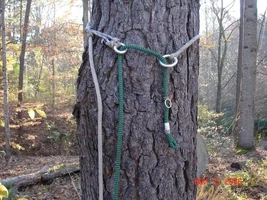
The ones we use were made by Rich H. The one in the picture uses 3/8ths Tech cord from All Gear (available from Knot & Rope Supply) and steel rings. The technora cordage is strong, but not super abrasion resistant. It splices SUPER easy.

Are you talking about using the webbing like you would a rope (ie as a single "strand"), or creating a loop. The loop is where you'd use a water knot or whatever. If you're talking about a single strand, I'd think a scaffold hitch would work. Also known as a "Double Fisherman's. A triple would be even more secure.
 
banjo, 4x the weight? really? i thought it was only doubled, but im probably wrong, it happens a lot, me being wrong that is, but (and no offense to you banjo, im just a a second opinion kinda guy) can you guys confirm this? is it really 4x the amount of weight in this situation
Quote:

id rather set it from the ground but i have no problems setting it while climbing as long as i dont have to go get it afterwards, there was a nice little idea i read, its kinda like drt off of srt climbing but for rigging, just throw the line up, tie a knot around a block at the end of the line already in the tree (include another line in the block) then pull the block up into the crotch of the tree and lock off that line, then use the line hanging from the block, its pretty nice but you need to have some low stretch lines in place, otherwise you are doubling your stretch, and if your using two lines that like to stretch, then you are adding a lot of flex into that sytem,

its nice because you can float the crotch up or down depending on where you have to rig from

kentucky, thanks for the tread, that was exactly what i was talking about, ill have to give mr haiter a ring, or a ring and ring friction saver, ha, haha, see what i did there
grin.gif
 
[ QUOTE ]
banjo, 4x the weight? really? i thought it was only doubled, but im probably wrong, it happens a lot, me being wrong that is, but (and no offense to you banjo, im just a a second opinion kinda guy) can you guys confirm this? is it really 4x the amount of weight in this situation


[/ QUOTE ]

Yup. 4X's.
 
[ QUOTE ]
[ QUOTE ]
banjo, 4x the weight? really? i thought it was only doubled, but im probably wrong, it happens a lot, me being wrong that is, but (and no offense to you banjo, im just a a second opinion kinda guy) can you guys confirm this? is it really 4x the amount of weight in this situation


[/ QUOTE ]

Yup. 4X's.

[/ QUOTE ]

I have posted this before on TB that I climb using an adjustable false crotch on a regular basis. It achieves the setting and retrieval of the pulley from the ground extremely easily.

When used as a doubled rope system; i.e., both ends of the rope that run through the pulley are then attached to the climber it doubles the force on the TIP. To use it as an SRT, what I do is tie an alpine butterfly on the rope that goes through the pulley and both ends hanging from the pulley are individual single ropes. When footlocking up this set up or using ascenders, you still have two times your weight at the TIP. If you were to anchor one end of your climbing line that runs through the pulley, then tie the other end off to your single rope system, then you would be having four times the weight at the tie in point. That's how my eyes see it. But I ALSO have been wrong before...:)

D Mc
 
What you describe for your systems is correct. But, what familytree described is for rigging and is basically the same as the last setup that you describe--so 4X's.


[ QUOTE ]
...adjustable false crotch...

[/ QUOTE ]


Really a type of floating false crotch. An adjustable false crotch is something like a Rope Guide or the setup in the attachment.


[ QUOTE ]
To use it as an SRT, what I do is tie an alpine butterfly on the rope that goes through the pulley and both ends hanging from the pulley are individual single ropes.

[/ QUOTE ]


So you have a rope hanging from the pulley, tie a butterfly, thread one end through the butterfly and run the knot up to the pulley?? Or is the butterfly hanging on the sheave of the pulley?? The latter, I think. Backs up both legs. Nice.
 

Attachments

  • 123888-DSC02668_resized_25%.webp
    123888-DSC02668_resized_25%.webp
    165.9 KB · Views: 93
thanks for the posts guys. It didn't hit me til this morning that what banjo said is valid. I forgot that by locking off the blocks rope to the tree and securing the cut limb to a tree created that much force. Actually it hit me this morning while standing in line to pay for my coffee. It must have been that first sip that smacked some sense into me. Thanks

To to hijack my own thread but. Mahk. Are you headed out to jersey again to teach the Vermeer sherrill class this year?
 
i like to say a 4x potential; then less for open/non-Zer0 angles and even more off that number for frictions. There is usually a spread angle in this type of setup; which often times isn't wide enough to reduce the forces by much. But perhaps more pertinent is the change in direction of the vector of loading; to be more inline rather than totally perpendicular to the support(so the forces aren't decreased so much as they are carried better). Also, the friction can be variable by it's amount and if it purposefully takes more of a wrap around on the 'outer'/parent system that holds the pulley(like not only going over a support, but also wrapping around under it somewhat from ground). The 2x from this system comes from the sum of pulls on both legs like any other; but if we have massive frictions on the control leg of this outer/parent system; this sum can be 1(load side)+ very little(highly frictioned control side). Thus, we can get more towards 2x loading many times. This is an advantage of Natural vs. Zer0 Friction (pulley) support.

These, scenarios all ways and always have 2 sides; a yin yang trade off as 1 quantity is increased, another is reduced etc. The secret is to capitalize on what ya got int he scenario; to one side or the other. These numbers are for static loading; and yes increase. But, that increase; at sum point can be good for dynamic loading; in that the increased loading will give more elastic response / buffering to the system. This is the reciprocal; of support with a power system (like Z-Rig + control leg etc.); whereby these give decreased support loading statically; but at some point the dynamic loading is increased over a 1:1 support + control leg (that gives 2x potential on support)

For, just as when we support with a Z-Rig + control leg; we reduce the static loading from the control leg situation of 2x potential to 1.3x potential statically; we also will have an increase in dynamic loads at some point from the loss of elastic buffering, because each leg is less loaded. At sum point all the numbers curve like this; there virtually are no straight across the board lines on the graph; is the best/ most open minded philosophy to have IMLHO.
 
Mahk, should I be calling my set up a floating false crotch? as opposed to an adjustable? See, I said I can be wrong. I always thought the floating false crotch was something like a pulley on a friction hitch that can be adjusted up or down or horizontally along a static line.

Yes, I tie the Alpine butterfly on to the sheave for a redundant single rope set up. It works great and I simply re tie to a doubled rope set up for working the tree.

D Mc
 
I think an adjustable friction saver is diameter-adjustable, so that it can fit around various diameter branches or be choked on various sized trunks.

A floating false crotch is (as you said) adjustable up or down or horizontally.
 

New threads New posts

Back
Top Bottom