Hi Dan, welcome to the buzz.
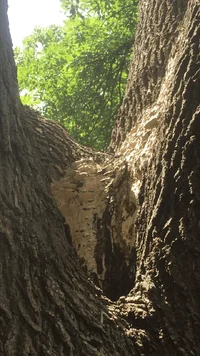
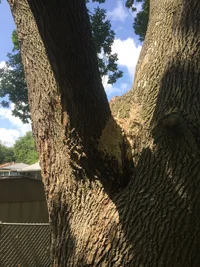
Identification of wood decay fungi from snapshots is always iffy and precision usually requires actually working with a sample of the creature. That being said, I'd start with Perenniporia fraxinophila. The second part of the name means "ash-loving" and this species is the most common wood decay of various ash species of the Midwest. This is a "white-rotter" with the lignin being preferentially decayed from the wood. It characteristically is not at ground line, but occurs further up the stem. Usually associated with pretty extensive decay.
Simple "photo-matching" without other experience to id this one is particularly tough because although common, it is frequently not included in guides. Or, if it is in field guides, only one of the growth forms are depicted. Past authorities placed it in several different genera in the past which speaks to the variation in growth form. The ash decay fungus was described as forming annual brackets (genus Polyporus), perennial brackets (genus Fomes), and patches lying more or less flat on the stem (genus Poria). Of course, it might be something else.
Of course, the above might not interest you as much as what to do about it. I'd recommend you contact a local certified arborist who knows something about both tree survival and wood decay processes. Looks as if there is decay right at the crotch and looks as if there might be a crack extending down the stem. Others with more practical experience should chime in.



 Apr 09 (Free CEUs) & May 07 - 'Urban Forestry Today' Webcasts @ Noon (Eastern)
