
Navigation
Install the app
How to install the app on iOS
Follow along with the video below to see how to install our site as a web app on your home screen.
Note: This feature may not be available in some browsers.
More options
You are using an out of date browser. It may not display this or other websites correctly.
You should upgrade or use an alternative browser.
You should upgrade or use an alternative browser.
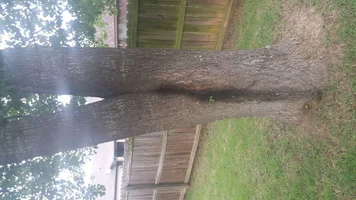
what is this black ooze?
- Thread starter AAA TREE
- Start date

- Location
- Massachusetts
The black is staining from standing water and decayed organic matter inside the inclusion of the codominate leaders. The watery material congeales when it hits the outside air. My guess..
Sent from my SM-G920V using Tapatalk
Sent from my SM-G920V using Tapatalk

easyphloem
Branched out member
- Location
- Louisville, KY
The tree is completely sideways, for starters. So that's a big problem.
I agree with Swifty that it looks like staining from organic material that is collected in that super tight angled main branch union.
I'm sure that this tree is cabled, and if it isn't, it should be. Make sure you are up to date on the BMPs for cabling and bracing, because you can do more harm than good by doing cabling wrong.
SZ
I agree with Swifty that it looks like staining from organic material that is collected in that super tight angled main branch union.
I'm sure that this tree is cabled, and if it isn't, it should be. Make sure you are up to date on the BMPs for cabling and bracing, because you can do more harm than good by doing cabling wrong.
SZ
easyphloem
Branched out member
- Location
- Louisville, KY
Also, "AAA Tree"?
Is this a yellow pages thing?
Have you considered "Acme Tree"? It has a more authentic ring to it, and it still gets you right up there in the yellow pages (lol)
SZ
Is this a yellow pages thing?
Have you considered "Acme Tree"? It has a more authentic ring to it, and it still gets you right up there in the yellow pages (lol)
SZ

KTSmith
Branched out member
- Location
- Maine, New Hampshire
That is commonly referred to as "slime flux" associated with bacterial wetwood, a condition resulting from the infection of heartwood with anaerobic bacteria (bacteria whose respiration does not require oxygen). The products of that respiration includes methane that forces the products of respiration out of the tree. The respiration products are somewhat alkaline (the opposite of acidic) that discourages the establishment and spread of wood decay fungi. Although objectionable in appearance to some, this is a beneficial infection in the sense that it resists the decay fungi. These infections are the source of that stinky smell in oak and beech. No, there is nothing to be done about it, at least as far as I know. In the old days, oldtimers would but in brass drainage tubes that only served to aerate the tree core and encourage decay.

cerviarborist
Very stable member
- Location
- Florida, USA
The tree has codominant stems, with a bark inclusion between them. It looks as though the inclusion holds water, which slowly seeps out and causes the staining on the trunk below the union and inclusion. This staining in and of itself is not necessarily a bad thing, and since it drew your attention to the real problem of the codominant stem and included bark, it might have actually done you a favor.
Treatment options to offset this weak union in the tree can include judicious end weight reduction of foliage at the extreme ends of the stems, The installation of one or more static support cables in the canopy to limit the range of motion the stems experience during dynamic loading conditions, and through bracing above, at and below the point where the stems diverge from each other to directly augment the support of the weak union.
You can purchase the International Society of Arboricultures booklet: Best Management Practices-Tree Support Systems 3rd edition here. http://www.isa-arbor.com/store/product.aspx?ProductID=135
I actually had this all typed out, and the phone blew up before I could send it. I see that the salient points have now been addressed, but I'll throw this in the mix anyway.
Treatment options to offset this weak union in the tree can include judicious end weight reduction of foliage at the extreme ends of the stems, The installation of one or more static support cables in the canopy to limit the range of motion the stems experience during dynamic loading conditions, and through bracing above, at and below the point where the stems diverge from each other to directly augment the support of the weak union.
You can purchase the International Society of Arboricultures booklet: Best Management Practices-Tree Support Systems 3rd edition here. http://www.isa-arbor.com/store/product.aspx?ProductID=135
I actually had this all typed out, and the phone blew up before I could send it. I see that the salient points have now been addressed, but I'll throw this in the mix anyway.

guymayor
Branched out member
- Location
- East US, Earth
"The tree has codominant stems, with a bark inclusion between them. It looks as though the inclusion holds water, which slowly seeps out and causes the staining on the trunk below the union and inclusion. This staining in and of itself is not necessarily a bad thing, and since it drew your attention to the real problem of the codominant stem and included bark, it might have actually done you a favor."
I agree with Richard. this does not look like slime flux or any kind of infection.
"Treatment options to offset this weak union in the tree can include judicious end weight reduction of foliage at the extreme ends of the stems,"
Yes 10-20% off the ends might be good to do, but
"The installation of one or more static support cables in the canopy to limit the range of motion the stems experience during dynamic loading conditions,"
If cabling is done, pruning may not be needed. One is probably enough--can you post a pic of the whole tree?
"and through bracing above, at and below the point where the stems diverge from each other to directly augment the support of the weak union."
Bracing looks excessive and definitely heavy wounding of a decay-prone species. The ISA BMPs are not really international--they copy the US standard which is also dominated by the same group and full of overkill. A much better deal is the German standard. http://www.fll.de/shop/ztv-baumpfle...-terms-and-guidelines-for-tree-care-2007.html
It was put together by scientists not corporations so its information is much more useful. Plus the language is ironically much easier to understand! $22.80 gets you guidance on support systems, pruning, soil work, contracts, etc. in an easy download,
I agree with Richard. this does not look like slime flux or any kind of infection.
"Treatment options to offset this weak union in the tree can include judicious end weight reduction of foliage at the extreme ends of the stems,"
Yes 10-20% off the ends might be good to do, but
"The installation of one or more static support cables in the canopy to limit the range of motion the stems experience during dynamic loading conditions,"
If cabling is done, pruning may not be needed. One is probably enough--can you post a pic of the whole tree?
"and through bracing above, at and below the point where the stems diverge from each other to directly augment the support of the weak union."
Bracing looks excessive and definitely heavy wounding of a decay-prone species. The ISA BMPs are not really international--they copy the US standard which is also dominated by the same group and full of overkill. A much better deal is the German standard. http://www.fll.de/shop/ztv-baumpfle...-terms-and-guidelines-for-tree-care-2007.html
It was put together by scientists not corporations so its information is much more useful. Plus the language is ironically much easier to understand! $22.80 gets you guidance on support systems, pruning, soil work, contracts, etc. in an easy download,

baumeister
New member
- Location
- New buffalo Michigan
Thanks for help I'm trying to learn this side of tree work, I've mainly been a removal guy
I'm glad your hear learning and sincerely hope you keep it up and broaden your horizons.
Removal guy says 2016
Removal = $1500
Professional says 2016 - 2066
A consultation= $80, Cable= $300, pruning =$ 500, 2 root zone treatments =$800, cable inspection =$80, second round of pruning /deadwood removal =$950, mulching =$200, your clients love and appreciation for your knowledge and expertise, priceless.
" (Tree companies) that do not care about the life of trees are none other than bogus doctors who predominantly kill their patients......... for money."
C.S.
guymayor
Branched out member
- Location
- East US, Earth
O and you could brush and rinse the ooze off the stem for aesthetic and other reasons.


KTSmith
Branched out member
- Location
- Maine, New Hampshire
I have no basis to quibble or disagree in any way with the practical treatment options above. I am quite confident that the discharge is the result of infection as I describe above. From the tree point of view, I submit that the infection by the bacteria is beneficial. None of this is radical, but pretty well-established forest pathology.
I think you should probably collect some of it and spread it all over your body. If it smells like baby diarrhea then KTS is correct!That is commonly referred to as "slime flux" associated with bacterial wetwood, a condition resulting from the infection of heartwood with anaerobic bacteria (bacteria whose respiration does not require oxygen). The products of that respiration includes methane that forces the products of respiration out of the tree. The respiration products are somewhat alkaline (the opposite of acidic) that discourages the establishment and spread of wood decay fungi. Although objectionable in appearance to some, this is a beneficial infection in the sense that it resists the decay fungi. These infections are the source of that stinky smell in oak and beech. No, there is nothing to be done about it, at least as far as I know. In the old days, oldtimers would but in brass drainage tubes that only served to aerate the tree core and encourage decay.

Treetopflyer
Been here much more than a while
- Location
- Coastal N.J
Torch it

John_KAYS
Carpal tunnel level member
- Location
- Eastern PA
Guy, why don't you think it is Slime flux? That's what I thought it might be. Is it not frothy enough? It looks pretty typical of wetwood...
guymayor
Branched out member
- Location
- East US, Earth
No telling if bacteria are colonizing the area but like Kevin says that's probably not real bad for the tree. I would not call it good because there's a lot more to consider than the Demon of Fungal Decay, which is so overblown these days. The inclusion is the issue, but reducing load would mitigate that.
John, the term 'slime flux' is like 'pin oak'; it means too many things to be all that useful imo.
If it was frothy then it would be frothy flux; a different beast altogether. Cleaning loose crud and gunk out of the fork and sounding the area might reveal more about the situation.
John, the term 'slime flux' is like 'pin oak'; it means too many things to be all that useful imo.
If it was frothy then it would be frothy flux; a different beast altogether. Cleaning loose crud and gunk out of the fork and sounding the area might reveal more about the situation.
Attachments

New threads New posts
-
test
-

-
What's on your mind? TCI Magazine wants to know
- Started by Tree Care Industry Assoc.
- Replies: 13
-
 Apr 09 (Free CEUs) & May 07 - 'Urban Forestry Today' Webcasts @ Noon (Eastern)
- Started by UFT
- Replies: 0
-

-
-


