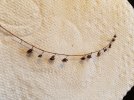
Here is a photo of one of the most annoying burrs in my part of the world (SE Wisconsin). What is it? I like to know the name of something when I swear at it.
Genus Xanthium, most likely. Also, most likely to be the common (X. strumarium) or spiny (X. spinosum) cocklebur. Making that call requires a close look at arrangements of the various parts, sketched out here. There are other species too, to delight the experts.
Thanks for the guess, but that's not it. I'm sorry I didn't put anything in the photo for scale. The burrs are only about 1/8 inch in diameter. As I recall the foliage, it's got small leaves. The burrs stick to EVERYTHING. Really annoying when it sticks to any rope that touches it and anything you're wearing--even boot laces. We do have cocklebur here, but it's not nearly as prolific. Cocklebur is definitely more painful. Those end spines are sharp.
I almost asked first as to how deep you need to go! OK then, a frequently-consulted text using classical ID characters is Love and others (1959). The recent molecular treatment (Tomasello 2018) recognizes 5 species, I believe. I don't know what sort of access y'all have to research literature, so I've attached both here. I haven't used it, but the more recent article has a key of field characteristics of the species he accepts.

Thanks. I also looked at what uses there are for cocklebur. I always find it interesting to see how plants have been used, especially noxious ones like cocklebur, burdock, stinging nettle, etc.
The common cocklebur made renown as a model system to study "short-day" periodism of flowering. They'll grow vegetatively fine until the length of day drops below a critical threshold, and then they go all-in for flowering and fruit production. Great for parlor tricks.
The funny thing is that there is a lot of genetic variation out there in the genus (in the broad sense). So botanists through the decades have variously delimited the group into a few variable species or many tightly-defined species. Through molecular analysis, Tomasello recognizes five true species that actually can be determined by field characters. It's a good example of agreement between molecular and classical techniques.
Long strands of super stick-to-you seeds, especially this time of year. The twigs (?) are very fragile and the seeds very velcro-ish, so you wind up with long stems of burrs attached to you in all kinds of places. And on your ropes. Ugh. At least now I know what I'm swearing at.