
Navigation
Install the app
How to install the app on iOS
Follow along with the video below to see how to install our site as a web app on your home screen.
Note: This feature may not be available in some browsers.
More options
You are using an out of date browser. It may not display this or other websites correctly.
You should upgrade or use an alternative browser.
You should upgrade or use an alternative browser.
What is a Marl?
- Thread starter AxeKnot
- Start date

Yes glens, marlin spike I know well for sending a chainsaw up a tree - used to clip biner into.
Sometimes use clove hitch for this application as well as it comes out as the climber unclips his saw.
Where as with the marlin spike - it sometimes stays in the rope.
Still dont understand what a marl is!?
Is it used in rigging beside a running bowline on vertical sections being dropped into a rigginf block?
Similar to the half hitch before the running bow?
Sometimes use clove hitch for this application as well as it comes out as the climber unclips his saw.
Where as with the marlin spike - it sometimes stays in the rope.
Still dont understand what a marl is!?
Is it used in rigging beside a running bowline on vertical sections being dropped into a rigginf block?
Similar to the half hitch before the running bow?
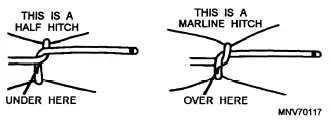

- Location
- Retired in Minneapolis
That's a good illustration.
Here is a post that I wrote for the original ISA discussion forum in January of 1999.
****
There IS a difference:Halfhitch/Marl
Sun, 10 Jan 1999 13:41:43 -0600 (CST)
This flap about using a Marl or a Half hitch goes back a few years. There are probably some folks that can remember the border war between the two famous, but unnamed riggers.
Grab your copy of The Ashley Book of Knots, you DO have a copy don't you? No? Every rigger should have one on the shelf. Go to page 518, top left. I will quote Ashley first:
"3114. HALF HITCHING (HH): Unless put around a rope, this is really single hitching but is commonly called "half hitching". It is a method of lashing in which a series of SINGLE HITCHES is employed to secure one or several objects, and it is universally used in tying up parcels, bundles and bales.
3115. MARLINE HITCHING (MH) is used to secure parceling on standing rigging. It is preferred to half hitching, as service lies over it more smoothly. It is also used in lacing the foot and heads of fore-and-aft sails to booms and gaffs and in lashing hammocks. It is firmer than half hitching. The difference in construction between the two may be illustrated by tying a series on a cylinder and then
slipping them off the end. HALF HITCHING spills instantly and completely, whereas MARLINE HITCHING resolves itself into a series of OVERHAND KNOTS."
To tie the MH and HH get two pop, soda for the East coast, bottles and two shoe laces about three feet long. Tie a running bowline around the necks of both bottles and let the laces hang. The HH is tied by passing the lace around the bottle then, when it somes back to the front, it goes UNDER the piece of rope that exited the bowline. The MH is tied by passing the lace around the bottle then, when the it comes back in front, it goes OVER the piece of rope that exited the bowline.
While I was preparing this post I played with the laces on my soda bottles and found a little difference in use. With a HH it acted like a bit of a choker and the HH would tighten up but would roll down the bottle in the same fashion as dropping a chunk from rigging. If the rope stretched too much when the piece hit the the pulley, or too much slack was left, the HH could roll right off the butt. The MH would
tighten too but it does not seem to roll down the bottle. That is why a MH is recommended for a back up to a running bowline.
Take the time to tie these with a bottle or a small chunk, you will see a difference.
Arborists are Johnny-Come-Latelys to rigging and rope work. It is necessary to look back every once in a while to see what our ancestors did and take those skills forward in whole, not just by pieces. Naming knots correctly and tieing them correctly is just as important as making collar cuts and not over-pruning trees.
Strong limbs and snug ropes!
Tom
Here is a post that I wrote for the original ISA discussion forum in January of 1999.
****
There IS a difference:Halfhitch/Marl
Sun, 10 Jan 1999 13:41:43 -0600 (CST)
This flap about using a Marl or a Half hitch goes back a few years. There are probably some folks that can remember the border war between the two famous, but unnamed riggers.
Grab your copy of The Ashley Book of Knots, you DO have a copy don't you? No? Every rigger should have one on the shelf. Go to page 518, top left. I will quote Ashley first:
"3114. HALF HITCHING (HH): Unless put around a rope, this is really single hitching but is commonly called "half hitching". It is a method of lashing in which a series of SINGLE HITCHES is employed to secure one or several objects, and it is universally used in tying up parcels, bundles and bales.
3115. MARLINE HITCHING (MH) is used to secure parceling on standing rigging. It is preferred to half hitching, as service lies over it more smoothly. It is also used in lacing the foot and heads of fore-and-aft sails to booms and gaffs and in lashing hammocks. It is firmer than half hitching. The difference in construction between the two may be illustrated by tying a series on a cylinder and then
slipping them off the end. HALF HITCHING spills instantly and completely, whereas MARLINE HITCHING resolves itself into a series of OVERHAND KNOTS."
To tie the MH and HH get two pop, soda for the East coast, bottles and two shoe laces about three feet long. Tie a running bowline around the necks of both bottles and let the laces hang. The HH is tied by passing the lace around the bottle then, when it somes back to the front, it goes UNDER the piece of rope that exited the bowline. The MH is tied by passing the lace around the bottle then, when the it comes back in front, it goes OVER the piece of rope that exited the bowline.
While I was preparing this post I played with the laces on my soda bottles and found a little difference in use. With a HH it acted like a bit of a choker and the HH would tighten up but would roll down the bottle in the same fashion as dropping a chunk from rigging. If the rope stretched too much when the piece hit the the pulley, or too much slack was left, the HH could roll right off the butt. The MH would
tighten too but it does not seem to roll down the bottle. That is why a MH is recommended for a back up to a running bowline.
Take the time to tie these with a bottle or a small chunk, you will see a difference.
Arborists are Johnny-Come-Latelys to rigging and rope work. It is necessary to look back every once in a while to see what our ancestors did and take those skills forward in whole, not just by pieces. Naming knots correctly and tieing them correctly is just as important as making collar cuts and not over-pruning trees.
Strong limbs and snug ropes!
Tom
Lumberjack
Branched out member
[ QUOTE ]
Here is a visual. I wish I knew where I copped it from so I could credit the source but I don't remember.
Mark
[/ QUOTE ]
Man that was so easy. Here was the pics I made for a thread a while back. Pictures save so much hassle.
Half Hitch:
http://img.photobucket.com/albums/v639/10mmsheepdog/IMG_8167-1.jpg
Marl:
http://img.photobucket.com/albums/v639/10mmsheepdog/IMG_8168.jpg
Here is a visual. I wish I knew where I copped it from so I could credit the source but I don't remember.
Mark
[/ QUOTE ]
Man that was so easy. Here was the pics I made for a thread a while back. Pictures save so much hassle.
Half Hitch:
http://img.photobucket.com/albums/v639/10mmsheepdog/IMG_8167-1.jpg
Marl:
http://img.photobucket.com/albums/v639/10mmsheepdog/IMG_8168.jpg

TheTreeSpyder
Branched out member
- Location
- Florida>>> USA
Quiet simply a HalfHitch is a Turn around a host/package/load with ends crossing and turned perpendicular to the Turn. A Marl is where you perform an Overhand around a host/package/load; and likewise crank the ends to lay perpendicualr to the Turn around the host. Thus in Tom's classic example, when you slip each off the end of a host/mount; you get a Turn melting to nothing where a HH was and an Overhand Knot forming where once was a Marl.
i think a marl gives more twist along the spar but lays flatter away from the spar in trade(especially easier to note in stiff lines and also small stuff around a postal package), but can give more grip; especially, if the tension is purposely placed on the other side of the marl (tension would be harder to 'sneak out' than same in a HH). Some prefer Marl for better grip, but i think that is more of a consdieration on smooth, polished spars. On our wood, i place either Marl or HH at imperfections in wood to trap well, or cut small notches/humboldts myself to make same.
The overhand's formed slipping Marls off end of host/mount can be more of a hassle than HH's. But, in tree work, one marl made and left in by groundie to form overhand can b-lock the rope from flying out of pulley on a return trip up!
A Knut finished with a Marl (rather than Half Hitch) becomes a TK. A Half Hitch is used in SheetBend, Bowline etc. A Marlinespike Hitch; is a type of slip knot on a marlinespike (like a stiff, tapered awl) for prying and leveraging line thru or around something without line cutting into fingers/hand from the intense pressure of lacing/reeving/wrapping the line for greater tightness or use same tool for 'picking' the lock of a knot apart. i think a list of marls/ marl hitchings, has come to mean a list/ succession of half hitches or marline hitches or mix informally;especially for our purposes.
Both Marl and HH can be used together on seperate lines as a bend; an upgrade from a SheetBend, but more likely to jam IMLHO.
The ABoK bible is a vey monu-mental, encyclopedic work that many half serious knotters might fade away from due to price and edifying bulk. But, should be in the toolbox of riggers and serious knottiers as Tom notes. The higher price (~$80) can be beat at ebay and Walmart.Com(~$50). Though published in the -40's no other book can give you so much depth, history, variance and even science on the art of knotting. It is mind boggling to think of the work and research done so long ago with no instruments of measurement, nor drawing other than observation and pencil on some 3800+ drawings; that yet still holds true and noone has even tried to top! If Santa din't bring ya one; go git one your own bad self! Hats off; and many thanks to Mr. Ashley!
i think a marl gives more twist along the spar but lays flatter away from the spar in trade(especially easier to note in stiff lines and also small stuff around a postal package), but can give more grip; especially, if the tension is purposely placed on the other side of the marl (tension would be harder to 'sneak out' than same in a HH). Some prefer Marl for better grip, but i think that is more of a consdieration on smooth, polished spars. On our wood, i place either Marl or HH at imperfections in wood to trap well, or cut small notches/humboldts myself to make same.
The overhand's formed slipping Marls off end of host/mount can be more of a hassle than HH's. But, in tree work, one marl made and left in by groundie to form overhand can b-lock the rope from flying out of pulley on a return trip up!
A Knut finished with a Marl (rather than Half Hitch) becomes a TK. A Half Hitch is used in SheetBend, Bowline etc. A Marlinespike Hitch; is a type of slip knot on a marlinespike (like a stiff, tapered awl) for prying and leveraging line thru or around something without line cutting into fingers/hand from the intense pressure of lacing/reeving/wrapping the line for greater tightness or use same tool for 'picking' the lock of a knot apart. i think a list of marls/ marl hitchings, has come to mean a list/ succession of half hitches or marline hitches or mix informally;especially for our purposes.
Both Marl and HH can be used together on seperate lines as a bend; an upgrade from a SheetBend, but more likely to jam IMLHO.
The ABoK bible is a vey monu-mental, encyclopedic work that many half serious knotters might fade away from due to price and edifying bulk. But, should be in the toolbox of riggers and serious knottiers as Tom notes. The higher price (~$80) can be beat at ebay and Walmart.Com(~$50). Though published in the -40's no other book can give you so much depth, history, variance and even science on the art of knotting. It is mind boggling to think of the work and research done so long ago with no instruments of measurement, nor drawing other than observation and pencil on some 3800+ drawings; that yet still holds true and noone has even tried to top! If Santa din't bring ya one; go git one your own bad self! Hats off; and many thanks to Mr. Ashley!

skew
New member
- Location
- scenic Skew Gardens
Some years back I wrote an article for Arbor Age Magazine at the request of then editor Helen Stone. Well I approached that project in much the same way that I approached all of my homework that I ever had until I dropped out of high school- I waited until the last minute and threw some crap together that would satisfy the requirements.
In this article I adressed some basic knots and tying. I incorrectly refered to amarl as a half hitch and vice versa. I had been taught this by a rigger and was never reallly exposed to much else in the ways of rigging or knots other that the rare time that I would work with others.
Fast forward to a rigging seminar in California put on by Don Blair, Ken Johnson, and Robert Phillips. During the lecture part Mr. blair refered to certain published articles that mis-identified knots as "crap". After the talk I approached Don and meekly offered- I think I wrote some of that crap that you refered to. Don smiled and accepted my contrition as a know nothing know it all and explained to me that-as Tom said earlier - that it is very important that we refer to our knots and such by the proper terms. I accepted this and wholehearted agreed. I suppose my ignorance was based on my isolation from mainstream arboriculture in general. One of the many benefits of tree buzz to be sure is that we have a resource to insure that we all speak the same "language".
In this article I adressed some basic knots and tying. I incorrectly refered to amarl as a half hitch and vice versa. I had been taught this by a rigger and was never reallly exposed to much else in the ways of rigging or knots other that the rare time that I would work with others.
Fast forward to a rigging seminar in California put on by Don Blair, Ken Johnson, and Robert Phillips. During the lecture part Mr. blair refered to certain published articles that mis-identified knots as "crap". After the talk I approached Don and meekly offered- I think I wrote some of that crap that you refered to. Don smiled and accepted my contrition as a know nothing know it all and explained to me that-as Tom said earlier - that it is very important that we refer to our knots and such by the proper terms. I accepted this and wholehearted agreed. I suppose my ignorance was based on my isolation from mainstream arboriculture in general. One of the many benefits of tree buzz to be sure is that we have a resource to insure that we all speak the same "language".
Great story Skew.
Thanks for all the feedback on 'the Marl'
Great explanations!
Firstly, marl is short for Marline Hitch
So Marline hitching looks identical to half hitching, but is very different.
The Half hitching collapses to nothing, so it can be tied on the bight,
But Marline hitching is series of overhand knots so requires a working end.
Marline hitching allows the rope to grab better during the tying process, but is slower to do than Half-hitching.
Good! I finally understand the difference.
Thanks
axeknot
Thanks for all the feedback on 'the Marl'
Great explanations!
Firstly, marl is short for Marline Hitch
So Marline hitching looks identical to half hitching, but is very different.
The Half hitching collapses to nothing, so it can be tied on the bight,
But Marline hitching is series of overhand knots so requires a working end.
Marline hitching allows the rope to grab better during the tying process, but is slower to do than Half-hitching.
Good! I finally understand the difference.
Thanks
axeknot

Norm_Hall
New member
- Location
- Wauconda, (Chicago),IL,USA
I think Marl and Marline are different. A Marl is the hitch before a bowline (Not really a half hitch) and a Marline is the overhand version. I have used both and highly recommend the Marline hitch.
[ QUOTE ]
I think Marl and Marline are different. A Marl is the hitch before a bowline (Not really a half hitch) and a Marline is the overhand version. I have used both and highly recommend the Marline hitch.
[/ QUOTE ]
Please dont confuse me! my small brain has just absorbed the idiosyncratic subtleties of a marl .
I thought the hitch you tie before a Running bowline is called a Half Hitch. I've been calling it that for years!
A Half hitch does exactly what it says.
A Marline(marl) hitch is the overhand version. Surely?
I think Marl and Marline are different. A Marl is the hitch before a bowline (Not really a half hitch) and a Marline is the overhand version. I have used both and highly recommend the Marline hitch.
[/ QUOTE ]
Please dont confuse me! my small brain has just absorbed the idiosyncratic subtleties of a marl .
I thought the hitch you tie before a Running bowline is called a Half Hitch. I've been calling it that for years!
A Half hitch does exactly what it says.
A Marline(marl) hitch is the overhand version. Surely?
TheTreeSpyder
Branched out member
- Location
- Florida>>> USA
May You See the Forces; and They be with You...
Ummmm if we are talking of the same thing; i define the lock of a Bowline as a Half Hitch and not Marl? i think of the Bowline as a SheetBend to self to form a fixed eye? If the same loop/cross in line is around an in flexible/ non-rope host/mount; it is a Hitch i think properly. The differance is in the amount of self pinching off of own force; by the Frictions, between the Standings(Part) and Bitters. A Rope as mount isn't as firm, so same pattern is a Half Hitch; add firm backing and size(?) same 'wrapping' is now a Hitch IMLHO.
Just as the lines between Marl (overhand around something else and ends pulled perpendicualr to line around mount) and Marling Hitches/ chain of Marls and Marline -Overhand around self(not something else) to form noose and be leverged by Marline Spike; yet not cut fingers etc. seem blurred(or same pulled by both ends across on a run of stakes). A lot of the confusion i think is the sound, similair speeling; and how Ashley uses MarlingSpike and most others Marlin(e)Spike as a tool, noose on such a tool or run of stakes!!
Further personally define (in trying to understand all this); a Square as a jam of 2 bights; so must be placed right. A SheetBend as an evolvemeant from Knot to Bend; from Thief/ Square to Sheet by adding a Half Hitch to 1 of the bights to form lock on 1 side and bight trying to escape on other side. Maid to self forms a Bowline Eye. Maid to another eye is a Becket(amd escape bight is somewhat neutralized); Becket to own self to form eye is Adjustable Bowline. But making 2 Half Hitches makes a Granny + Thief= Grief or WhatKnot; depending if dressed to actually be 2 Half Hitches or laid as 2 poorly laid bights- kinda a higher evolved jam(from same pattern; the former working, the latter failing in magician's trick).
See a Clove/Cow as not 2 Hitches or Halfs opposing/ in series; but the 1st pulled crossing as a Crossed Turn and the 2nd Crossing as a Hitch/ HalfHitch. Differance being the 2nd crossing is more self pinching of greater pressure on top of lessor; rather than the lessor pressure on top of the greater in the 1st crossing(more of a slide of reduced force transfer, than a self pinching off mechanic).
i think the key to understanding all this is understanding the individual mechanical modules; their properties and how they assemble. The forces of rigging; a chance to see the internal forces of a knot under a microscope!
Ooooooooops, did ya see my signature?

Ummmm if we are talking of the same thing; i define the lock of a Bowline as a Half Hitch and not Marl? i think of the Bowline as a SheetBend to self to form a fixed eye? If the same loop/cross in line is around an in flexible/ non-rope host/mount; it is a Hitch i think properly. The differance is in the amount of self pinching off of own force; by the Frictions, between the Standings(Part) and Bitters. A Rope as mount isn't as firm, so same pattern is a Half Hitch; add firm backing and size(?) same 'wrapping' is now a Hitch IMLHO.
Just as the lines between Marl (overhand around something else and ends pulled perpendicualr to line around mount) and Marling Hitches/ chain of Marls and Marline -Overhand around self(not something else) to form noose and be leverged by Marline Spike; yet not cut fingers etc. seem blurred(or same pulled by both ends across on a run of stakes). A lot of the confusion i think is the sound, similair speeling; and how Ashley uses MarlingSpike and most others Marlin(e)Spike as a tool, noose on such a tool or run of stakes!!
Further personally define (in trying to understand all this); a Square as a jam of 2 bights; so must be placed right. A SheetBend as an evolvemeant from Knot to Bend; from Thief/ Square to Sheet by adding a Half Hitch to 1 of the bights to form lock on 1 side and bight trying to escape on other side. Maid to self forms a Bowline Eye. Maid to another eye is a Becket(amd escape bight is somewhat neutralized); Becket to own self to form eye is Adjustable Bowline. But making 2 Half Hitches makes a Granny + Thief= Grief or WhatKnot; depending if dressed to actually be 2 Half Hitches or laid as 2 poorly laid bights- kinda a higher evolved jam(from same pattern; the former working, the latter failing in magician's trick).
See a Clove/Cow as not 2 Hitches or Halfs opposing/ in series; but the 1st pulled crossing as a Crossed Turn and the 2nd Crossing as a Hitch/ HalfHitch. Differance being the 2nd crossing is more self pinching of greater pressure on top of lessor; rather than the lessor pressure on top of the greater in the 1st crossing(more of a slide of reduced force transfer, than a self pinching off mechanic).
i think the key to understanding all this is understanding the individual mechanical modules; their properties and how they assemble. The forces of rigging; a chance to see the internal forces of a knot under a microscope!
Ooooooooops, did ya see my signature?
knudeNoggin
New member
[ QUOTE ]
Great story ... Great explanations!
Firstly, marl is short for Marline Hitch
[/ QUOTE ]
You're right initially--"great story" !
Webster's 3rd has 8 definitions for "marl", 3 of them substantives (nouns) of which NONE means anything ropey.
So the equality advanced here is just that (advanced here)--mostly from Spydery spewing,
to point a finger.

I.e., you won't find is as a noun in Ashley or Day or ... .
And while "to marl" seems often tied to the Marlinespike H., I can see it equally
applying to binding with some other knot--notably the Reverse Groundline Hitch,
which is in common use on commercial fishing netting (headropes).
*kN*
Great story ... Great explanations!
Firstly, marl is short for Marline Hitch
[/ QUOTE ]
You're right initially--"great story" !
Webster's 3rd has 8 definitions for "marl", 3 of them substantives (nouns) of which NONE means anything ropey.
So the equality advanced here is just that (advanced here)--mostly from Spydery spewing,
to point a finger.
I.e., you won't find is as a noun in Ashley or Day or ... .
And while "to marl" seems often tied to the Marlinespike H., I can see it equally
applying to binding with some other knot--notably the Reverse Groundline Hitch,
which is in common use on commercial fishing netting (headropes).
*kN*
knudeNoggin
New member
[ QUOTE ]
That's a good illustration.
Here is a post that I wrote for the original ISA discussion forum in January of 1999.
****
...
Arborists are Johnny-Come-Latelys to rigging and rope work. It is necessary to look back every once in a while to see what our ancestors did and take those skills forward in whole, not just by pieces. Naming knots correctly and tieing them correctly is just as important as making collar cuts and not over-pruning trees.
[/ QUOTE ]
Here I will like to steer in a different direction: going back raises issues not only
of accuracy (of the historical record--knot books are notoriously bad), but of materials
(what worked in laid hemp might well be a poor choice in double-braided polyester).
One should not have to reinvent the wheel where it exists, but the wagon wheel
is less than ideal for even a bicycle, let alone a car. Today there is more to be gained
by looking laterally, broadly, vs. parochially (within one's own domain).
Still, one must keep in mind ***material***:
the Fisherman's knot is used widely but Dave Richard's testing found it to slip in low-elongation
nylon kernmantle ropes; similarly for the Sheet Bend; and, by Lyon Equipment, for the
Clove hitch, which gets much use in climbing kernmantle. Fishermen will laugh & scoff
at the notion of a Bowline being liable to loosen; but there are some dead & injured
rockclimbers from just that happening (possibly from not well tied knots, but ... ).
-->materials!
As for "naming knots correctly", that is a tough nut to crack--what's correct?
("(dbl) fisherman's knot" for the (Strangle/Dbl.Oh.) noose hitch to a ring/'biner is NOT,
but ... .) When dealing with just a few knots--ten to twenty--, it can seem pretty easy
to have a set of distinct knot names; but with a broad view it is not so easy at all.
I think that it will be easier to come up with an identification system for knot experts
to use for discrimination, but the terms won't be appropriate for use in practice.
It's gonna be hard to escape the confusion. But the least we can do is try to not add
to it (as with the "dbl.fish." misnomer cited).
Here's an image of a compound Reverse Groundline H. which I referred to previously,
found out "in the wild" of actual use (mightly sparkly cordage, though!).
http://charles.hamel.free.fr/knots-and-c...au/target9.html
Materials: the binding cord is a 16-strand braided nylon (well, I've not burn-tested any,
but presumably: can be a bit stretched when put on, then shrink tighter in use)
which flattens on compression of wrapping, and lies nicely flat around the object;
try this same structure with cord with a firmly round cross-section and it'll suck!
The Marling H. is also used, sort of, in the commercial-fishing realm for binding, in conjunction
with follow-on Half-hitches: working left-to-right, say, the marl is put in but then
the end is brought back leftwards in a series of Half-hitches, with the last one's ending
by continuing rightwards with the cord to the next binding point. And that compound
knotted structure looks much like this (but this I'm pretty sure is just HH.'s running
with the flow. (Notice how in going in ONE direction with the HH.s here that the cord is raised
away from the object, unflat, and suffers more abrasion; with the RGHitch, the HH.s
reverse direction each time and stay flat--pretty well even when stacked back'n'forth!)
Re materials: the netting is a PP kernmantle (parallel core fibres), knotted with Sheet bend-like
net-knots; the pale blue (typical!) headrope however is flat-fibre coextruded PP/PE (I believe).
http://charles.hamel.free.fr/knots-and-c...u/target21.html
Yet you won't find these knots in your local knots books: why not?!
(Neither in Ashley nor Day, for that matter, really!)
Because most popular-knots-books authors do their *research* in other books
(copying mistakes and all, sometimes)!
Oops, sorry--yes indeed, What was the question?

*kN*
That's a good illustration.
Here is a post that I wrote for the original ISA discussion forum in January of 1999.
****
...
Arborists are Johnny-Come-Latelys to rigging and rope work. It is necessary to look back every once in a while to see what our ancestors did and take those skills forward in whole, not just by pieces. Naming knots correctly and tieing them correctly is just as important as making collar cuts and not over-pruning trees.
[/ QUOTE ]
Here I will like to steer in a different direction: going back raises issues not only
of accuracy (of the historical record--knot books are notoriously bad), but of materials
(what worked in laid hemp might well be a poor choice in double-braided polyester).
One should not have to reinvent the wheel where it exists, but the wagon wheel
is less than ideal for even a bicycle, let alone a car. Today there is more to be gained
by looking laterally, broadly, vs. parochially (within one's own domain).
Still, one must keep in mind ***material***:
the Fisherman's knot is used widely but Dave Richard's testing found it to slip in low-elongation
nylon kernmantle ropes; similarly for the Sheet Bend; and, by Lyon Equipment, for the
Clove hitch, which gets much use in climbing kernmantle. Fishermen will laugh & scoff
at the notion of a Bowline being liable to loosen; but there are some dead & injured
rockclimbers from just that happening (possibly from not well tied knots, but ... ).
-->materials!
As for "naming knots correctly", that is a tough nut to crack--what's correct?
("(dbl) fisherman's knot" for the (Strangle/Dbl.Oh.) noose hitch to a ring/'biner is NOT,
but ... .) When dealing with just a few knots--ten to twenty--, it can seem pretty easy
to have a set of distinct knot names; but with a broad view it is not so easy at all.
I think that it will be easier to come up with an identification system for knot experts
to use for discrimination, but the terms won't be appropriate for use in practice.
It's gonna be hard to escape the confusion. But the least we can do is try to not add
to it (as with the "dbl.fish." misnomer cited).
Here's an image of a compound Reverse Groundline H. which I referred to previously,
found out "in the wild" of actual use (mightly sparkly cordage, though!).
http://charles.hamel.free.fr/knots-and-c...au/target9.html
Materials: the binding cord is a 16-strand braided nylon (well, I've not burn-tested any,
but presumably: can be a bit stretched when put on, then shrink tighter in use)
which flattens on compression of wrapping, and lies nicely flat around the object;
try this same structure with cord with a firmly round cross-section and it'll suck!
The Marling H. is also used, sort of, in the commercial-fishing realm for binding, in conjunction
with follow-on Half-hitches: working left-to-right, say, the marl is put in but then
the end is brought back leftwards in a series of Half-hitches, with the last one's ending
by continuing rightwards with the cord to the next binding point. And that compound
knotted structure looks much like this (but this I'm pretty sure is just HH.'s running
with the flow. (Notice how in going in ONE direction with the HH.s here that the cord is raised
away from the object, unflat, and suffers more abrasion; with the RGHitch, the HH.s
reverse direction each time and stay flat--pretty well even when stacked back'n'forth!)
Re materials: the netting is a PP kernmantle (parallel core fibres), knotted with Sheet bend-like
net-knots; the pale blue (typical!) headrope however is flat-fibre coextruded PP/PE (I believe).
http://charles.hamel.free.fr/knots-and-c...u/target21.html
Yet you won't find these knots in your local knots books: why not?!
(Neither in Ashley nor Day, for that matter, really!)
Because most popular-knots-books authors do their *research* in other books
(copying mistakes and all, sometimes)!
Oops, sorry--yes indeed, What was the question?
*kN*
New threads New posts
-
test
-

-
What's on your mind? TCI Magazine wants to know
- Started by Tree Care Industry Assoc.
- Replies: 12
-
 Apr 09 (Free CEUs) & May 07 - 'Urban Forestry Today' Webcasts @ Noon (Eastern)
- Started by UFT
- Replies: 0
-

-
-


