- Location
- Retired in Minneapolis
On Saturday I was in the French Quarter of New Orleans. The rain was coming down hard so it was a day to spend inside at the Louisana State Museum on Jackson Square.
On one of the placards in the museum I found this:
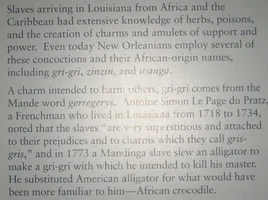
Slaves arriving Louisiana from Africa and the Caribbean had extensive knowledge of herbs, poisons, and the creation of charms and amulets of support and power. Even today New Orleanians employ several of these concoctions and their African-origin names, including ‘gri-gri’ and ‘wanga’.
A charm intended to harm others, gri-gri comes from the Mande word ‘gerregerys’. Antoine Simon Le Page du Pratz, a Frenchman who lived in Louisiana from 1718-1734, noted that the slaves ‘are very superstitious and attached their prejudices and to charms which they call ‘gris-gris’, “ and in 1773 a Mandinga slave slew an alligator to make a gri-gri with which he intended to kill his master. He substituted American alligator for what would have been more familiar to him-African crocodile.
On one of the placards in the museum I found this:
Slaves arriving Louisiana from Africa and the Caribbean had extensive knowledge of herbs, poisons, and the creation of charms and amulets of support and power. Even today New Orleanians employ several of these concoctions and their African-origin names, including ‘gri-gri’ and ‘wanga’.
A charm intended to harm others, gri-gri comes from the Mande word ‘gerregerys’. Antoine Simon Le Page du Pratz, a Frenchman who lived in Louisiana from 1718-1734, noted that the slaves ‘are very superstitious and attached their prejudices and to charms which they call ‘gris-gris’, “ and in 1773 a Mandinga slave slew an alligator to make a gri-gri with which he intended to kill his master. He substituted American alligator for what would have been more familiar to him-African crocodile.