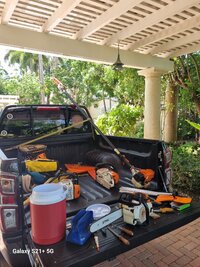
What can I or we do to get a better file on our chains?

I would recommend the raker (depth gauge) tools that only rest on one tooth and angles down to the strap. These allow each raker and it's tooth to be synced up, especially if the teeth are different sizes. The raker gauges that sit on two teeth are kind of "averaging" the raker height. I hope this makes sense. After I switched, I had much better chains.
 
If you never took high school metalwork, you probably will always be mediorce at filing chains. It really is very simple. Just saying. Overthink it and you will also have problems. Squaregrind will never amount to anything down here in the tropics. Trees here turn it too dull in a few cuts. Tried it, was disappointed.
 
BTW, all the good info has bern said and reiterated already. Get to filing folks. Doing some right now outside. I have never filed in a vice ever. About to build a filing bench in my garage for night time filing. This thread inspired that. Vice will be going in. But not only for filing.
 
It will cut hardwood fine, but will dull very quickly.
i wonder why that is your experience. the edge of a round filed chain is „hollow ground“ and in theory should be weaker than square filed which has a straight edge.

i have not noticed any extra quick dulling in hardwood (i cut beech, oak, maple..but also softwoods)

greetings :)
 
@Friedrich
Actually your round filled chain is not hollow ground. Hollow ground means the metal is thinner the further away from the edge you go, not the curve of the edge.
On a square grind you are cutting the edge at about a 45 degree angle and making it thinner than the taper of your round grind, which are typically 25 to 35 degrees.
 
If you can sew, weld, knit etc you can file. It’s mostly fine motor skill and technique. Two skill sets blended into one.
One can know all the correct angles, depths and all that but still can’t sharpen worth a shit.
Vise versa, one can assemble a circuit board but still file a chain like crap.
It’s the blend of these two skill sets…. It’s more complex than sharpening a knife, as that is maintaining one angle, and a chain is 3 dimensional.
 
If you can sew, weld, knit etc you can file. It’s mostly fine motor skill and technique. Two skill sets blended into one.
One can know all the correct angles, depths and all that but still can’t sharpen worth a shit.
Vise versa, one can assemble a circuit board but still file a chain like crap.
It’s the blend of these two skill sets…. It’s more complex than sharpening a knife, as that is maintaining one angle, and a chain is 3 dimensional.
Well put.
I have tried to show a couple of lads how to do it to a reasonable standard, to no avail.
My nephew for example, in the end he was working back in the UK and got fed up with blunt saws and really applied himself to it.
In other words they have to suffer the consequences of not being able to in order to motivate themselves to learn.

You have to almost ‘see’ with your fingers tips to know how and where to apply the right pressure.
 
@Friedrich
Actually your round filled chain is not hollow ground. Hollow ground means the metal is thinner the further away from the edge you go, not the curve of the edge.
On a square grind you are cutting the edge at about a 45 degree angle and making it thinner than the taper of your round grind, which are typically 25 to 35 degrees.

how is that possible? when you look at a round filled chain it‘s pretty obvious that the top is hollow ground like an edge that you would grind on a tormek or other wheel-grinders.
 
how is that possible? when you look at a round filled chain it‘s pretty obvious that the top is hollow ground like an edge that you would grind on a tormek or other wheel-grinders.
What @Shadowscape is referring to is the area between the edge and the spine of the knife bevel being hollow ground. Which is a concave bevel. While the cutting edge is generally a flat bevel for durability
A well sharpened axe is a convex bevel which offers the stongest edge

A round filed chain is 100% hollowed ground/filed. Arguably a different term should be used as the above analogy is describing the area LEADING to the cutting edge and not the edge it's self. This is where getting the 'hook' right is important, too much hook while razor sharp has no durability. The perfect hook maintains durability as the angle of the cutting edge is closer to flat single bevel chisel type edge but with a slight concave (hollow).
 
Last edited:

New threads New posts

Kask Stihl NORTHEASTERN Arborists Wesspur TreeStuff.com Teufelberger Westminster X-Rigging Teufelberger
Back
Top Bottom