Two-way radios

Thanks for this response, Tyler. Now you have me wondering if I've got the wrong idea about the proximity mic on the boom arm version of the Sena units. I thought that flipping the boom arm up and out of the way would prevent the transmission of any unneeded vocalizations, but that you would still be able to hear if someone wanted to get your attention to ask a question or something similar.

I'd love to hear from some of the folks that own the boom arm version to find out how they use it. I apologize if this has already been covered earlier in the thread. I guess I need to go back and make sure I've read the whole thing. Sometimes if I've read a thread, and come back to it much later, I'll just pick up on it where the conversation is currently, without playing catch-up like I probably should.

Thanks again for your response, Tyler, and thanks in advance to anyone else who cares to chime in with their experiences with the boom mic version.

Tim
 
I never used the boom mic myself, but with the guy on my crew that had one, it always seamed like he was wearing it too close. We could hear him breathing all day, then when he talked it was way too loud.
I am from the "set it and forget it" school of thought. The only time I touch my set up is to charge it. Do make sure to mount the mic somewhere that you don't put your thumb when removing the helmet, that is why mine is off set a bit.
I do have to give a shout out to UrbanTC for introducing this system to me.

Sent from my SAMSUNG-SM-G870A using Tapatalk
 
The boom mic does not require close proximity at all. I keep mine most typically tucked way back by my ear muff. I attempt to have it so my crew does not have to hear how out of shape I have gotten
 
Yeah... it's an electret condenser mic. Just like the one in your cell phone, smart phone, tablet or cheesy webcam. It will pick up a mouse fart from six blocks away.
 
Thanks for that, Jeff. I guess I was thinking wrongly about these microphones. Maybe the noise-canceling feature is a separate aspect of microphone technology. I thought I remembered reading on the forums that guys could be working right near a running chipper or chainsaw, and still be heard clearly, which I thought meant that it was a proximity microphone that was being used. In other words, the source of the sound would need to be directly in front of the microphone, or it would hardly be heard at all.

But noise-canceling may account for the lack of background noise with the use of the Sena units. I can see I still have a lot of reading to do. Thanks everyone, for all of the comments.

Tim
 
Tim, you are not wrong. The boom mic is extremely directional when placed close to the speaker's mouth. That is how we use ours and with the mic close you can indeed talk and be heard while chipping brush or running a saw. It is one of Sena's great features.
 
Noise cancelling with microphones is, indeed, a tough thing to grasp. It's largely hype, partially engineering... all microphone types can be made (more or less) noise cancelling by either cartridge design, electronically with filtering/compression schemes or using elaborate algorithms to separate certain types of sound patterns (such as ignition noise, static, etc.) and then decreasing gain on those patterns. Condenser microphones have great sensitivity and frequency response, but in communications applications these attributes aren't necessarily what you want. They are very cheap to construct (at least the electret type are) which is a plus, but they're highly prone to proximity effect (not a good thing). You may have noticed that if you get too close to a microphone, it gets louder but it gets real boomy with too much bass. That is proximity effect, and it's very hard to correct for with condenser mics. So, if you cut back the gain to allow for that, you lose sensitivity and turning your mouth away from the mic makes you practically disappear to the listener. The manufacturers of comm devices try to strike a balance with all these problems to make something that works good. The more expensive techniques add to the cost, so generally speaking the more you pay the better the chances are that you won't sound like some idiot screaming into a cell phone because he thinks it will make up for a lousy cell tower connection.

For communications work, 300Hz to 3000Hz is about as much frequency bandwidth as you want the microphone to cover, because that's where the human voice range lies. You may have noticed that communications mics do a terrible job of reproducing music. Sounds like total crap. This is why. There's no sense in wide audio bandwidth for a microphone that's used for comm work... it will just amplify all the stuff you don't want in there, like birds and chainsaws and jackhammers.

I've only played with the Sena a couple of times... seems like a good mix of technology to get the job done without sounding like a $30 Kraco CB radio or a $5 computer mic.
No matter how good it is, you'll still have to play with mic placement, etc. to get it to sound right for your application. There just isn't a perfect solution that automatically adjusts for everything... no matter what the sales hype says. Remember, the advertising department is never going to make a product description brochure that says, "Our product uses some pretty low budget versions of technology that sort of half-azzed works some of the time!" because no matter how true that may be, it won't sell their overpriced product as well as, "Our product uses the very latest, superior technology to give you the perfect performance you've been looking for!" even if that is a huge exaggeration of the truth.
 
Wow, thanks for all of the detailed background information on how microphones work, JeffGu! I really appreciate you taking all of the time and trouble to write such a post. I'll need to re-read it a couple of times to let it all sink in.

I guess learning to use the Sena units effectively is just like everything else in life, a bit of trial and error.

I appreciate all of the input from everyone.

Tim
 
I have been using the senas for about 6 months now and this is a post I put on their website detailing how I think they could be made better, hope this helps:

-There needs to be an intercom function that links up all paired units within range. I know it is possible to link several units but I generally end up only linking to one or two. There are several reasons for this, the most basic is that the wheel button is so large and located in such a place that myself and my coworkers are always bumping it (especially while climbing in the tree) and accidentally initiating or closing the intercom. So that even if we have taken the time to get 3 or 4 units all talking to each other it won't last. The second is that when someone is using a chainsaw or next to the chipper they will pick up so much noise that its hard to communicate.

-I would like there to be an option to mute the mic in intercom mode. It is important for the climber to be able to transmit to many people on the ground but the climber doesn't want to be picking up their noise all the time. (Its generally quieter up in the tree and I don't care if they have to listen to my chainsaw noise because I want them to hear my warnings). This could be as simple as a switch on the boom of the mic.

-You should consider making a set specifically for arboriculture. The improvement in communication will save lives, but for them to be widely adopted they need to be tougher, easier to install, and easier to use (especially the intercom). You should also consider making a set that is already integrated with helmet mounted ear muffs.

You have created something that could change my whole industry for the better, don't miss the chance to capture this market.

Thanks!
 
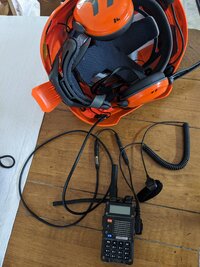
Old thread - may start a new one, but I'm trying out this Open Half Face Motorcycle Bike Helmet Earpiece Headset from Amazon today with the infamous BAOFENG BF-F8HP radio. Using MURS frequencies but have GMRS license (I'm a ham as well) and may use GMRS depending on where I'm at. Mounting the speakers and mic in Pfanner Protos helmet...will be testing VOX (voice activated) and PTT (push to talk).
Hoping I can find a nice way to mount radio on suspenders - maybe on back.

(update: don't get this one - I returned it)
I ended up using this one:

QSPORTPEAK Accessory Speaker Mikrophone and Motocycle Intercom Mounting Bracket for V6/V4 Motorcycle Bluetooth Headset (Clamp & Speaker Mikrophone)

It was cheaper. The clip it comes with is not used. I'll post a full list of the parts once I get it working.
 
Last edited:
This is another interesting option for the Baofengs that is for full face (vs open half face) helmet styles. These don't have the boom mics - the mic is supposed to attach to the inside of chin guard on the helmet. Most arborist helmets don't have chin guards - so it would attach to the top of the rim somewhere, as was posted in a prior picture in this post.

https://www.amazon.com/dp/B01D4MIR46/
 
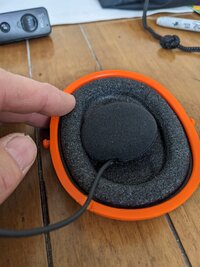
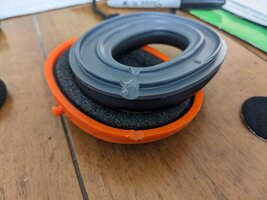
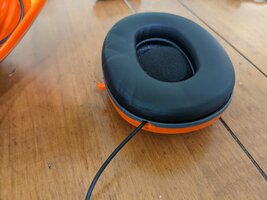
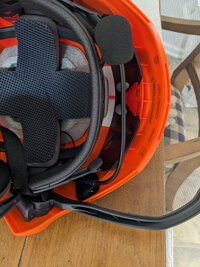
Wired up my helmet today...after a little Dremel work to make a small hole for the speaker wires on the ear muffs...

PXL_20230321_181909825.jpgPXL_20230321_181828875.jpgPXL_20230321_182054884.jpg
Protip - make the hole on the outer shell side and just dremel the inner grey plastic ridges. It looks nicer if the hole is not in both parts. A little silcone if you want to seal it up, but I left mine as is.
 
Last edited:
These don't have the boom mics - the mic is supposed to attach to the inside of chin guard on the helmet. Most arborist helmets don't have chin guards - so it would attach to the top of the rim somewhere, as was posted in a prior picture in this post.
I have used Sena's since 2018 without the boom mic, just used the small stick-on mic up under the rim above the face, works perfectly. In AV production, the best mic placement is always above the speaker, which is why they have boom operators following the actors around, holding the mic overhead in the optimal spot...
 
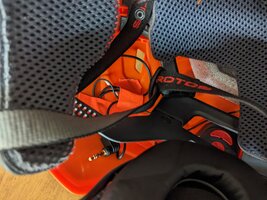
PXL_20230322_144209625.jpg
Input jack at back of helmet. Wires are taped in.

PXL_20230322_144217463.jpg
Boom mic on some velcro - can move it if needed with some more velcro patches.

PXL_20230322_144301248.jpg
Full setup wired into helmet. Might need to see about a screw down TRRS connector if this pulls loose, but it seems pretty secure. Radio has stubby antenna and PTT button has velcro to attach somewhere on harness suspenders.

Need to find some good places to keep them out of the way. Radio will likely be on the front of my harness suspenders in a pouch with excess wires stowed away.

It's working and sounds pretty good - will take it up in tree next to see how the wires do.

Speaking of which...I need to pull an antenna wire up into a big tree in my backyard...
 
Trying to do all this < $100 with multiple ground points. But yeah there are lots of options some of which are quite spendy. Sena is the go-to grafted from the motorcycle world.
 

New threads New posts

Back
Top Bottom