Truck mounted bollard/lowering device

Tom Dunlap

Here from the beginning
Administrator
There are many bollard configurations that can be fabricated and mounted on hitch receivers for portability. Sometimes I've seen bollards built right onto decks of bucket trucks. A more common approach is to mount receivers at several places and more the bollard.

On one of my vans I fab'd a hitch for the front. Slipping the bollard into the receiver worked really well. We could use the van for pulling or tensioning. Having a receiver upfront was super nice for backing trailers or the chipper into tight spaces. Much faster than backing in.

How common is it to use receiver mounted bollards?
 
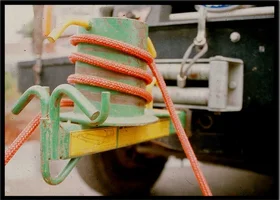
I've used a large shackle to fasten a Port-a-Wrap III to my truck mounted hitch many times. I use the insert that would hold a ball but instead of a ball the pin on a 3/4 inch shackle is placed in the hole. It's great because it can be tied off easily, tightened by moving the truck, and lowered easily. In almost all cases my usage has been for wind thrown trees that are hanging in other trees and a lot of pulling power has been needed.

118328-PortaWrapOnHitch.jpg
 

Attachments

  • 118328-PortaWrapOnHitch.webp
    118328-PortaWrapOnHitch.webp
    60.5 KB · Views: 131
i have down similar(with much older Porty style!). Favoring weight in back of truck, turning steering wheel to tighten line more if it starts to slip and chocking(chocks from a 4X4 with handle or at least rope handle). Will also use truck to pretighten; sometimes to lift or force on hinge. For larger stuff i like to place an additional pulley low, so that as line pulls on truck it is across, rather than upward vector. Especially if using truck to pull or lift, so that as line tightens and pulls back, it doesn't also make truck 'lighter' and thus more likely to slip. Sometimes this is also to a floating Porty, on a pulley, on a truck powered 2:1 etc. You have to have a brake device to lower stuff pulled with truck(not enough 'backing up run' to lower; this is magnified by 2,3:1 type lifts), lock it off to lift, then lower through brake after chocking truck. Sometimes these lines had to run between several powerlines guided by several pulleys to line up between lines like a pool shot, to go were no crane would go. A few times the chock for truck was a railroad tie rolled from the outsides by guys; as truck pulled forward; sometimes in a parbuckle type formation to make it easier and have'em even more clear(and make sure they were in front of railroad tie instead of them sneaking from the side to behind railroad tie were truck could conceivably push tie into them; though this lil'control freak didn't get any truck slip anyway). a few times we even had truck drag the tie behind it, but that can be problematic on uneven ground we found; as compaired to rolling it.
 
The electric winch is used in conjunction with the rope brake. As the tension is picked up with the winch the slack is picked up on the rope brake. This system comes in handy when speed lineing portions of a tree. Pick it up and let it down with ease.


I'm with you on the chipper hook up. It is always easier to navigate when the load is in front of you. I have chipped right over the top of the truck cab and right into the back of the truck.
 

Attachments

  • 118517-Winchwithropebrakepic.webp
    118517-Winchwithropebrakepic.webp
    49.5 KB · Views: 154

New threads New posts

Back
Top Bottom