Training Young Trees

I was just wondering everyone's opinion on the structure pruning of young trees. How important is it to maintain a central leader, especially in a tree with a decurrent growth habit?

 
I think the whole 'strong central leader' theory is a little overrated, although I think it's good for very young trees to develop a main stem. Some trees such as American Elm and Hackberry can develop good codominant leaders at maturity, so it's not always the best idea to train them to have one stem. It depends on species, where the tree will be planted, and how it will be managed in the future.

However, if a lateral looks like it's beginning to overtake the main leader, it should be subordinated or 'supressed' to avoid potentially weak structure in the future.

-Tom
 
I think Tom has it exactly right. Tree care follows the ever present axiom "it depends". We do have a tendency to over "pick" at trees, IMHO.

Dave
 
And I also concur with the previous two gentlemen's sentiments. Encouraging proper structuring of young trees is not bad, but can be over done to the point the poor little tree gets nitpicked to death.

And not all trees are meant to be excurrent. The encouragement of this as a proper choice, IMO, comes from the view point of what trees will do well in an urban setting with little space and lots of targets. Your species selection there will be different than if you have plenty of room and no or few targets.

My husband and I were at a seminar presented by a knowledgable and reputable nurseryman/grafter who was demonstrating proper pruning techniques for fruit trees...with the constant reinforcement of maintaining a central leader. I raised my hand and asked "at what point are you going to let these decurrent specimens become decurrent?" He stared at me for a moment and then looked around at the group and said "any other questions?" (I'm constantly enduring myself to presentors that way.)

But my point was, these were decurrent trees and by constantly trying to change that, you are fighting a natural balance.

Personally, I like the diversity nature has given us. It bugs the crud out of me that some seem to think nature needs perfecting.

Sylvia
 
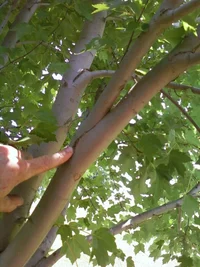
I don't think a central main leader is all that important, BUT, it better not have any tight V shaped crotches starting, or ones that will be v-crotches; that is what I feel is the MOST imporant to correct as it grows. (see attached picture)

and it seems if the individual tree has one big bad v-crotch, look elsewhere in the tree and it will have more. Seems to be a genetic thing, or perhaps one bad growth habit in the tree grows more of them in the same tree.
 

Attachments

  • 202668-youngv-crotchbefore.webp
    202668-youngv-crotchbefore.webp
    203 KB · Views: 85
I agree with the previous statements. At some point a tree must be allowed to "grow." Included bark attachments should be eradicated at the earliest time possible. They only get worse and more abundant.
 
trimmed.

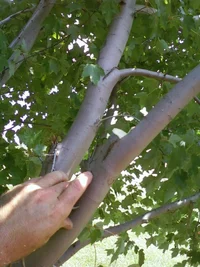
trimming a small tree like this; taking out v-crotches and other structural problems can sure save a lot of failure and money in the trees future. Trimming a small young tree hardly takes any time and very little cost. But most ordinary people don't think about tree trimming until it's large or something has split out of it.

depending on the specie, the severity of the v-crotch and what weather events that happen to the tree; a v-crotch can split early in the trees life, or later when it's 80 or 100 years old. One way or another, it will likely split at some time.

I'm worried about all the zelkova I see planted in these last 10 years in my area. They are a strong fiber tree, but they grow with all those tight V's. I think that since they are such strong wood, the trees are going to be very large and very heavy before they start splitting. But when they do split, wow, there is going to be some real damage happening. Just a prediction I have. We don't have any large Zelkova to speak of around here yet. I think they are going to hold together like a large old beech with a v-crotch, then one day in a rain or ice storm, POW!
 

Attachments

  • 202674-youngv-crotchafter.webp
    202674-youngv-crotchafter.webp
    210.2 KB · Views: 83
Gilman's Illustrated Guide to Pruning is the best book on this subject. He focuses mostly on training nursery stock from saplings to sellable size. He emphasizes training a single, central leader many times in that book, but not because decurrent trees are weak. If a tree in the urban environment is going to break out into codominants, it is generally better that it does so above a certain height, usually at least 8-10 feet off the ground. This makes it easier later on to raise the canopy to a certain height without making any really large wounds. So from the viewpoint of someone selling trees, training a single, central leader is what makes good nursery stock for most shade trees.
I have no problem with codominant trees but I do feel they look better when they branch out further off the ground. That is to say that I prefer this type of structure:

15_19_1---Tree--Sunrise--Northumberland_web.jpg


over this one:

Paper_Birch_Clump_Tree.jpg


Again, nothing against clumped birches or anything else, its just a preference thing.
 
X, I have never seen a large Zelkova with included bark/V-crotch fail, but there is information out there that says they do, so I think your prediction is correct. I think the fact that their leaders taper quicly and generally don't get too long is the reason we don't see more failure.

Encouraging news, the specimens coming out of some Nurseries in the past 4-5 years are looking much better, as they are able to correct those problems with early pruning. Same with Kwanzan cherry, they are coming out with good branch spacing also. Nurseries we have gotten good specimens from lately are Schmidt, Schictel, Millane, Kogut, Sylvan, and Bigelow.

-Tom
 
Totally agree that central leader is way overemphasized in industry writings. I've seen Yoshino cherries butchered because of the absolutism of this advice; bound to fail and bound to turn stomachs.
crazy.gif


V-crotches can be bad IF they have included bark in scaffold forks, but subordination often mitigates the defect adequately. V-crotches are NOT so bad on laterals, and it is no good to punch holes in the crown as they are overzealously cut out. o and zelkovas are amazingly resistant to breakouts but i've seen a few and they are not pretty.

S, that speaker was caught in dogma and you outed him; no wonder he dissed you. Keep enduring as you *endear* yourself that way; speakers need to be challenged to remain credible imo. PS I'm not correcting an error, just pointing to the illuminating Freudian double entendre within.
wink.gif
 
The point I keep coming away with most, is that specimen trees in landscaping are often prone to growing differently than they would in the forest, primarily due to a lack of competition. They, just like humans, can get too much of a good thing, when they don't have to work as hard, or compete for their sustenance. Sedentary people start to carry weight in areas that they wouldn't under more rigorous conditions, and so might a landscape tree.

I think the trick is to have good knowlege of how a particular tree grows naturally in a diverse forest, and then use that knowlege to encourage the specimen tree to better follow its own genetic growth programming. Better yet, plant them in diverse groups in the landscape, and let them sort it out themselves!
 
Thanks for all the replies so far. Lots of good info. I think one of the biggest issues is with proper plant selection for the site. If you want a street tree to develop a strong central leader, wouldn't make a whole lot more sense to plant a species that naturally grows that way, than to fight with a tree that doesn't fit the space in the first place?
 
[ QUOTE ]
If you want a street tree to develop a strong central leader, wouldn't make a whole lot more sense to plant a species that naturally grows that way, than to fight with a tree that doesn't fit the space in the first place?

[/ QUOTE ]

You would think so, but that would just make too much darned sense. Seriously, though, young trees don't always grow the way they are 'supposed' to. Take Linden, for instance. We plant lots of them that are perfect from the nursery, and 3-4 years later, they develop competing or codominant stems that need attention to maintain a single main trunk. Go figure. I think Cervia's point about lack of competition has something to do with this.

-Tom
 
[ QUOTE ]
Gilman's Illustrated Guide to Pruning is the best book on this subject. He focuses mostly on training nursery stock from saplings to sellable size. He emphasizes training a single, central leader many times in that book, but not because decurrent trees are weak. If a tree in the urban environment is going to break out into codominants, it is generally better that it does so above a certain height, usually at least 8-10 feet off the ground. This makes it easier later on to raise the canopy to a certain height without making any really large wounds. So from the viewpoint of someone selling trees, training a single, central leader is what makes good nursery stock for most shade trees.
I have no problem with codominant trees but I do feel they look better when they branch out further off the ground. That is to say that I prefer this type of structure:


I agree with Gilman's emphasis on central leader training.
 
[ QUOTE ]

My husband and I were at a seminar presented by a knowledgable and reputable nurseryman/grafter who was demonstrating proper pruning techniques for fruit trees...with the constant reinforcement of maintaining a central leader. I raised my hand and asked "at what point are you going to let these decurrent specimens become decurrent?" He stared at me for a moment and then looked around at the group and said "any other questions?" (I'm constantly enduring myself to presentors that way.)


[/ QUOTE ]

Luv it! Hope you could make some Western Chapter Seminars in the future. We could tag team...

All the best.
grin.gif
 
I think we can over-exaggerate a tree's ability to fend for itself when placed in a landscape or treelawn and surround it with human demands. Almost regardless of species, the highest quality of nursery stock will grow structural defects with time, bad ones will get worse, and well-maintained trees will outgrow their grooming as well.

The most important concept (I think) in Gilman's manual is that structural work is achieved in doses over a managed cycle. Too much of our work is a one-shot deal, which forces an arborist to choose between heavy doses to react to immediate problems, and a less invasive pruning which may be easier on the eye and induce less of a response from the tree, but may also miss an opportunity to add decades to the time a tree may be retained in the landscape.

Without having an idea when you'll be able to continue from your initial work, there really is no way to set objectives and judge what you should or shouldn't be pruning from a tree.
 
I like establishing a good center leader and isolating it, if necessary/possible.

I know that there are many species of trees that have a decurrent growth pattern, so I won't sweat those species.

I enjoy young tree training.
 
Isn't there a debate that if trees were densely planted together (like a forest), there wouldn't be any decurrent trees?
thinking.gif


So, take a tree out of it's natural environment (into a suburban yard) and whala! We get all sorts of structural defects...
 
That's one of the arguments I've heard...That selecting for a strong central leader came from the forestry crowd, because "that's how they grow in the forest". Obviously, a suburban yard is far from a forest, so why try to manage a tree in a yard like a tree in a forest?
 
[ QUOTE ]
...so why try to manage a tree in a yard like a tree in a forest?

[/ QUOTE ]

A good question.

However, I don't think we would be trimming a tree exactly like any given tree from a forest. That would be extreme.
wink.gif


With moderation, urban trees could look like the one the ISA provides in their information about pruning young trees.
 

New threads New posts

Back
Top Bottom