













Richard Mumford-yoyoman
Been here a while
- Location
- Atlanta GA
Especially in the first use example of this video, I see a real danger in demonstrating a single tie off with heavy metal attached to a shock absorbing line.
Follow along with the video below to see how to install our site as a web app on your home screen.
Note: This feature may not be available in some browsers.
Well you know how I feel about a less expensive, better performing option.The Crosby stuff is nice but it is really expensive and limited in its rope applications.
Sent from my iPhone using Tapatalk
Well, I only really know my own core values, but back to the questions of this post.I dunno, Richard...if the mousetrap TreeStuff invents efficiently kills mice, but also frequently and without warning whacks your fingers, is it really a better mousetrap? I think core values play a larger role in who I spend my tree equipment $$$ with, than trade-offs such as price, weight, eye appeal, etc.
How is it limited in its rope applications? And the toggle will be more secure than just a shackle and a hook?The Crosby stuff is nice but it is really expensive and limited in its rope applications.
Sent from my iPhone using Tapatalk

@bonner1040 in a totally different note, just while I remember cause I'll forget and never say it, I think TreeStuff should sell GoPro shit, just a suggestion.
Sorry about the random thought


I don't see the system as stable if the load is removed for even a split second.
Crosby has a special T protrusion that makes unintended removal unlikely but even possible remotely as described in this video.The same could be said for the crosby. I was thin ign a way to fix that would be to have a keeper knot like a prussic on the rope behind the ring to cinch it up and make sure it can't move when unloaded
I would argue that your rope is less likely to break using a system like this given a higher break test result vs a running bowline. Appreciate the feedback though!


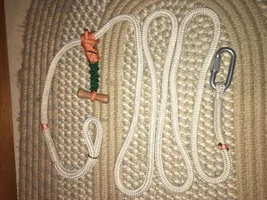

The toggle in the spliced eye is a great idea. What if instead of being on a prussic, the toggle was spliced to an xrr to allow it to move on the rope and cinch down?Hi BigKid, I mean the toggle should go into a rope loop rather than a metal ring.
View attachment 42907
Above the toggle is on the Prusik to allow tightening on the branch. I also added a ring on the rope loop to slide and cinch the toggle in the loop.
I'm going to use the above for small self rigging to test it out. The toggle is made out of hickory and is based (copied) from the Tylaska dog bones, a toggle they make in aluminum and stainless steel.
I think that this type of configuration would also work good on the end of a winch line.


 My apologies but, what are you referring to as a rope receiver? What would it look like? Field testing would be a great idea, regular guys trying these pieces would be. Maybe Nick Bonner will chose a couple average arborists for this!




















