Today's Job

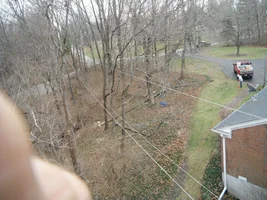
me td ing a 100' white ash 36" dbh measured by climbing line as part of a 6 ash removal job, trees been dead for over 2 years and some falling apart. Picts. Fri 9 am temp. 25 degrees :frio: every one bent over primaries. No bucket/crane access anywhere.
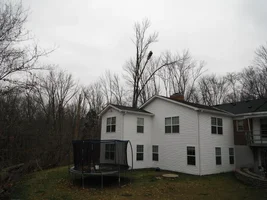
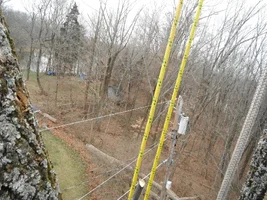
Had to drop some ends past the primary and had to turn a approx 800 lb lower limb/lead 90 degrees hinged sideways off the wires with a pulley up top and mechanical advantage by groundman second pulley at base and friction on another tree.

DSCF1811.webp DSCF1814.webp DSCF1818.webp DSCF1816.webp
 
I have a general question for anyone....Does your climbing/lowering line sustain any damage laying or looped over those primaries in pictures above? Because they were and nothing happened. But this is not with the side by side of hot and neg lines where if you lay a limb across them they cook up and I would have blown the transformer. But I assume the neg is the line below. Just not used to seeing that set up.

 
Because I was beyond the lines. Guess could have tucked it in my pocket. These new linen like lines...Velocity/Vortex move around unlike what I am used to.
 
I have a general question for anyone....Does your climbing/lowering line sustain any damage laying or looped over those primaries in pictures above? Because they were and nothing happened. But this is not with the side by side of hot and neg lines where if you lay a limb across them they cook up and I would have blown the transformer. But I assume the neg is the line below. Just not used to seeing that set up.

I'm an electrical engineer for an electrical utility company in NE Ohio ... that's my day job anyway. From your picture (the one with the yellow rope), the uppermost silver wire is the primary/hot conductor ... probably 13.2 kV or 12.5 kV ... the middle silver wire is the neutral conductor, and the lower silver wire appears to be a guy wire. All 3 wires should be treated as energized conductors.

I implore you keep any and all ropes or rigging gear off of any utility conductors unless you can verify they have been deenergized and grounded per the Utility in your area.

Treevet, IMO, you are gambling with your life and the lives of others if you're letting your ropes come in contact with electrical conductors. Yes, you can probably do it and nothing will happen ... clean rope has good resistance ... but all it takes is a little contamination (dirt, dust, sap, moisture, salt) and the electricity will start tracking on your rope. As soon as a good path to ground is established, you'll get an arc and it's all over. Hopefully, just the tail of your rope is vaporized between the two conductors it's laying across...hopefully, the ground guy doesn't walk over and grab it, completing the path to ground ... hopefully, you yourself don't complete the path to ground by touching the tree or something else.

Another reason to keep your ropes off conductors, even deenergized ones, is that many/most of them have broken strands and really sharp burrs ... those could easily cut, snag, or otherwise damage your rope.

In the future, if you're working near energized power lines and there is no way to keep your rope off of them, contact the electrical utility and schedule a power kill.

My 2 cents.
 
Don't know what its like in your area, but around here by law the utilities have to provide a safe work enviroment for anybody working around their powerlines, remember if those lines weren't there your job would be considerably less life-threatening and they're the ones making money from those lines.
 
Let me clarify. Thanks Paulin and Classic but as my Screen name would indicate...this is not my first rodeo. I was really just wondering the effects of my line briefly and inadvertently contacting the top wire. I probably have been intimately close to primaries in my job since around '69 and been to numerous burn the hotdog seminars and have successfully maneuvered thousands of trees over the years around said wires....legally or illegally...I could give a rat's just so the client pays for the job they requested.

But in this case with about 10 years of dead ash trees from eab virtually EVERYWHERE. including massive #s of them dead, broken and looming over the primaries ...MANY that should...have not...been dealt with. The lady in the house has implored Duke Electric to get rid of this big ole dead monster which has shed onto her house to no avail. Week ago the utility climbers (as I said...NO aerial truck access) arrived and she asked them were they to remove this very technical take down. The reply was "no, sorry mam, we are just removing limbs this size.." and held their thumb and forefinger apart as much as they could spread them.

There were 3 leaders that extended well past the primaries from the stem. I went up top and set a lowering line (yellow line) and did all the (relatively) easy stuff that was in the way. I then went out on the biggest most extended leader as I always like to do the hardest stuff first. I took the lowering line with me as I intended to fold the top over and swing it above the primary ( could only go SO high as the top was REAL dead). I let my tail of my climbing line feed thru a crotch at the main stem and it would have been just fine there (similar to running it thru a pulley like mentioned above). But upon reaching the top an illusion had occurred as often happens and I found myself uncertain it would actually clear the wire. If it lodged on the wire it could have been a mess and may as I suspected have also contacted the neg wire and blown the transformer.

I decided to butt hinge it at the cut and lower it beyond the wire straight down but to do this I needed to have a line sent up and to do that I had to pull my climbing out from the main stem to send it to the groundy to obtain the another lowering line. If I used the stem lowering line there would have been too much friction likely to get it to the ground.

Everything worked fine with that one and the next one and the bottom one which I beanbagged the tip (the lowest and most parallel to the ground) and then with another lowering crotch up top ...actually got to turn 90 degrees OFF the wires with some mechanical lift, a feat my gm gave applause to and never had seen done before.

So there you have it. Not so much in need to technical advice, advice on strategy, advice on protection of me, the groundman or the public in general as Paulin offered...just

advice on the possible negative effects of my line from brief exposure to the wire when the wind blew it over it. 10647077_10203191349484853_2948518699893531328_n.webp
 
Last edited:
No disrespect intended.

Check out your rope in the area where it came into contact with the conductor ... There may be small burn or singe marks there, depending on the humidity of the rope/air.

When I first worked for the electric utility here, I worked with the linemen for a week or two...one guy showed me the effect of humidity by dragging a rag over a 13.2 kV line ...dry, it sounded like rice crispy's and sparkled where it touched the line, leaving tiny singe marks. Damp, it sounded like popcorn, and the arc left a good burn mark.
 
Like I said I don't know much about your area, we have called the ministry of labour(same as your OSHA) in the past because utilities refused to denergize lines for us, now things are a little different and have been for about 5years, now the utility has to denergize and ground lines for anybody working near their lines...for free!!! However if you don't let them now you're working near their lines you're totally at fault.

I'm not telling you how to do business, but if I was doing work in your area, I would be trying to set precedence with OSHA to get regs changed, I have no problem working around power either, but if I don't have to why would I endanger my self?
 
Last edited:
c883877ed120e00ac8460b9ea972c2fb.jpg
 
I don't like climbing ash trees near powerlines. Little lone dead ones. I had pop off a leaf over a wire once (like I believe vet was describing) and it ended up barber chairing, stripping down and contacting the lines. I didn't get zapped but honestly I don't see why. Scary stuff.
 
Paulin...thanks for becoming a member and stick around. You can add a lot Im sure.
It is important to rememember different areas have different line set ups. Even in a familiar area lines may have been temporarily fixed during a storm and not returned to.

Treevet...I am with you on working near lines regularly Im sure you don't make it a practice to drape your ropes over the lines so that was a good question and we have some good responses. I always use a rope bag but have also coiled it up and held it til over the wires.
I recently was contacted by a tree company near me to help him with a tree(that I also bid on) because he called the power company for a line kill and they told him he needed to be a qualified line person to do the work and because he didn't have a crane certification. The lines needed to be killed nomatter what because the tree (24' diameterwhere it went tbetween the primaries) was actually rubbing on the primary wire. Power companies are not always easy to deal with.
 
I've never seen them cut power around here either (Nola).

Tree vet, you should get a couple of Pinto Rigs on loop runners for X-mas. They would of solved all your problems in that situation.

One brief contact should not be tolerated.

I have a question about electric lines that are post transformer and running to service drops. I've been working around them a lot lately. 2 or 3 wide bare copper, tree limbs touching em, and I'm in a spider lift. I'll just chop suey little stuff with my top handle, making sure I don't land a piece that connects two lines. I'll avoid direct contact of wires with my boom and myself.

What's the risk with these post transformer, exposed copper lines?
 

New threads New posts

Back
Top Bottom