Looking at 1D cosine as 1D rope support column(s) against Load,
Load = Number of equivalent support columns X (cosine of 1 support column xTension).
If multi-legs (2) of support, for cleanest number examples must assume self equalizing (pulley on Load).
.
Cosine = 50% @60degrees deflection (2oclock) from a pure inline Zer0 deflection of 12noon column against gravity powered Load(downward).
>>120degree span in dual leg support:60 degree deflection to each side of Load line
>>10-2 on clock, load at center of clock pressing downwards towards 6 on clock for gravity powered Load
>> 'stay loose' sign(?) of span across from thumb to pinky fully stretched gives 120 degree span(da Vinci)
So @120degree span support is dual legged of cosine 50%
>>support potential equals 1/2 tension per support column(50%) x2 columns, so is the tensile strength of the rope as a known benchmark, and safety line. In loading the rope xTension factor = Load at this point of the 'balance'; even tho 2 legs sharing support equally.
.
Every degree past this 120 benchmark look at load as having leverage over the rope.
>>as takes(incites) greater rope tension than Load itself in leveraged return; and gets more upside down against rope as you go wider/flatter span.
So closed more to less than 120degree dual leg support span the rope by contrast has leverage over the Load;
>>the rope incites more force against Load than rope exerts in xTension.
until @Zer0 deflection of parallel supports to Load where has 2x Leverage over Load.
takes 200# pull to lift 400# etc. with 2 columns of support at 100% cosine of Zer0 deflection xTension factor=200# effort input.
.
Takes longer to get to 120degree from Zer0; than the higher impacting changes going from 120 to 180/flat; and the changes much more radical.
Flatten more to 160 (80degree deflection each side) cos=17.3%, tension:2879.4 from 1000# Load of 500# per leg.
Theoretically, 180flat is impossible division by Zer0 cosine, towards infinite force, so snaps or causes deflection to softer angle. So very volatile change from benchmark 120 where xTension = 1000# Load, to 2979.4 is xTension factor, then super volatile as goes from there theoretically to infinity at 180. At 89degrees deflection to each side, 1000# Load on 178degree span = 28,649 for the xTension factor. Big numbers all over, only the pattern is important.
.
These are speed line forces, the flatter the speedline is.
These are also sweat/swig rope range, where exploit the weakness in cosine(riding/exploiting the sine multiplier instead; in this range). This is where would not want to be at the end to pull on center pulley, but rather reverse to want to pull pulley to affect the ends, like bow string, sweat/swig.
.
Great article, even if don't exactly use the setup gets brain going about rope logic.
Expands threshold of understanding, to leave the more normal; deeper in own powerband.
.
edit:
Old pic(now) for hand sizing of key angles in field(on right side) and discussion on numbers with 2000# Load :
.
and wow, found this real old one for/from here, due to coloring style would think before y2k during my lower tech 'crayon years' w/MS Paint. "Team TB" after ISA bbs fold!
.
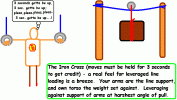
Had to hold for 3seconds for B credit, kinda went for C level Cross w/L-seat (legs out at 90degrees w/o knee bend) held for the longest freaking 3 count ever want to go thru.
There was this clock across gymnasium i stared at first as outer focus thru the ripping pain, then later to wait a legal 3(kinda tend to count real fast in head in such times).
But thru time as went cross-eyed doing so, there were 2 clocks, 1 for each arm as i lowered self in to cross, and noted a pattern with trig in school at the time.
Thus, using clock to decode cos/sine/tangent math with degree line markers on clock was born.
Over time, became easy in rigging to guesstimate using old cheat from high school(math teacher thru chalk at blackboard and walked out for a bit; but wasn't 1st time.. ) .
Cheat allows to read all around, in many lessons daily how stuff works with angles, until rope work etc. is just another math puzzle.
Without is more like on neighboring radio frequency of some info, some loss, no cohesive flow across, and much garbled, as like in computing w/wrong baud connection and get machine language with a few readable spots..
.
2extreme gears: zer0 deflection is pure column, 90degree deflection is pure wrenching.
pure column(cos=1) is no wrenching(sine=0),while pure wrenching (sine=1) has no support column(cos=0)
all points between are hybrids where allow so much direct column + deflected wrenching to suit.
Just the pattern of (force or distance)change is NOT easy equal incrementals like the degrees, but the cosine scale of change(mirrored to reverse for sine scale). At Zer0 and 90 degree outer limits only do cos+sine=1 tho.
Thru the rest of the span, cos+sine>1, quite counter-intuitively on top of the counter-intuitive of not equal increments of change per each degree walked....
.
Would not ever want to be left with this s(h)ituation of bad numbers someone posted somewhere long ago and i stole from not sure who nor when, sorry:
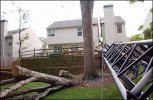
not sure what...... but just don't want anyone hurt, nor that mess be mine/any of

ours!



































